Deciding whether to divorce an alcoholic spouse usually depends less on how much he drinks and more on three questions: are you safe, has he had a clear chance to get help, and what is staying costing you? Research shows family-based approaches like CRAFT get most resistant drinkers into treatment, and most people recover well after leaving a high-distress marriage. Lisa Chen & Associates Therapy in Hermosa Beach helps partners make this decision, in person and by telehealth across California.
He is good at his job. People at work would never guess. He makes it to the early meetings, closes the deals, remembers the names of everyone's kids. And at home, you have started counting what is in the recycling bin, timing your conversations around the second drink, and quietly rehearsing what you would say to a lawyer. Then you talk yourself out of it, because he is not that kind of drinker. Is he?
If you are married to a high-functioning drinker and wondering whether to stay or leave, this post is for you. It is not a quiz and it will not hand you a verdict. It will walk you through what the research actually says about getting a drinking partner into treatment, what staying costs the spouse, and how people really fare after divorce, so you can make the decision with clearer eyes.
Why a high-functioning drinker makes the decision harder
When someone's drinking costs them their job or their license, the problem is visible to everyone. When it doesn't, the person closest to it carries the evidence alone. His competence becomes an argument against your own perception. Friends see the charming host. Colleagues see the reliable leader. You see the version of him that shows up after nine o'clock, and you start to wonder whether you are the problem for noticing.
No blog post can tell you whether your husband has an alcohol use disorder, and neither can an online quiz. What I can tell you is that the question "is it bad enough?" rarely gets settled by more evidence. Most partners already have plenty. What they are missing is a way to think about the decision that doesn't depend on winning an argument about labels.
"The partners of high-functioning drinkers rarely need more proof. What they need is permission to trust what they already know." Lisa Chen, LMFT
When to give up on an alcoholic husband: the question underneath
There is usually no single moment when it becomes obvious. Instead, three questions tend to matter more than how many drinks he has on a Tuesday.
The first is whether you are safe. Drinking that comes with intimidation, control over money or movement, threats, or driving drunk with family in the car is a different situation, and it calls for a safety plan before anything else. There is more on that below.
The second is whether he has had a clear, specific chance to change, and what he did with it. Not a fight at midnight, but a calm, concrete request made when he was sober, with real support around it.
The third is what staying is costing you. Your sleep, your health, your work, your friendships, your sense of who you are. That cost is real data, and it belongs in the decision.
What the research says about getting him into treatment
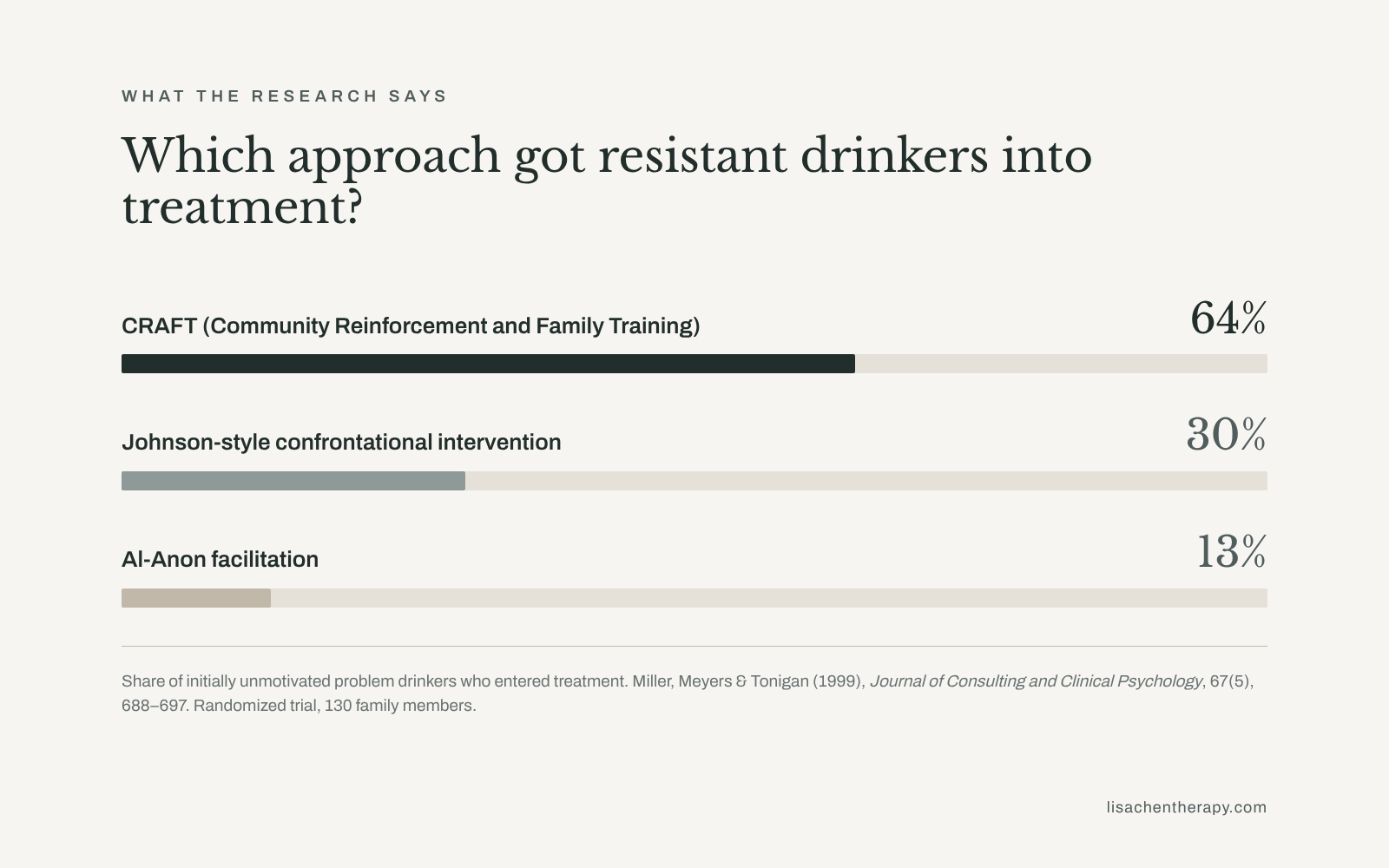
Many partners assume their only options are to confront him or to let go entirely. The research points to a third path. It is called Community Reinforcement and Family Training, or CRAFT, and it teaches family members how to change the rewards around drinking, communicate without triggering defensiveness, protect themselves, and invite treatment at the moments when he is most likely to say yes.
In a randomized trial of 130 family members, Miller, Meyers and Tonigan (1999) reported that "the CRAFT approach was more effective in engaging initially unmotivated problem drinkers in treatment (64%) as compared with the more commonly practiced Al-Anon (13%) and Johnson interventions (30%)." The same study found that most family members assigned to the confrontational Johnson-style intervention ended up deciding not to go through with it (70 percent).
That comparison is not a knock on Al-Anon. Al-Anon was never designed to get the drinker into treatment. Its focus is your own recovery and peace of mind, and many partners find it steadying. CRAFT and Al-Anon can work side by side. If you want a readable guide to the CRAFT approach, the book Beyond Addiction: How Science and Kindness Help People Change by Jeffrey Foote, Carrie Wilkens and Nicole Kosanke is the one I recommend most often.
"Before you decide whether to leave, it is worth knowing what he does when the incentives change. That answer is information you cannot get any other way." Lisa Chen, LMFT
What staying is costing you
The spouse of a drinker is often the last person anyone checks on, including herself. The research suggests that is a mistake.
A study of Kaiser Permanente members compared family members of people with alcohol or drug dependence to family members of people with diabetes or asthma. Ray, Mertens and Weisner (2009) found that "in the year before initial diagnosis of the index person, AODD family members were more likely to be diagnosed with substance use disorders, depression and trauma than diabetes or asthma family members." They also had "similar, or higher, health-care cost and utilization."
A follow-up study looked at what happened to family members after the person with the drinking problem went through treatment. Weisner and colleagues (2010) found that family members of patients who were abstinent a year later had medical costs similar to a comparison group, while costs for family members of patients who were still using stayed higher. The authors concluded that "successful AOD treatment is related to medical cost reductions for family members, which may be considered a proxy for their improved health."
Put simply, your health is tied to his drinking, and it tends to recover when the drinking stops. That is a strong reason to try CRAFT. It is also a reason not to wait indefinitely if nothing changes.
Is the drinking really straining the marriage?
If part of you wonders whether you are exaggerating its impact, a large Norwegian study offers some perspective. Torvik and colleagues (2013) followed nearly 20,000 married couples for 15 years. They reported that "the HR for divorce was 1.51 when only the husband was a heavy drinker," which means roughly a 50 percent higher risk of divorce compared with couples where neither partner drank heavily. The researchers concluded that "both the level of alcohol use and compatibility in alcohol use are important predictors of marital dissolution."
In other words, a mismatch in drinking is not a small difference in lifestyle. It predictably strains marriages. You are not imagining it.
What the research says about life after divorce
Fear of what comes next keeps many people frozen. The research here is more encouraging than most people expect, though it is honest about the hard parts too.
In a study of 559 adults who went through a divorce, Malgaroli, Galatzer-Levy and Bonanno (2017) found that the most common pattern was resilience: "resilience (67%), emergent depression (10%), chronic pre-to-post divorce depression (12%), and decreasing depression (11%)." Two out of three people stayed emotionally steady through the process, and another group actually improved.
Whether divorce helps also depends heavily on what kind of marriage you are leaving. Amato and Hohmann-Marriott (2007) studied 509 couples who divorced and found that "individuals in high-distress marriages reported increases in happiness following divorce, whereas those in low-distress marriages reported declines in happiness." Hawkins and Booth (2005) looked at the other side of the coin and found that "remaining unhappily married is associated with significantly lower levels of overall happiness, life satisfaction, self-esteem, and overall health."
The honest caveat comes from Lucas (2005), who followed more than 30,000 people over 18 years. "Results show that satisfaction drops as one approaches divorce and then gradually rebounds over time. However, the return to baseline is not complete." Divorce is not a reset button. But for many people, the hardest stretch is the one they are already living in, before the decision is made.
If you have been married a long time, a Swiss study of 308 people divorcing after an average of more than 20 years together is worth knowing. Knöpfli, Morselli and Perrig-Chiello (2016) concluded that "the majority of individuals divorcing after a long-term marriage adapt successfully over time."
None of these studies can predict your outcome. Together, they suggest that staying in a high-distress marriage is not the safe default it can feel like, and that leaving one is something most people recover from.
A way to decide: give it a window, not a deadline in your head
Many partners live with a vague private deadline that keeps moving. A clearer approach is to give the situation a defined window, often three to six months, and use it deliberately.
During that window, get your own support first, whether that is individual therapy, Al-Anon, or both. Learn the CRAFT approach and make one calm, specific request for him to get help. Then watch what he does, not what he promises. Meanwhile, quietly gather the information you would need either way: a clear picture of your finances, a consultation with a family law attorney, and the names of people you can lean on.
At the end of the window, you will be deciding based on what actually happened, not on hope or fear.
"Staying and leaving can both be good decisions. The one that tends to go badly is the decision you never actually make." Lisa Chen, LMFT
The legal side of divorcing an alcoholic in California
California is a no-fault divorce state, so you do not need to prove his drinking to end the marriage. Where drinking can matter is in custody decisions. California Family Code section 3011 lists a parent's habitual or continual abuse of alcohol among the factors a court can consider when deciding what is in a child's best interest. Courts may also order alcohol monitoring in some cases.
This is general information, not legal advice. If you are considering divorce, a consultation with a California family law attorney early in the process will help you understand your options around property, support and custody before you make any moves.
If you do not feel safe
If the drinking comes with threats, intimidation, control or violence, your safety comes before any decision about the marriage. The National Domestic Violence Hotline is available around the clock at 1-800-799-7233, or by texting START to 88788. The SAMHSA National Helpline at 1-800-662-4357 offers free, confidential referrals for substance use treatment, including support for families. If you are in immediate danger, call 911.
How therapy can help you decide
At Lisa Chen & Associates Therapy, we work with the partner who is carrying this decision. Our focus is you, your relationship, and the choice in front of you. We help you sort out what you know from what you fear, learn CRAFT-informed ways to respond to his drinking, and make a decision you can stand behind. When couples therapy makes sense and it is safe, we offer that too. For his drinking itself, we refer to specialized addiction treatment.
We see clients in person at our Hermosa Beach and Pasadena offices and by telehealth anywhere in California. Every new client starts with a free 20-minute consultation, and session fees range from $180 to $450 depending on the clinician. If you are ready to stop carrying this alone, we would be glad to talk.
Research cited
Miller, W. R., Meyers, R. J., & Tonigan, J. S. (1999). Engaging the unmotivated in treatment for alcohol problems: A comparison of three strategies for intervention through family members. Journal of Consulting and Clinical Psychology, 67(5), 688–697.
Ray, G. T., Mertens, J. R., & Weisner, C. (2009). Family members of people with alcohol or drug dependence: Health problems and medical cost compared to family members of people with diabetes and asthma. Addiction, 104(2), 203–214.
Weisner, C., Parthasarathy, S., Moore, C., & Mertens, J. R. (2010). Individuals receiving addiction treatment: Are medical costs of their family members reduced? Addiction, 105(7), 1226–1234.
Torvik, F. A., Røysamb, E., Gustavson, K., Idstad, M., & Tambs, K. (2013). Discordant and concordant alcohol use in spouses as predictors of marital dissolution in the general population: Results from the HUNT study. Alcoholism: Clinical and Experimental Research, 37(5), 877–884.
Malgaroli, M., Galatzer-Levy, I. R., & Bonanno, G. A. (2017). Heterogeneity in trajectories of depression in response to divorce is associated with differential risk for mortality. Clinical Psychological Science, 5(5), 843–850.
Amato, P. R., & Hohmann-Marriott, B. (2007). A comparison of high- and low-distress marriages that end in divorce. Journal of Marriage and Family, 69(3), 621–638.
Hawkins, D. N., & Booth, A. (2005). Unhappily ever after: Effects of long-term, low-quality marriages on well-being. Social Forces, 84(1), 451–471.
Lucas, R. E. (2005). Time does not heal all wounds: A longitudinal study of reaction and adaptation to divorce. Psychological Science, 16(12), 945–950.
Knöpfli, B., Morselli, D., & Perrig-Chiello, P. (2016). Trajectories of psychological adaptation to marital breakup after a long-term marriage. Gerontology, 62(5), 541–552.
Foote, J., Wilkens, C., & Kosanke, N. (2014). Beyond Addiction: How Science and Kindness Help People Change. Scribner.
Frequently asked questions
When should you give up on an alcoholic husband?
There is no single moment. Research and clinical experience point to three questions: whether you are safe, whether he has had a clear, supported chance to get help and what he did with it, and what staying is costing your health. A defined window of three to six months can turn endless waiting into a real decision.
Can you get an alcoholic spouse into treatment if he refuses?
Often, yes. In a randomized trial, Miller, Meyers and Tonigan (1999) found the CRAFT approach engaged 64 percent of initially unmotivated problem drinkers in treatment, compared with 30 percent for Johnson-style interventions and 13 percent for Al-Anon facilitation. CRAFT teaches family members how to change the rewards around drinking and invite treatment.
Does being married to an alcoholic affect your health?
Research suggests it does. A Kaiser Permanente study by Ray, Mertens and Weisner (2009) found family members of people with alcohol or drug dependence were more likely to be diagnosed with depression, trauma and substance use disorders, with similar or higher health care costs than family members of people with diabetes or asthma.
Does drinking matter in a California divorce?
California is a no-fault divorce state, so you do not have to prove drinking to end a marriage. Drinking can matter in custody decisions, since Family Code section 3011 lets courts consider a parent's habitual or continual abuse of alcohol. A California family law attorney can explain how it applies to you.
Will I be okay after divorcing an alcoholic?
Most people are. A study of 559 divorcing adults by Malgaroli, Galatzer-Levy and Bonanno (2017) found 67 percent followed a resilient pattern. People leaving high-distress marriages tend to report more happiness afterward. Recovery is not instant, and individual support during the first year or two makes a real difference.
Does Lisa Chen & Associates Therapy treat alcohol addiction?
Our focus is the partner and the relationship: helping you decide whether to stay or leave, learn CRAFT-informed ways to respond, and protect your own wellbeing. We refer the person who is drinking to specialized addiction treatment. We see clients in Hermosa Beach and Pasadena and by telehealth across California, starting with a free 20-minute consultation.