Burnout Recovery: Why You Feel Exhausted Even When You “Have It All”

The High-Achiever Burnout Reset
If you’re a high achiever, burnout doesn’t look dramatic.
It looks functional.
You still show up. You still perform. You still meet deadlines.
But internally, something feels off.
You wake up tired. Small things irritate you. You feel detached from people you love. The drive that once felt energizing now feels heavy.
This is the version of burnout most successful professionals experience. And it’s the one that gets missed.
At Lisa Chen & Associates Therapy in Hermosa Beach, we often work with executives, physicians, entrepreneurs, and couples who say some version of the same thing:
“I don’t understand. My life is objectively good. Why do I feel this drained?”
Burnout isn’t about failure. It’s about chronic overextension without emotional recovery.
Take our free burnout check to see where you are.
What Burnout Actually Is
Burnout is not simply “being stressed.”
According to the World Health Organization, burnout is a syndrome resulting from chronic workplace stress that has not been successfully managed. It includes:
• Emotional exhaustion
• Increased mental distance or cynicism
• Reduced sense of effectiveness
But in high achievers, burnout is usually fueled by more than work.
It’s fueled by perfectionism.
It’s fueled by internal pressure.
It’s fueled by the belief that slowing down equals weakness.
How Perfectionism Drives Burnout
Perfectionism is socially rewarded. It looks like discipline. It looks like excellence. It looks like leadership.
But psychologically, it often sounds like this:
“If I don’t do it, it won’t be done right.”
“I should be able to handle this.”
“I can rest after I finish everything.”
The nervous system never completes a stress cycle under those rules.
When your brain perceives constant pressure, it increases cortisol and adrenaline. Over time, that dysregulates sleep, mood, immune function, and emotional resilience. The American Psychological Association has repeatedly documented the long-term effects of chronic stress on physical and mental health.
High-functioning burnout doesn’t collapse loudly. It erodes quietly.
Common Signs of Chronic Stress in High Achievers
You may be experiencing burnout if you notice:
• Persistent fatigue despite adequate sleep
• Irritability or emotional numbness
• Feeling disconnected in your relationship
• Difficulty concentrating
• Loss of enjoyment in things that used to matter
• Physical symptoms like headaches, tension, or frequent illness
• A subtle sense of “What’s the point?” even while succeeding
Many people assume this is depression. Sometimes it is. But often, it is unprocessed stress combined with relentless self-pressure.
Why Burnout Impacts Relationships
Burnout does not stay contained to your job.
When your nervous system is overloaded, you have less patience, less emotional availability, and less capacity for connection.
Partners often interpret this as withdrawal or disinterest. In reality, it is depletion.
If this dynamic feels familiar, you may find it helpful to read more about how stress affects couples in our couples therapy work in Hermosa Beach.
Burnout is rarely just an individual issue. It becomes relational.
What Real Burnout Recovery Looks Like
Burnout recovery is not a weekend off.
It is not a vacation.
It is not a productivity hack.
Real recovery involves three layers:
Nervous System Regulation
You cannot think your way out of physiological depletion. Techniques like EMDR, somatic work, and trauma-informed therapy help the body process accumulated stress. Research published through the National Institute of Mental Health highlights how chronic stress alters brain function and emotional regulation.Restructuring Internal Standards
Perfectionism often operates as an internal critic. In Internal Family Systems therapy, we explore the “protector” parts that push you to overperform. The goal is not to eliminate ambition. It is to reduce fear-driven pressure.Boundary Repair
Burnout frequently reveals where boundaries are misaligned — at work, in family systems, or in relationships. Sustainable recovery means redefining what is truly yours to carry.
High achievers often resist this step because it feels like losing edge.
In reality, clients frequently report sharper clarity, improved leadership, and better relational presence after doing this work.
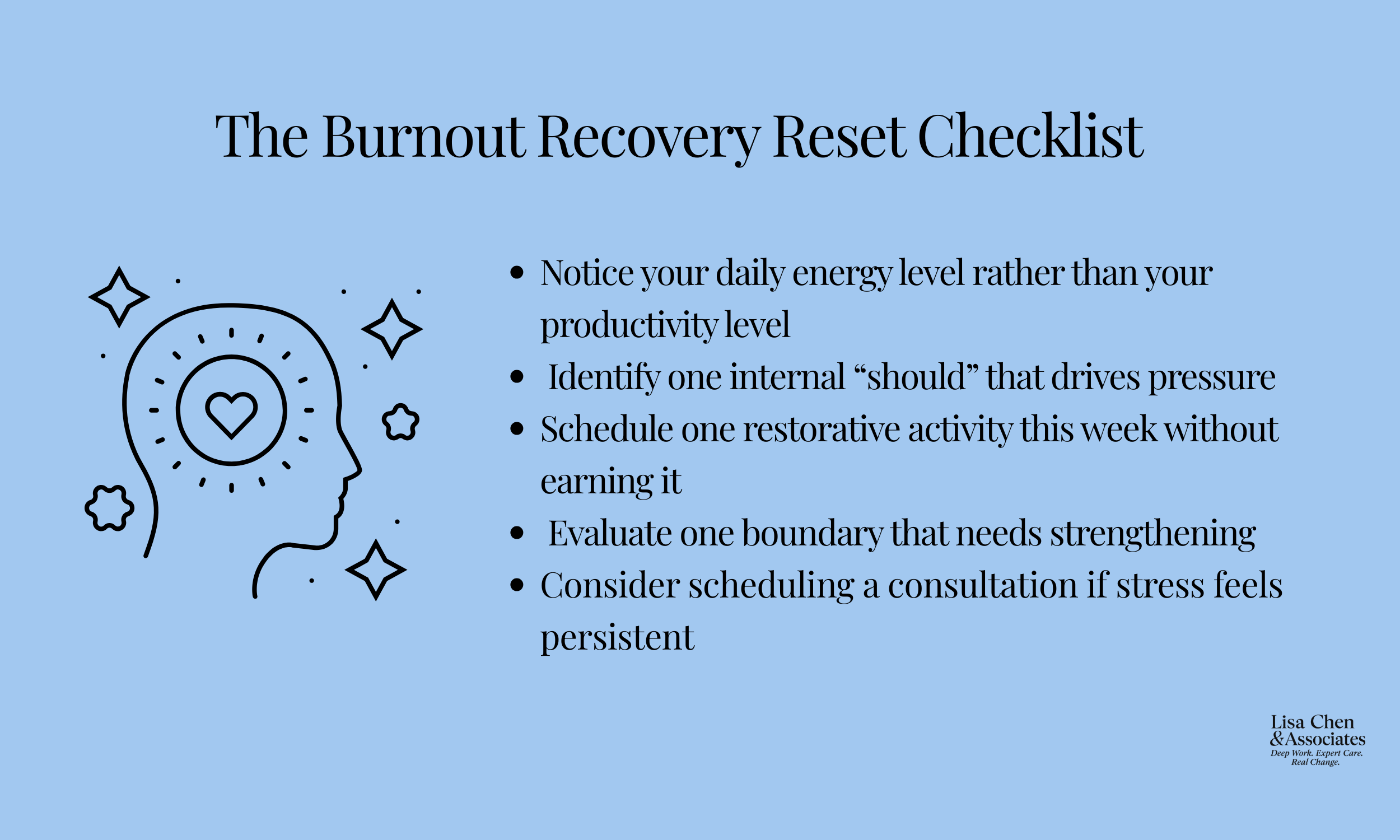
The High-Achiever Burnout Reset
Therapy for Burnout in Hermosa Beach
At Lisa Chen & Associates Therapy, we specialize in working with professionals who are outwardly successful but internally depleted.
Our approach integrates psychodynamic insight, EMDR for stress processing, and IFS for perfectionism and inner critic work.
Burnout recovery is not about dulling your drive.
It is about recalibrating it.
When success comes at a cost, therapy helps you redefine strength, not by carrying more, but by healing what’s underneath the pressure.

Quick Summary
Burnout in high achievers often presents as quiet exhaustion rather than collapse. Chronic stress combined with perfectionism dysregulates the nervous system and erodes emotional capacity. Real burnout recovery requires physiological regulation, internal standard restructuring, and boundary repair. If stress is affecting your relationship, couples therapy may also be beneficial. Learn more about our therapy services in Hermosa Beach at www.lisachentherapy.com.
Frequently Asked Questions
What are the first signs of burnout?
Early signs include emotional exhaustion, irritability, reduced motivation, sleep disruption, and feeling detached from work or relationships. High achievers often overlook these symptoms because they are still functioning at a high level.
How is burnout different from depression?
Burnout is typically linked to chronic stress and overextension, often in professional or relational roles. Depression involves broader mood symptoms, including persistent sadness, hopelessness, and loss of interest across areas of life. A therapist can help assess the difference.
Can therapy really help with burnout?
Yes. Therapy helps regulate the nervous system, identify perfectionistic patterns, and rebuild sustainable boundaries. Evidence-based approaches such as EMDR and trauma-informed therapy are particularly effective for chronic stress recovery.