Your Nervous System Has a Plan. Here's How It Works.

Quick Summary
Your nervous system is constantly scanning for safety and threat, often without your awareness. Polyvagal theory, developed by Dr. Stephen Porges, explains how three distinct nervous system states shape the way you feel, connect, and respond to stress. Understanding this hierarchy can transform how you relate to your own reactions and open the door to more effective healing. Learn how trauma therapy approaches like EMDR work directly with your nervous system to build lasting change.
You have probably had the experience of going blank in a meeting you prepared for. Or snapping at your partner over something small and then wondering where that reaction came from. Or feeling completely checked out on a Sunday afternoon, not tired exactly, but unable to engage with anything or anyone.
Most people chalk these moments up to personality, stress, or just having a bad day. But your nervous system has a much more specific explanation for what is happening. And once you understand it, everything changes.
What Is Polyvagal Theory?
Polyvagal theory was developed by neuroscientist Dr. Stephen Porges and introduced in the mid-1990s. It describes how the autonomic nervous system organizes itself around three distinct states, each one serving a survival function that evolved over millions of years.
The theory centers on a concept called neuroception, your nervous system's unconscious process of scanning the environment for cues of safety or danger. This happens below the level of conscious thought, which is why your body can react to a situation before your mind has had a chance to evaluate it.
"What I find most valuable about the polyvagal framework is that it gives people language for experiences they have been living with but could not name," says Lisa Chen, LMFT, founder of Lisa Chen & Associates Therapy. "When clients learn that their shutdown or their hypervigilance is a biological response, not a character flaw, it changes the entire therapeutic conversation."
The Three States of Your Nervous System
The polyvagal defense hierarchy moves through three primary states, organized from the most recently evolved to the most ancient.
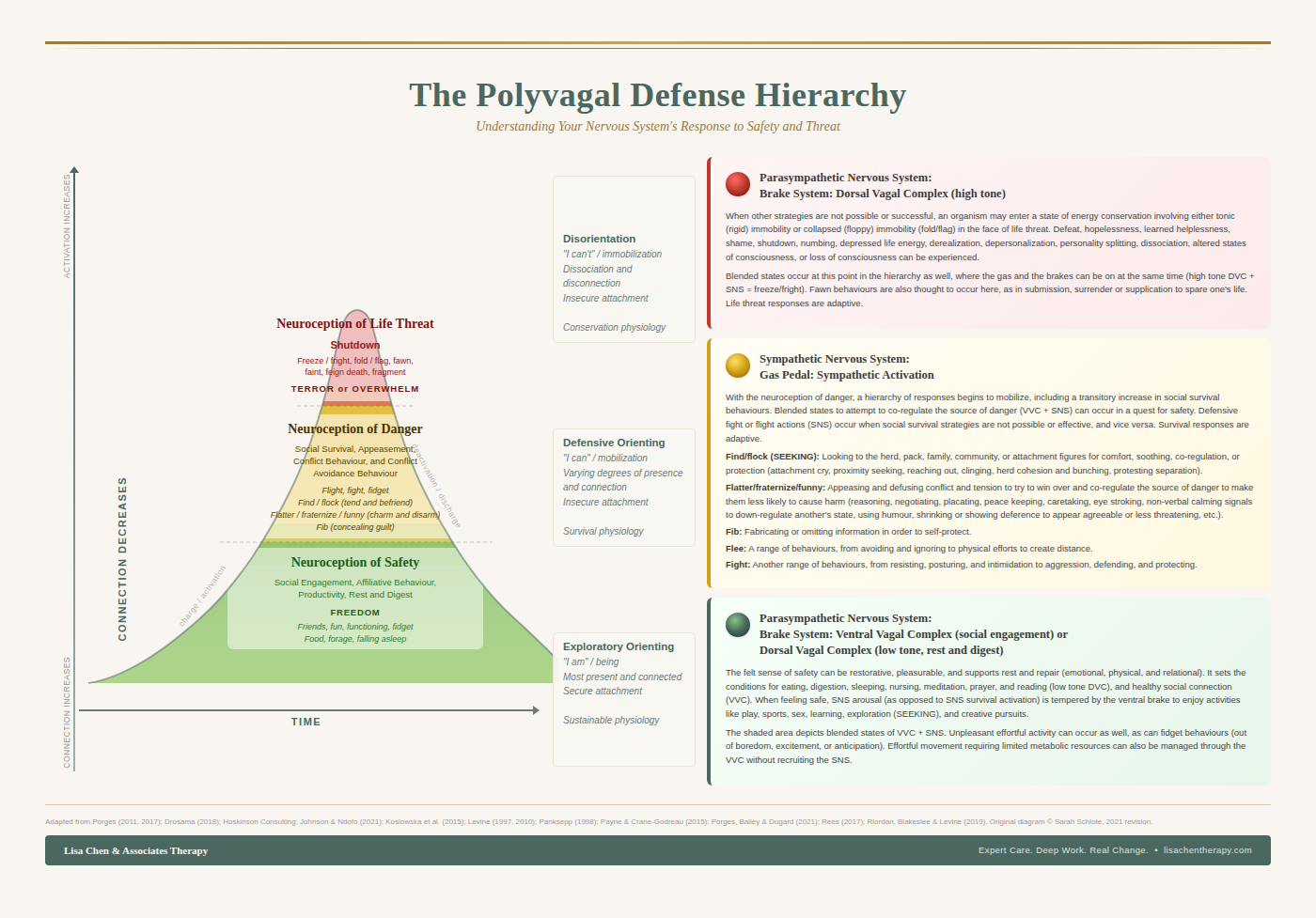
Neuroception of Safety: The Green Zone
When your nervous system detects safety, the ventral vagal complex is running the show. This is the state of social engagement, connection, rest, and creativity. You can think clearly, feel present, and connect authentically with the people around you.
In this state, your body supports digestion, sleep, play, curiosity, and relational warmth. It is not just the absence of danger. It is a felt sense of being safe enough to be yourself.
Neuroception of Danger: The Yellow Zone
When your nervous system picks up cues of threat, the sympathetic nervous system activates. This is the mobilization state, designed to get you moving toward safety. The classic fight or flight response lives here, along with a range of less obvious survival strategies.
These include the flock response, seeking proximity to others for co-regulation and protection. The flatter response, which uses humor, charm, or appeasement to defuse perceived threats. Fib, which involves withholding or altering information to self-protect. And fidgeting, which reflects the body's attempt to manage rising activation.
These are not signs of weakness. They are adaptive strategies your nervous system has learned to deploy when it senses danger.
Neuroception of Life Threat: The Red Zone
When danger becomes overwhelming and mobilization strategies are not working, the dorsal vagal complex takes over. This is the shutdown state, the most ancient part of your nervous system's defense hierarchy.
In this state, a person may experience freeze, collapse, dissociation, numbness, or what feels like emotional flatness. Some people describe it as going offline. The body is conserving energy, and connection becomes nearly impossible.
“Many of my clients who are high achievers are surprised to learn they spend significant time in dorsal vagal shutdown. They associate shutdown with lying on the floor unable to move. But it can also look like emotional numbness behind a very productive exterior.”
Why This Matters for Therapy

Understanding where you live on the polyvagal hierarchy is one of the most powerful first steps in therapy. When you can name the state you are in, you gain a foothold for change.
Trauma-informed modalities like EMDR therapy work directly with the nervous system. Rather than asking you to simply talk about difficult experiences, EMDR helps the brain reprocess traumatic memories so the nervous system can come out of its protective stance. Internal Family Systems therapy also works beautifully with this framework, helping clients understand the parts of them that are stuck in survival mode.
The goal is not to eliminate the yellow or red zones. These responses exist because they have kept you alive. The goal is to expand your capacity to return to safety, to widen the window of tolerance so that your nervous system does not get stuck in states that no longer serve you.
If you are curious about how trauma therapy or therapy intensives can help you build nervous system flexibility, we would welcome that conversation.
Frequently Asked Questions
What is the polyvagal defense hierarchy?
The polyvagal defense hierarchy is a model from Dr. Stephen Porges's polyvagal theory that describes three nervous system states organized by evolution. The most recently evolved state supports social engagement and safety. When safety is disrupted, the system shifts to sympathetic activation for fight or flight. When that is not effective, the most ancient dorsal vagal response produces shutdown, freeze, or collapse. According to Porges's 2025 paper in Clinical Neuropsychiatry, this hierarchical model provides a framework for understanding how the autonomic nervous system supports social engagement, emotional resilience, and adaptive responses.
Why do I freeze or shut down instead of fighting back?
Freezing or shutting down is not a choice. It is your nervous system's oldest and most protective response to overwhelming threat. When your brain determines that fighting or fleeing is not possible, the dorsal vagal system activates to conserve energy and minimize harm. This response is common in people who have experienced repeated or early trauma, and it is something that can be addressed in therapy through approaches like EMDR and somatic work.
Can therapy help regulate my nervous system?
Yes. Trauma-informed therapies such as EMDR, Internal Family Systems, and somatic approaches are specifically designed to help your nervous system shift out of survival states and build greater capacity for safety and connection. A skilled therapist can help you recognize which state you are in and develop tools to expand your window of tolerance over time. Lisa Chen & Associates Therapy offers in-person sessions in Hermosa Beach and telehealth throughout California. Schedule a consultation to learn more.