
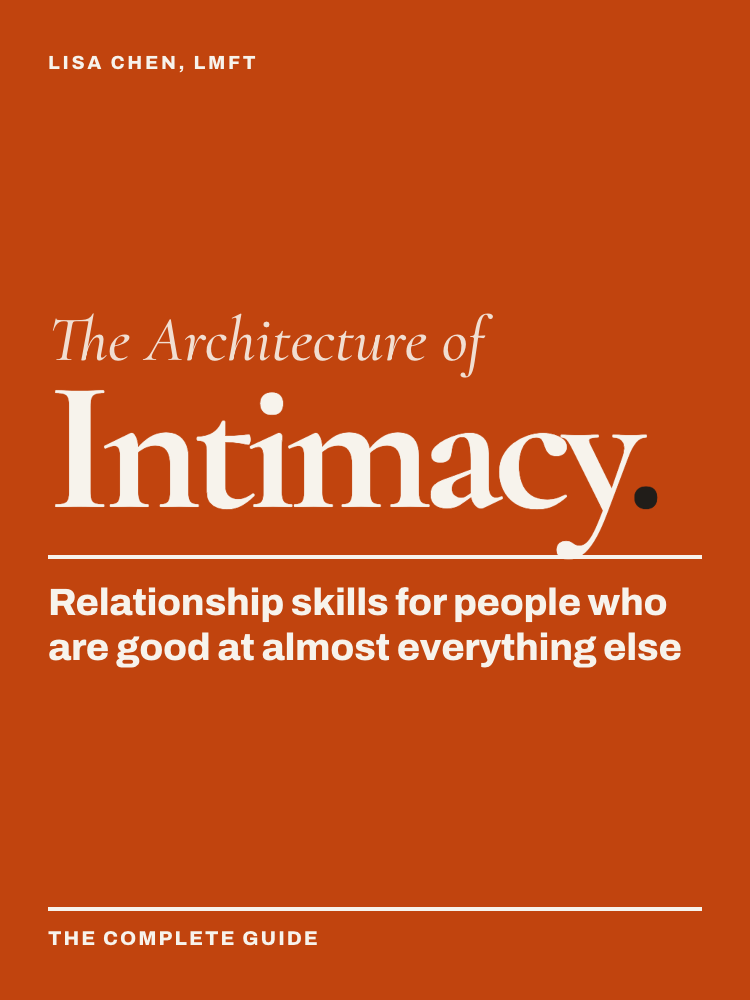
The Architecture of Intimacy™
A psychological framework for couples and individuals who want to understand (not just manage) the way connection actually works.
By Lisa Chen, LMFT | Lisa Chen & Associates Therapy | Hermosa Beach, CA
This is not a couples workbook.
It is not a list of conversation starters or a conflict resolution script.
The Architecture of Intimacy™ is a clinical guide to the invisible structure underneath every intimate relationship — the attachment patterns, nervous system dynamics, and relational blueprints that determine whether connection deepens or quietly erodes.
Drawing on attachment theory, Internal Family Systems, and relational neuroscience, it gives you a framework for understanding what is actually happening when closeness feels difficult — and a concrete roadmap for rebuilding it.
Lisa Chen, LMFT California License #140374

Lisa Chen, LMFT is a psychotherapist, author, and founder of Lisa Chen & Associates Therapy in Hermosa Beach, California. She specializes in high-achieving professionals and couples navigating burnout, emotional disconnection, and relationship strain.
The frameworks in this guide were developed through clinical work with executives, founders, and couples navigating some of the most demanding relational terrain — people who needed more than communication advice. They needed a map.
Who This Guide Is For
Written for people who understand themselves and are still stuck.
This guide is not for people in crisis. It is for people who are functional, self-aware, and carrying something they have not been able to resolve through insight alone. The ones who have done the work, understand their patterns, and still find the same dynamics playing out in the relationships that matter most to them.
Most couples don't have a communication problem. They have an architecture problem — the invisible structure underneath the relationship has never been examined.
- 01 Couples who love each other but keep having the same conversation
- 02 Partners who feel genuinely close in some moments and completely disconnected in others, without understanding why
- 03 Individuals who want to understand their relational patterns before or between therapy
- 04 High-achieving couples who run their relationship with the same efficiency as their careers — and feel the emotional cost of it
- 05 Anyone who has tried communication tools and found them insufficient for what they are actually experiencing
- 06 People who want clinical depth they can access on their own terms, outside of a therapy room
This guide will not tell you to use "I statements." It will help you understand why the same rupture keeps happening — and what it would actually take to change it.
What’s Inside
Five proprietary frameworks developed through clinical practice
Each framework addresses a different layer of intimate connection — from how your nervous system shapes closeness, to why the same protective patterns that once kept you safe now keep you separate.
The optimal emotional range for genuine intimacy — and what happens when one or both partners drift outside it. Understand why some moments of closeness feel effortless while others feel impossible, and what your nervous system is actually doing in each.
A three-part framework for navigating the moments when connection breaks down in real time. Most couples try to resolve conflict with words — this method works with the underlying physiological and emotional state that determines whether words land or escalate.
How the different parts of you — the protector, the pleaser, the withdrawer, the critic — show up inside your relationship and why they often work against the closeness you want. Based on Internal Family Systems, adapted for relational use.
How to maintain your own emotional limits without creating distance. This framework distinguishes between protection and walls — and gives you a way to stay present with your partner without losing yourself in the process.
A self-assessment tool for tracking your relational temperature and identifying what your nervous system actually needs before a conversation begins. Know your state before you speak — the single most underused skill in intimate relationships.
What You Get
- Instant PDF download — readable on any device
- Five proprietary clinical frameworks
- Applicable to individual and couples use
- Grounded in attachment theory, IFS, and relational neuroscience
- Developed from clinical work with high-achieving professionals and couples
- Pairs with The Architecture of Us™ companion workbook
Frequently Asked Questions
It is a guide — written to be read and understood, not just filled in. It offers clinical frameworks and insight rather than blank prompts. A companion workbook, The Architecture of Us™, is available separately for those who want structured exercises and a two-week practice log.
Both. The frameworks apply whether you are working through this with a partner or reading independently to understand your own relational patterns. Many clients use it alone first, then bring it into couples work.
No. The guide is written to be accessible and actionable on its own. Many people use it alongside therapy, but it stands completely alone as a resource. It was designed for people who want clinical depth outside of a therapy room.
PDF, delivered instantly via Gumroad after purchase. Readable on any device — phone, tablet, or desktop.
Yes — and in some ways more so. The frameworks in this guide are most useful when you have enough relational bandwidth to actually examine what's happening. This guide is for couples who want to understand their patterns and deepen connection proactively, not reactively.
Yes. Several frameworks — particularly the Internal Boardroom™ and State of the Heart Dashboard™ — are designed for individual use. Understanding your own patterns changes how you show up in the relationship, regardless of where your partner is.
Yes. The Architecture of Us™ is a 39-page companion workbook with seven original frameworks, 14 exercises, and a two-week practice log — designed to be used alongside or after this guide for couples who want to go deeper together.
At Lisa Chen & Associates, we offer evidence-based couples and individual therapy for high-achieving professionals throughout Los Angeles and California.
This guide is a clinical educational resource produced by Lisa Chen & Associates Therapy and is not a substitute for professional mental health treatment. If you are in crisis, please contact the 988 Suicide & Crisis Lifeline by calling or texting 988.
Published 2025 · Last reviewed April 2026 · © Lisa Chen & Associates Therapy, Hermosa Beach, CA · For personal use only · Not for redistribution · California LMFT License #140374
This guide is a clinical educational resource produced by Lisa Chen & Associates Therapy and is not a substitute for professional mental health treatment. If you are in crisis, please contact the 988 Suicide & Crisis Lifeline by calling or texting 988.
Published March 2026 · Last reviewed August 2026
© 2026 Lisa Chen & Associates Therapy, Hermosa Beach, CA · For personal use only · Not for redistribution · California LMFT License #140374