How Do I Know If Therapy Is Working?

Table of Contents
Introduction
Quick Summary
Why Progress in Therapy Is Hard to See at First
What Real Progress Actually Looks Like
The Difference Between Feeling Better and Getting Better
When EMDR and Other Modalities Change the Picture
Questions Worth Asking Your Therapist Directly
When It May Be Time to Reassess
What to Do When Therapy Hits a Plateau
Why Ruptures and Repairs Are Part of the Healing
Therapy in Hermosa Beach and Throughout California
Frequently Asked Questions
Progress in therapy rarely announces itself. It tends to show up quietly: in a conversation you handled differently, a pattern you finally noticed, or a reaction that no longer owns you. This post breaks down what it actually looks like when therapy is working, why it can feel hard before it feels better, what to do when things plateau, and what to do if you are not sure you are moving forward.
You started therapy. You have shown up, you have talked, and somewhere in the back of your mind a question keeps surfacing: is this actually doing anything?
It is one of the most common things people wonder, and one of the least talked about. Therapy is an investment, not just financially but emotionally. You are opening up parts of yourself you probably did not plan to share with anyone. Wanting to know if it is working is not impatience. It is a reasonable question that deserves a real answer.
The honest truth is that progress in therapy looks nothing like what most people expect.
Quick Summary
Topic: Progress in therapy rarely announces itself — real change tends to show up quietly, in a conversation handled differently or a pattern finally noticed, and understanding what to expect (including plateaus and temporary setbacks) helps distinguish genuine stalling from deep work in progress.
Key Takeaways:
Real progress is behavioral before it's emotional: noticing patterns in real time instead of in hindsight, holding a boundary that used to collapse, and recovering faster from difficult moments — these feel ordinary, which is how big change actually moves.
Feeling worse for a stretch isn't necessarily a sign of failure — as deeper material surfaces, things can temporarily feel harder before they settle, and this is different from a genuine plateau, which is best addressed by naming it directly to your therapist.
Ruptures between client and therapist (feeling misunderstood or unsettled) aren't signs something has gone wrong — when repaired well, they teach the nervous system that a relationship can hold conflict without collapsing, often becoming one of the most healing parts of treatment.
Next Steps: Readers unsure whether their therapy is working can explore what to expect further or schedule a consultation with Lisa Chen & Associates to talk it through.
Why Progress in Therapy Is Hard to See at First

In most areas of life, progress is visible. You finish a project. You hit a number. You get feedback. Therapy does not work that way, especially in the beginning.
Early sessions are largely about building safety. Your therapist is learning how you think, how you prot
ect yourself, and where the roots of things actually are. You may leave those first sessions feeling lighter, just from being heard. That is real, but it is not the full picture of what therapy can do.
As the work deepens, things can temporarily feel harder. This is not a sign that something is wrong. It usually means you are getting closer to something important. "What my clients often interpret as a setback is actually the beginning of real movement," says Lisa Chen, LMFT. "When we start touching the material that actually matters, it tends to stir things up before it settles."
Understanding this distinction changes everything. Feeling worse for a stretch does not mean therapy is failing. It often means it is working.
If You Have Not Started Yet: Seven Signs It Is Time
You do not have to be in crisis to benefit from therapy. Most of the people who come to us are functioning well on paper. Here is what usually tips them into making the call.
Stress that never switches off. You are on edge most days, lying awake running through work, money or the kids' schedules, and the tension has started showing up in your body as headaches, a tight jaw or a stomach that will not settle.
A low mood that has stuck around. Everyone has flat weeks. If the heaviness, the lack of motivation or the sense that nothing is worth the effort has lasted more than a couple of weeks, or your sleep and appetite have shifted, that is worth a conversation.
The same argument on repeat. With a partner, a parent or a close friend, you keep ending up in the same fight with different scenery, or you have gone quiet and distant to avoid it.
Something from the past that is still running the present. Big events count, but so do the quieter ones: a critical parent, bullying, a household where you learned to read the room before you walked in. Nightmares, flinching at reminders, feeling numb or being quick to startle are signs the past has not finished with you.
Habits you use to not feel. Food, alcohol, spending, scrolling or work itself, used to take the edge off. They work for an evening and cost you the morning.
A harsh inner voice. Persistent self-doubt, feeling like a fraud, or a running commentary that you are not enough, especially if it is sabotaging relationships or a career you have earned.
A big transition. A new baby, a marriage, a divorce, a move, a promotion or a loss. These are hard to carry alone even when they are good news.
If two or three of these are familiar, a free consultation is a low-cost way to find out whether therapy would help. The rest of this post is about what to expect once you start.
What Real Progress Actually Looks Like

The signs of a working therapeutic relationship are almost always behavioral and relational before they are emotional. Watch for shifts like these.
You start noticing your patterns in real time instead of only in hindsight. Where you used to recognize a reaction days later, you begin catching it as it happens. That gap closing is significant.
Your relationships shift in subtle ways. You hold a boundary you would normally collapse. You say something honest instead of reflexively agreeable. You stop over-explaining.
You become harder to derail. A difficult conversation does not ruin your week the way it once did. You recover faster. You are less at the mercy of other people's moods or moments.
You start making different choices quietly, without drama. Not because someone told you to. Because something internal has reorganized enough that the old choice no longer fits.
None of these feel like breakthroughs in the moment. They feel ordinary. That is how big change actually moves.
The Difference Between Feeling Better and Getting Better
This is a distinction most people do not realize matters until they are inside it.
Feeling better can happen quickly in therapy. A skilled therapist creates a space that is probably unlike any conversation you have had before: nonjudgmental, contained, focused entirely on you. That experience alone can produce real relief.
Getting better is something else. It is the structural work: understanding why you keep ending up in the same place, what the original wound was, how your nervous system learned to protect you, and what it would take to actually update those patterns.
Clients who have worked with coaches, mentors, or consultants sometimes notice this distinction clearly. Coaching tends to focus on behavior, strategy, and forward motion. Therapy works further back, on the material underneath behavior. Both have value. They are doing different things. If you are curious about how therapy compares to coaching and which one might fit where you are right now, that question is worth exploring directly with a therapist.
When EMDR and Other Modalities Change the Picture

Standard talk therapy follows a particular rhythm. EMDR, somatic work, and other evidence-based approaches work differently, and progress can look different too.
EMDR, which stands for Eye Movement Desensitization and Reprocessing, targets traumatic memory networks directly. Clients often report that specific memories or triggers lose their charge faster than they expected. The shift can feel sudden and sometimes disorienting, because the nervous system has actually reorganized around a particular memory rather than gradually building insight over time.
If you are working with a modality like EMDR, traditional markers of progress such as talking through things and gaining insight may not be the most relevant measure. Your therapist should be helping you track what is happening somatically and behaviorally, not only what you are discussing.
Questions Worth Asking Your Therapist Directly
If you are genuinely unsure whether therapy is working, the most productive thing you can do is bring that question into the room.
A good therapist welcomes this conversation. You might ask: what are we working toward, and how will we know if we are getting there? What does progress look like in your clinical view? Is there something we should be doing differently?
This is not a confrontation. It is a collaboration. Your therapist cannot do this work without you, and your active engagement in evaluating the process is part of what makes it effective.
If a therapist responds defensively or avoids the conversation, that is information worth paying attention to.
When It May Be Time to Reassess
Therapy is not working when nothing is shifting after a sustained period of genuine effort. Not a rough few weeks, but months of sessions where you feel no movement, no new understanding, and no change in the patterns you came in with.
It may also not be working if you do not feel safe in the room. Safety does not mean comfortable. Therapy is often uncomfortable. But you should feel respected, heard, and free to be honest. If you are performing for your therapist, managing their reactions, or editing yourself heavily, that is worth examining.
Reassessing does not always mean leaving. Sometimes it means adjusting the approach, the frequency, or the focus. Sometimes it means trying a different modality. Occasionally it means finding a different therapist. None of those outcomes is a failure.
““The goal of therapy is never dependency It is building something durable inside the client. When that is not happening, it deserves an honest conversation.”
"The goal of therapy is never dependency," says Lisa Chen, LMFT. "It is building something durable inside the client. When that is not happening, it deserves an honest conversation."
What to Do When Therapy Hits a Plateau
Plateaus in therapy are real, and they are not the same as therapy failing. They tend to happen at predictable moments: after an initial period of relief, after a major insight has been integrated, or when the next layer of work requires more than either you or your therapist has named yet.
A plateau can feel like going through the motions. Sessions feel flat. You are not bringing new material, and nothing feels particularly alive in the room. You leave without much sense of having moved anywhere.
The most important thing to do when this happens is also the thing most people avoid: say it out loud, in session, to your therapist.
This is harder than it sounds. Many people worry that naming the plateau will hurt their therapist's feelings, or that it signals something unfixable. Others quietly assume the flatness is their own fault, that they are not trying hard enough or do not have enough to bring. Neither of those things is usually true.
A plateau is clinical information. It tells a skilled therapist that something in the work needs to shift. Maybe the focus has been too narrow and there is something adjacent you have not touched yet. Maybe the pace needs to change. Maybe a different modality would move things that conversation alone has not been able to reach. EMDR, somatic work, and other body-based approaches are particularly useful at exactly this stage, when insight is present but something is still stuck.
"A plateau is often the threshold of the next real piece of work," says Lisa Chen, LMFT. "It is not a wall. It is usually a door the client has not walked through yet, sometimes because they do not know it is there, and sometimes because it feels too vulnerable to open."
Naming the flatness does not end the work. In most cases, it deepens it.
Why Ruptures and Repairs Are Part of the Healing
There is something that happens in good therapy that most people are never told to expect: at some point, something between you and your therapist will feel off. You might feel misunderstood, or like your therapist said something that did not land right, or like the room suddenly felt less safe than it did before. This is called a rupture, and it is not a sign that something has gone wrong.
It is one of the most important things that can happen in treatment.
Research on therapeutic outcomes consistently shows that rupture and repair, when handled well, is one of the most healing sequences available in the clinical relationship. This is not an accident. For many people, the relational patterns that cause the most suffering in their lives were formed in relationships where ruptures were never repaired. Where someone said the wrong thing and the hurt was either ignored, minimized, or punished. Where you learned that the safest response to tension was to go quiet, agree, or disappear.
Therapy offers something different. When a rupture happens and your therapist stays curious, takes responsibility for their part, and works to repair the connection with you, something registers at a deeper level than insight. The nervous system learns, perhaps for the first time, that a relationship can hold conflict without collapsing. That you can say "that did not feel right" and be met instead of abandoned.
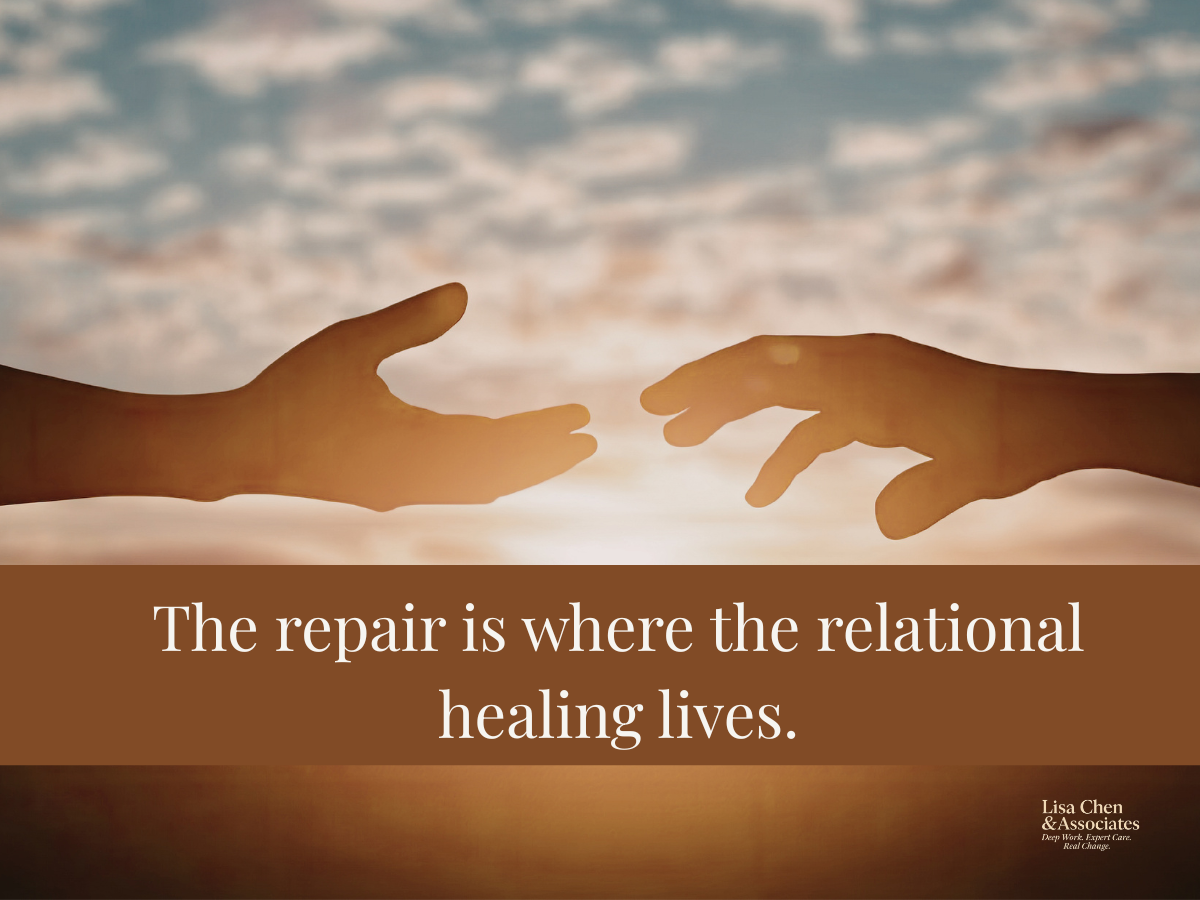
"The repair is where a lot of the relational healing actually lives," says Lisa Chen, LMFT. "When a client can tell me something felt off, and we can sit with that together, that moment often becomes one of the most significant in the whole course of treatment."
If something in your therapy feels off, you do not have to wait for the right moment or the right words. You can bring it in exactly as it is. A therapist worth working with will not need you to make it comfortable for them. That is the whole point.
Therapy in Hermosa Beach and Throughout California
Lisa Chen and Associates offers in-person therapy in Hermosa Beach and telehealth throughout California. Our work is particularly suited to high-achieving professionals, executives, and individuals who have tried other forms of support and are ready for something with more depth. If you are asking whether therapy is working for you, or wondering whether to start, we are glad to talk.
Frequently Asked Questions
How do I know if therapy is working?
The clearest signs are behavioral, not emotional. You begin noticing your patterns in real time, handling relationships differently, recovering from stress faster, and making choices that did not feel available to you before. Progress in therapy is rarely dramatic. It tends to show up quietly in everyday moments.
How long does it take for therapy to work?
It depends on what you are working on, how often you attend, and the approach being used. Many clients notice meaningful shifts within 8 to 12 sessions. Deeper structural change, particularly around long-standing patterns or trauma, often takes longer. EMDR and somatic approaches sometimes move faster on specific issues than traditional talk therapy.
What if therapy feels harder than when I started?
This is common and often a sign that the work is deepening rather than stalling. Early sessions tend to bring relief. Deeper sessions can stir things up before they settle. If the difficulty feels persistent or you are not sure what is happening, bring it directly to your therapist. That conversation is part of the work.
What should I do if my therapist says something that feels hurtful or wrong?
Bring it up in your next session, or in the same one if you can. A skilled therapist will not be defensive. They will want to understand what happened and work through it with you. That process, called rupture and repair, is one of the most healing sequences in therapy, particularly for people whose earlier relationships did not offer the experience of conflict being worked through rather than avoided.
What should I do if therapy feels like it has stalled?
Name it in the room. Tell your therapist that sessions have been feeling flat or that you are not sure you are moving. This is not a criticism. It is clinical information. A good therapist will use it to reassess the approach, introduce a different modality, or open up a new layer of work. The conversation itself often becomes the turning point.
Ready to Start or Go Deeper?
If you are not sure whether therapy is right for you, or whether what you have tried so far has gone deep enough, a consultation is a good place to start. Lisa Chen and Associates works with clients in Hermosa Beach , Manhattan Beach, Torrance and via telehealth across California.