How Long Does It Take to Recover from Burnout? A Therapist’s Guide
Table of Contents
Quick Summary
How Long Burnout Recovery Actually Takes
Burnout Recovery Timeline
Why Burnout Lasts Longer Than You Expect
Stages of Burnout Recovery
Burnout Recovery for High Achievers
What Actually Helps Burnout Recovery
Signs You’re Recovering
When to Seek Help
Frequently Asked Questions
Action Steps
Quick Summary
Topic: How long burnout recovery actually takes, and why it isn’t quick.
Key Takeaways:
Recovery timelines vary by severity: mild burnout can improve in 2-6 weeks, moderate burnout typically takes 2-6 months, and chronic burnout can take 6+ months or longer.
Rest alone often isn’t enough because burnout usually persists due to unchanged patterns, a still-activated nervous system, an identity tied to productivity, or unprocessed emotional load.
High achievers often take longer to recover because the same habits that drive their success can also reinforce burnout.
Next Steps: If your burnout has been ongoing for months or is affecting your relationships, health, or sense of self, reach out to Lisa Chen & Associates to get support building a more sustainable way forward.

How Long Does Burnout Recovery Actually Take?
This is one of the most common questions people ask—and one of the most misunderstood.
Most people expect burnout to resolve quickly. They assume a few days off, a vacation, or a lighter week will fix it.
But burnout isn’t just fatigue.
It’s a state of emotional, physical, and psychological depletion that builds gradually over time. And because it builds slowly, it also takes time to unwind.
Recovery isn’t about “bouncing back.” It’s about creating a different way of operating.
A More Honest Burnout Recovery Timeline

While everyone’s experience is different, most people fall into one of these general patterns.
Mild burnout: 2–6 weeks
You’re tired, overwhelmed, but still functioning relatively well.
You may notice reduced energy, difficulty focusing, and feeling more irritable than usual. At this stage, recovery can happen relatively quickly with rest, reduced pressure, and better boundaries.
Moderate burnout: 2–6 months
Burnout is starting to affect your day-to-day life more noticeably.
You may feel emotionally drained, disconnected from your work or relationships, easily overwhelmed by small tasks, or mentally foggy and unmotivated. At this stage, recovery requires more than rest. It involves changing how you relate to stress, expectations, and productivity.
Chronic burnout: 6+ months
This is where many high achievers find themselves.
Burnout has been present for so long that it starts to feel normal. You may feel constantly exhausted, even after rest, emotionally flat, disconnected from yourself or others, or stuck in patterns you can’t seem to change.
Recovery at this stage often requires deeper work, including nervous system regulation, identity shifts, and consistent support.
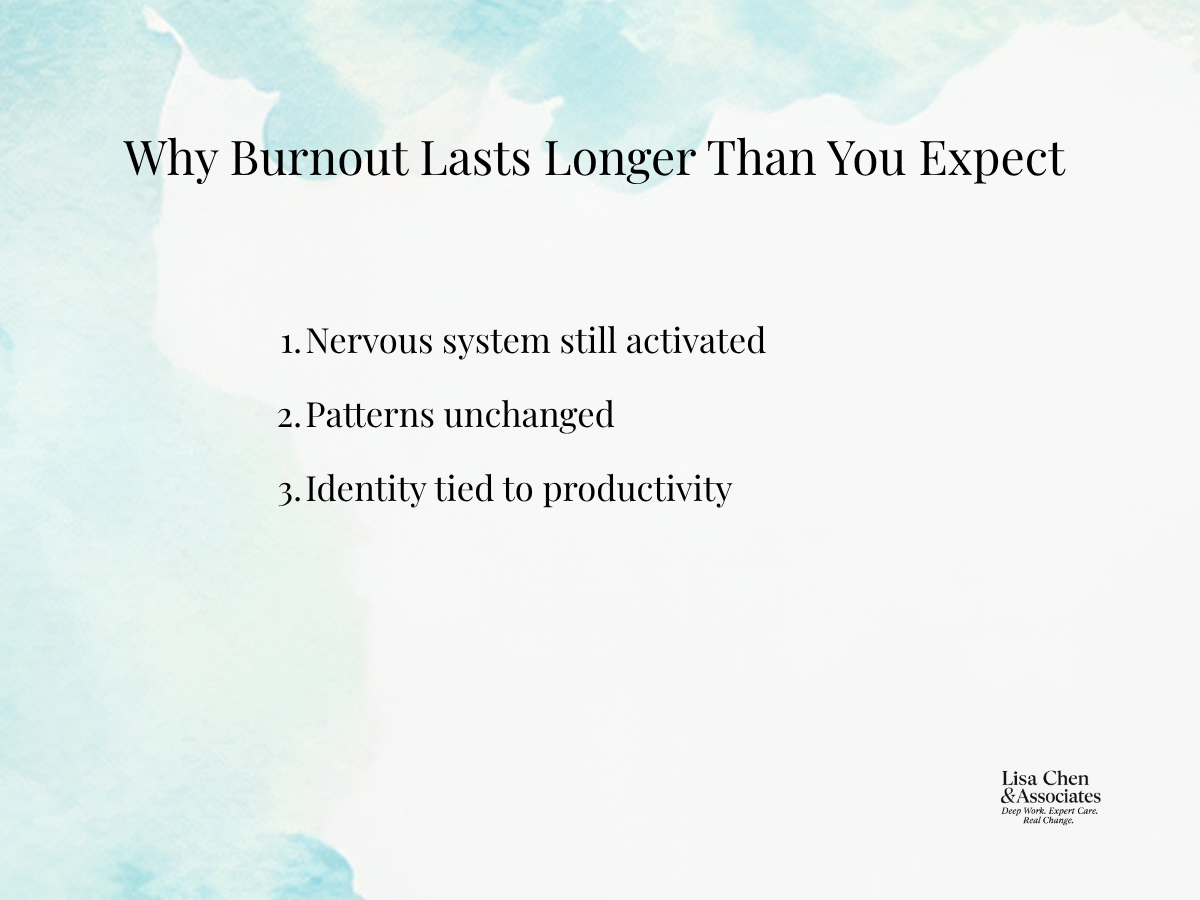
Why Burnout Lasts Longer Than You Expect
One of the most frustrating parts of burnout is how long it lingers.
Many people say, “I’ve tried resting, but I still feel off.”
That’s because burnout isn’t just about how much you’re doing. It’s about how you’re relating to your life.
Here are some of the most common reasons burnout doesn’t resolve quickly.
The underlying patterns haven’t changed
You may take time off, but return to the same pace, expectations, and pressure.
Your nervous system is still activated
Even when you stop working, your body may still be in a state of stress or hypervigilance.
Your identity is tied to productivity
Slowing down can feel uncomfortable, unfamiliar, or even unsafe.
Emotional load hasn’t been processed
Burnout often includes unacknowledged stress, resentment, or pressure that hasn’t been fully felt or addressed.
This is why rest alone often isn’t enough.
What Burnout Actually Is (and What It Is Not)
The World Health Organization lists burnout in the ICD-11 as an occupational syndrome. It is the result of chronic workplace stress that has not been managed. It is not a disorder and it is not a character flaw. It has three parts: exhaustion that sleep does not fix, a growing distance or cynicism toward work you used to care about, and a sense that you are not as effective as you were.
Only the first of those is about being tired. The other two live further in, which is why a vacation rarely touches them. It also helps to know that chronic stress changes the brain in measurable ways. Imaging studies show the prefrontal cortex, which handles focus and decisions, gets smaller under long stress, while the amygdala, which handles threat, gets larger. That is part of why depleted people feel more reactive and less sharp. The good news is that these changes reverse when the load changes and recovery gets real.
Why High Achievers Take Longer
If you built your career on long hours and mental toughness, your version of burnout does not look like collapse. It looks functional. You still show up and still hit the deadline, but you wake up tired, small things irritate you, and the drive that used to feel energizing now feels heavy. If you are not sure whether that is you, read Am I Burned Out or Just Busy? or take the free burnout check.
In my clients, and in my own years in finance before I trained as a therapist, the engine underneath is usually perfectionism. It sounds like "if I don't do it, it won't be done right," "I should be able to handle this," and "I can rest after I finish everything." Under those rules the stress cycle never completes. Cortisol and adrenaline stay high, and over time that disrupts sleep, mood, immune function and patience.
It also does not stay at work. When your nervous system is overloaded you have less patience and less emotional room for the people at home. Partners often read that as distance or disinterest. Most of the time it is depletion. If that sounds familiar, our couples therapy page explains how we work with stress inside a relationship, in person in Hermosa Beach for couples from across the South Bay including Torrance, and online across California.
The Stages of Burnout Recovery
Burnout recovery doesn’t happen in a straight line. Most people move through phases.
Stage 1: Awareness
You start to recognize that something isn’t right. You may feel, “I can’t keep going like this.”
Stage 2: Slowing Down
You begin to reduce your pace, even if it feels uncomfortable. This is often where guilt or anxiety about resting shows up.
Stage 3: Discomfort and Resistance
This is one of the most important phases.
When you stop pushing, underlying emotions often surface such as frustration, sadness, or exhaustion. Many people mistake this phase for getting worse, when it’s actually part of recovery.
Stage 4: Rebuilding
You begin to create new patterns, including better boundaries, more sustainable pacing, and increased emotional awareness. This is where things start to feel different—not just temporarily better.
Why Burnout Recovery Is Different for High Achievers
If you’re used to performing at a high level, burnout can be harder to recognize and harder to recover from.
You may continue functioning despite exhaustion, normalize stress as part of success, feel guilty when resting, or push through discomfort automatically.
“Many high achievers don’t realize they’re burnt out because they’re still functioning. But functioning isn’t the same as feeling well.”
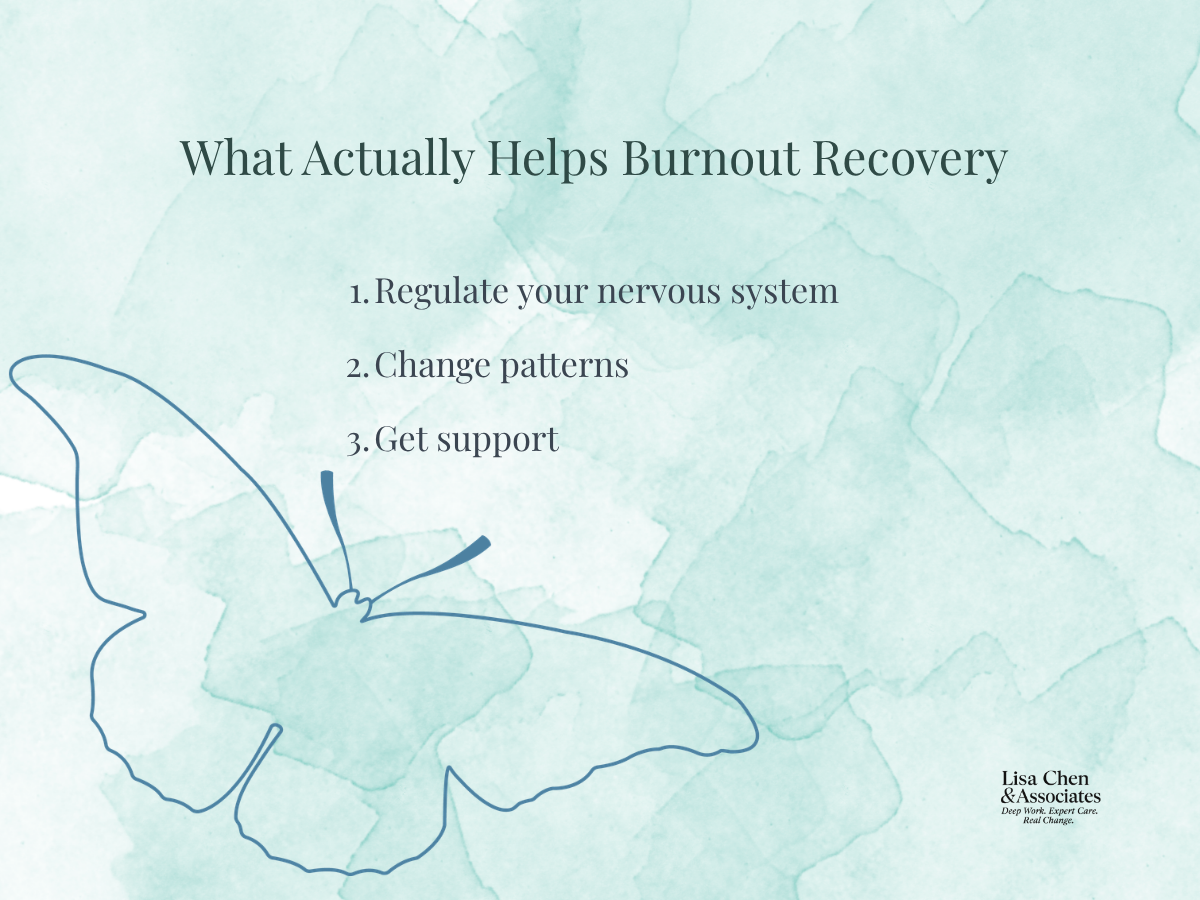
What Actually Helps Burnout Recovery
Rest matters, but it’s only one part of the process.
What supports real recovery is a combination of reducing ongoing stressors, regulating your nervous system, changing patterns such as overworking or people-pleasing, creating real recovery time, and getting the right support.
Working with a therapist can help you identify and shift the deeper patterns driving burnout.
Completing the Stress Cycle
Stress is a loop the body expects to finish. A threat shows up, the body mobilizes, the threat passes and the body settles. Modern work keeps the loop open. The pressure never fully passes, so the hormones never fully clear. Recovery means giving the body the signal that the loop is closed, and it responds to physical signals more than to logic.
Movement is the most reliable one. A run, a swim, a hard walk or a yoga class tells the body the emergency is over. Slow breathing works through the same channel; a few minutes of long exhales switches on the rest-and-digest side of the nervous system. Saying what you feel to a friend, a journal or a therapist lets the emotional charge move instead of sitting in your chest. Sleep, seven to nine hours of it, is when most of the repair happens. None of these fix the pattern that created the burnout, but they are how you stop adding to the debt while you work on it.
Signs You’re Actually Recovering (Even If It Feels Slow)
Burnout recovery can feel subtle at first.
You may notice that you’re less reactive to stress, have moments of clarity or energy, pause before pushing through, or feel more connected to yourself.
These small shifts matter. They are often the first signs your system is changing.
When to Seek Help for Burnout
If burnout has been ongoing for months or is affecting your relationships, health, or sense of self, it may be time for more structured support. Reach out to Lisa Chen & Associates Therapy.
Burnout recovery isn’t about forcing yourself to bounce back. It’s about understanding what got you here and creating a more sustainable way forward.
Frequently Asked Questions
How long does burnout usually last?
Burnout can last from a few weeks to several months, depending on severity and whether underlying stress patterns are addressed.
Can burnout go away on its own?
Mild burnout may improve with rest, but deeper burnout typically requires changes in behavior, boundaries, and emotional processing.
Why am I not recovering from burnout?
Burnout often persists when the underlying patterns—like overwork, stress, or emotional load—remain unchanged.
Is burnout the same as depression?
Burnout and depression can overlap, but burnout is typically tied to chronic stress, while depression affects mood more broadly. It’s important to assess both carefully.
Is burnout the same as stress?
No. Stress is the load. Burnout is what happens when the load runs ahead of recovery for long enough that exhaustion, detachment and a fading sense of effectiveness set in. Stress can be short and even useful. Burnout is a chronic state.
Can burnout qualify for a medical leave?
Sometimes. Burnout itself is not a diagnosis, but when it is driving a diagnosable condition such as an anxiety or depressive disorder, a clinician can document that and support a leave request. It is worth raising with your therapist or doctor.
What is the difference between weekly therapy and an EMDR intensive for burnout?
Weekly therapy works gradually, building the changes over months. An EMDR intensive condenses the deeper processing into one or two long days, which suits people who need traction fast or cannot hold a weekly slot.
Can burnout come back after you recover?
Yes, if the patterns that caused it, usually perfectionism and thin boundaries, were never addressed. That is why recovery work goes after the root, not just the symptoms, so the changes hold.
Action Steps
Identify your level of burnout (mild, moderate, or chronic)
Reduce at least one ongoing stressor
Build in real recovery time (not productive rest)
Notice early signs of improvement
Seek support if burnout feels ongoing or unclear