Table of contents
Quick answer · What questions are asked · Why they matter · Why marriage asks more now · We are not fighting · How to use the checklist · The 20 questions · FAQ
What are premarital counseling questions?
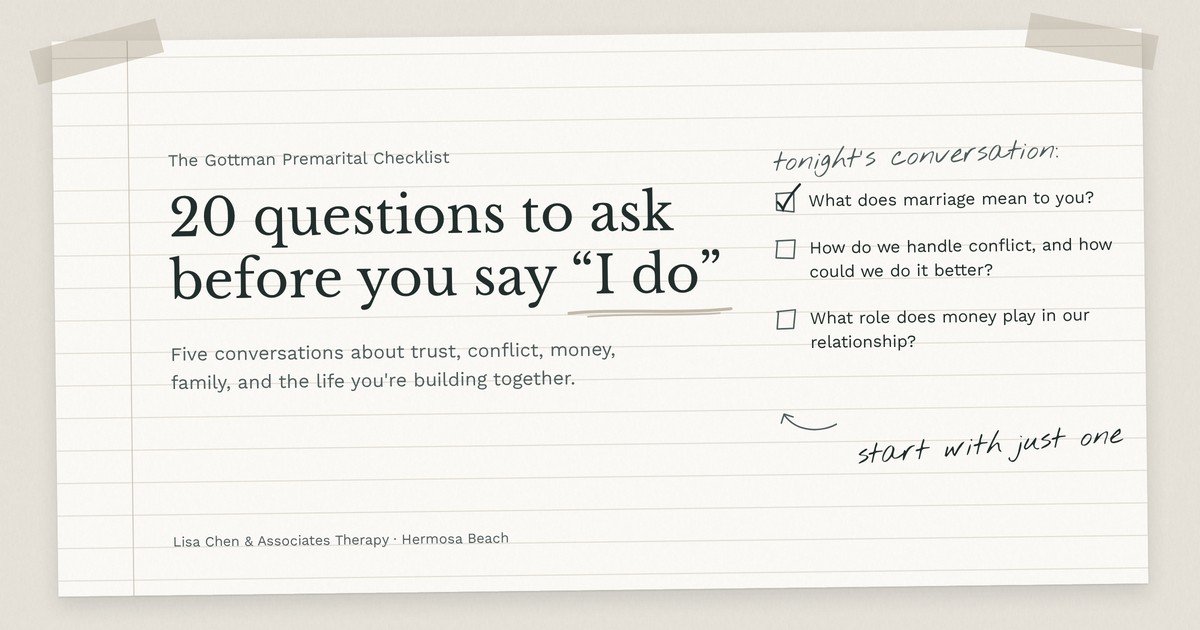
Premarital counseling questions are the structured conversations a couples therapist guides engaged partners through before the wedding: what marriage means to each of you, how you handle conflict and repair, money, family, intimacy, children and the life you want to build together. The 20 questions below are the Gottman-informed checklist Lisa Chen & Associates Therapy uses with couples in Hermosa Beach and online across California.
The goal is not identical answers. It is to find out, while you are both still curious about each other, where you agree, where you differ and how the two of you handle a difference once it is on the table. Couples who have those conversations before the wedding tend to walk into marriage with fewer surprises and a shared language for the hard moments.
This checklist draws on the research of Drs. John and Julie Gottman, who spent decades studying what separates couples who stay close from couples who drift. Their finding was not that happy couples avoid conflict. It was that they know each other's inner worlds, turn toward each other in small moments, repair quickly after a fight and build a sense of shared meaning. Every question below points at one of those four skills.
What questions are asked in premarital counseling?
Most premarital counselors, whatever their training, cover the same ground: communication and conflict style, money and financial expectations, family boundaries and in-laws, intimacy and emotional connection, whether and how you want children, faith and values, career ambitions and how you share a household. The difference is in how deep each conversation goes and whether you leave with a skill or just an answer.
In Gottman-based premarital counseling the therapist is less interested in your position on each topic than in what happens between you when your positions differ. Does one of you go quiet? Does one push? Can you come back and repair an hour later? Those patterns, not the topics themselves, predict how the marriage will feel in year seven.
If you only have time for a few conversations before the wedding, start with questions 1, 5, 9, 13 and 14 below: what marriage means to you, how you define trust, how you handle conflict, the role of money, and children. They are the five that most often surface a difference neither partner knew was there.
Why these questions matter
The Gottman Institute's research found that the first few minutes of a disagreement predict how it ends, that small everyday bids for attention matter more than grand gestures, and that couples who share a sense of meaning weather hard seasons better. A good premarital checklist is a way to practice all three before the stakes rise.
It also gives each of you permission to say the thing you have been holding back. Most engaged couples have at least one topic they have been quietly steering around. Naming it now, with a structure that keeps the conversation kind, is far easier than discovering it during a mortgage decision or the first year with a newborn.
Why marriage asks more of couples than it used to
For most of history marriage was practical. People married young, and it gave them economic stability, a place in the community and a way to raise children. Emotional closeness mattered, but nobody expected one person to meet every psychological need.
Couples today marry later, often after a decade of building a career, a set of habits and a clear sense of who they are. And they will be married far longer. A couple marrying in their mid-thirties can reasonably expect fifty years together. That partner is now expected to be emotionally fluent, supportive, interesting, financially sensible and able to keep growing alongside you the whole way. It is a beautiful aspiration. It is also a lot to ask of one human being, and it is why the conversations on this checklist matter more than the ceremony does.
When both partners are ambitious, there is one more layer. Work is not just a job for many professionals; it is an identity. Two full careers in one home means the relationship is always negotiating time, attention and who gets to be tired tonight. Those negotiations are rarely discussed before the wedding, and they shape the everyday rhythm of the marriage afterward.
We are not fighting. Do we still need this?
Not fighting is not the same as being prepared. Plenty of high-functioning couples handle stress well while dating. Marriage changes the stakes. Once the commitment is permanent, each nervous system starts asking quieter questions. Am I safe here for the long run? Will I still matter when life gets hard? Will I be chosen under pressure? Those questions usually surface after the wedding, during a career shift, a baby, a money decision or an in-law boundary.
The Gottmans' research is clear that avoiding conflict does not predict stability. Repair does. Some couples do not fight because they are secure. Others do not fight because one fears being left, one fears being swallowed, and the hard topics keep getting deferred. The questions below are how you find out which kind of quiet you have, while both of you are still open.
How to use this checklist
Take one theme per sitting rather than all 20 questions in a night. Pick a time with no phones and no wedding logistics, a long walk or a slow dinner. Take turns answering, and before you respond to your partner's answer, ask one follow-up question. Each question below includes an "ask next" prompt to make that easy.
Be curious rather than critical. If an answer surprises you, say so and ask where it comes from. If a topic brings up more heat than you expected, that is useful information, not a verdict on the relationship. It is usually the topic to bring to a therapist first. You can also download the printable checklist and write your answers side by side.
Meaning & Commitment
What you each believe marriage is for.
What does marriage mean to you?
Couples who share a sense of purpose tend to weather hard seasons better. Gottman calls this shared meaning, the top floor of his Sound Relationship House.
Ask next: What did marriage look like in the family you grew up in, and what would you keep or change?
What are your dreams for the next 5–10 years?
Feeling that your partner supports your dreams is closely tied to long-term satisfaction.
Ask next: Is there a dream you've been hesitant to say out loud?
What role does spirituality or religion play in your life?
Different beliefs rarely harm a marriage on their own. A lack of respect and open conversation does.
Ask next: How would we handle ceremonies, holidays, or raising children around faith?
What rituals or traditions matter to you?
Small, repeated rituals, like a Sunday dinner or a goodbye kiss, build a feeling of safety.
Ask next: What's one ritual we could start this week?
Trust & Connection
How you stay close in ordinary moments.
How do you define trust, and how do we build it every day?
Trust grows in small moments when one partner reaches out and the other turns toward them. Gottman calls these sliding door moments.
Ask next: When have you felt most trusted by me?
What are your emotional needs, and how can I meet them?
Knowing your partner's inner world is what Gottman calls building a Love Map. It helps couples handle stress and change.
Ask next: What do you need from me on a hard day?
What does intimacy mean to you?
Intimacy problems often start with emotional distance, not only physical issues.
Ask next: What helps you feel close to me outside the bedroom?
How do you like to give and receive love?
Everyday bids for connection, like a comment, a touch, or a joke, keep couples close. Noticing and responding to them matters more than grand gestures.
Ask next: Is there a small bid of mine you might be missing?
Take these to the kitchen tableAll 20 questions in a printable worksheet, with space to write down what you learn.
Download the checklist (PDF)Conflict & Repair
How you disagree, and how you come back together.
How do we handle conflict, and how could we do it better?
How a disagreement starts strongly shapes how it ends. Gottman's research found the first few minutes of a conflict conversation predicted how couples fared over time. Starting gently helps.
Ask next: What's one thing I do in arguments that makes it harder for you?
What relationship patterns did you learn growing up?
We often repeat what we saw at home, and naming those patterns makes them easier to change.
Ask next: How did your parents handle anger and making up?
How do you cope with stress, and how can I support you?
Feeling understood under stress builds connection for the long haul.
Ask next: When you're stressed, do you want solutions or just listening?
What do apologies and forgiveness look like for you?
Repair, not perfection, is what keeps couples close. Being able to say “I was wrong” and mean it builds lasting trust.
Ask next: What makes an apology feel real to you?
Money, Family & Daily Life
The practical decisions that shape a shared life.
What role does money play in our relationship?
Money disagreements are usually about deeper values such as security, freedom, or status.
Ask next: What did money mean in your family growing up?
Do you want children, and how do you imagine parenting?
Some parenting differences are what Gottman calls perpetual problems: ongoing differences you manage through dialogue rather than solve once.
Ask next: What's one thing you'd do differently from your parents?
How will we handle holidays and extended family?
Couples who act as a united team with extended family report greater satisfaction.
Ask next: Which holiday traditions matter most to each of us?
How will we share household work and career decisions?
Fairness isn't a strict 50/50 split. It's mutual respect and flexibility as life changes.
Ask next: If one of us got a big opportunity in another city, how would we decide?
Independence & Growth
Room for each of you, and for the two of you to change.
How do we balance independence and togetherness?
Healthy couples honor both personal space and closeness.
Ask next: What does a perfect afternoon alone look like for you?
What boundaries do we want around social media and friendships?
Agreeing on boundaries ahead of time prevents misunderstandings and protects trust.
Ask next: Is there anything you'd feel uncomfortable with but haven't mentioned?
How will we support each other through hard times?
Couples who stay emotionally connected under stress handle life's challenges better.
Ask next: What's the hardest thing you've been through, and what helped?
How do we keep growing as a couple over time?
Lasting love is built, not found. It grows through curiosity, shared experiences, and intention.
Ask next: What's something new we could learn or try together this year?
Engaged? Start well together. Free 20-minute call.
 Lisa ChenLMFT #140374
 Lisa NewmanLMFT #150738
 Chandra BreslowAMFT #165437
 Laura MalandrinoAPCC #15514
 Rebekah RichinAMFT #161608
 Payton RundAMFT #161567
 Jessica SlavinAMFT #140590
Hermosa Beach, Pasadena and online across California. We reply within one business day. Verify any license with the California BBS.
Frequently asked questions about premarital counseling questions
Do we need to agree on all 20 premarital counseling questions before we get married?
No. The goal is understanding how each of you thinks, not identical answers. The Gottmans' research shows that lasting marriages are not free of conflict; the partners are skilled at handling it together. Knowing where you differ before the wedding is the point of the exercise, not a reason to worry.
What if these questions bring up tension between us?
Tension usually means you have found something that matters. Pause, name what came up, and come back to it later rather than pushing through in one sitting. If the same topic keeps producing heat, that is exactly what premarital counseling is designed to help you work through with a therapist in the room.
When should we start premarital counseling?
Most couples begin three to six months before the wedding, and some start as soon as they are engaged. Earlier is easier, because you are still curious about each other rather than defending positions. There is no wrong time, though; couples who are already married use these same questions in their first years.
How long does premarital counseling take?
Most couples attend four to eight weekly 50-minute sessions. Couples working against a wedding date, or who want more than an hour a week, often choose a one or two day couples intensive instead, which covers the same ground in a concentrated format. Your therapist will suggest a plan after the first session.
How much does premarital counseling cost?
At Lisa Chen & Associates Therapy, sessions are $180 to $300 with our associate therapists and $450 to $500 with Lisa Chen. We are out of network and provide monthly superbills you can submit to your insurance; many employers' PPO plans reimburse a portion. Check your out-of-network mental health benefits to see what yours covers.
Does premarital counseling reduce the risk of divorce?
Research on premarital education, including meta-analyses in the journal Family Relations, finds consistent gains in communication skills and relationship satisfaction for couples who complete it. Its direct effect on divorce rates is harder to measure and varies by study. What it reliably does is teach you how to repair after conflict, which the Gottmans found matters most.
Can we do premarital counseling online?
Yes. We offer premarital counseling in person at our Hermosa Beach office and online by secure video for couples anywhere in California. Many engaged couples mix the two, meeting in person for the first session and then online around work schedules. Both partners need to be physically in California for telehealth sessions.
What does Gottman-based premarital counseling cover that other approaches do not?
It is built on research into what keeps marriages together: friendship, how you handle conflict, how you respond to each other's bids for attention, and the meaning you build together. We add attachment and IFIO-informed work, so you also learn what each of you does under stress and how to come back from it.
Love is a choice you build together
The most successful marriages do not happen by accident. They are built with intention, one honest conversation at a time. By asking these questions now, you are doing the quiet, unglamorous work that most couples put off until something hurts.
Start with one question tonight and see where it leads. If you would like a therapist to guide the harder ones, book a free 20-minute consultation or find the right therapist for the two of you. We see engaged couples in person in Hermosa Beach, including couples from Redondo Beach and Torrance, and online across California.
Download the Premarital Clarity Guide (PDF)
A free guide to the conversations that matter most before marriage, from Lisa Chen & Associates Therapy.