
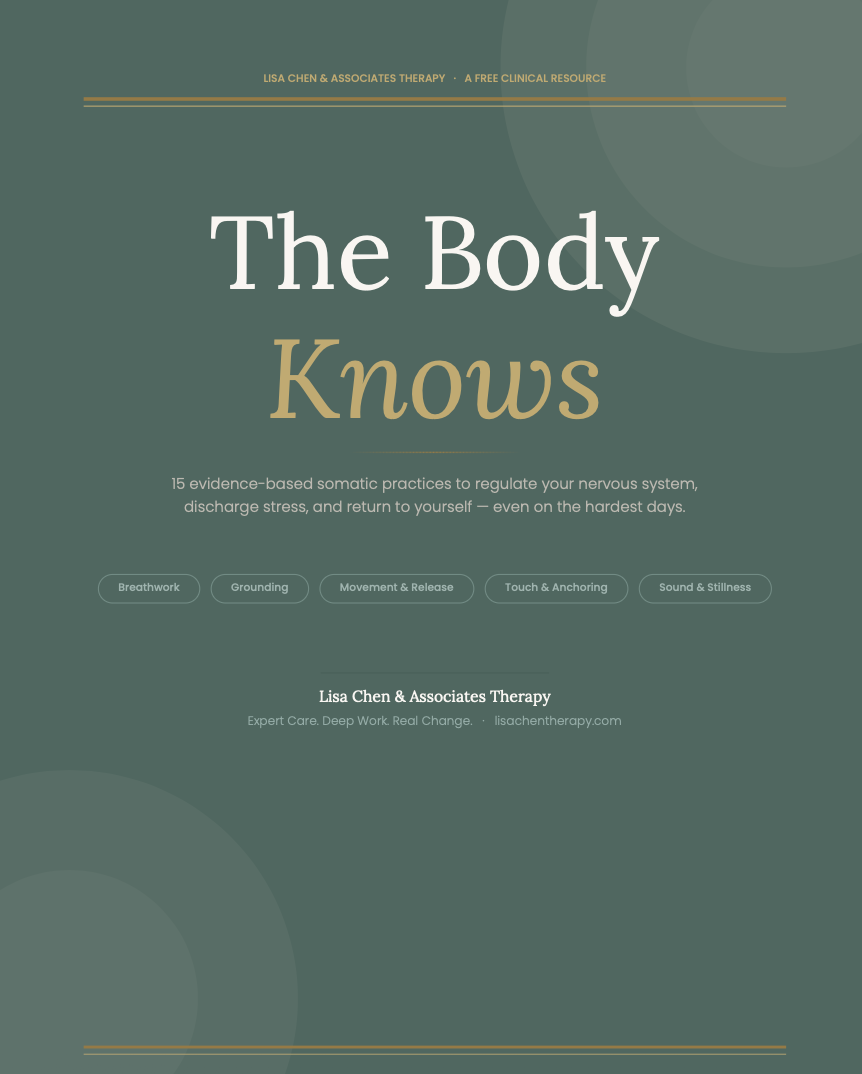
Somatic Exercises for Anxiety & Nervous System Regulation: A Free Guide for High Achievers
By Lisa Chen, LMFT | Lisa Chen & Associates Therapy | Hermosa Beach, CA
Somatic exercises are body-based practices that work directly with the nervous system to reduce anxiety, discharge stress, and restore a felt sense of safety — without requiring you to talk through every feeling first. Unlike cognitive techniques that work top-down, somatic practices work bottom-up, addressing the physiological roots of stress responses that thinking alone can't reach.
This free clinical guide from Lisa Chen, LMFT, brings together 15 evidence-based somatic exercises drawn from polyvagal theory, Somatic Experiencing, and EMDR research — the same modalities used in therapy at Lisa Chen & Associates. Each practice is organized by emotional state, so you are never searching for the right tool in a hard moment.
Whether you are managing chronic stress, recovering from an anxiety spiral, working through emotional numbness, or simply trying to come down after a demanding day, this guide meets you where you are. Techniques include breathwork that activates the parasympathetic system in under two minutes, grounding practices to interrupt dissociation and racing thoughts, movement exercises that complete the biological stress cycle your body never got to finish, and touch-based anchoring tools rooted in bilateral stimulation.
Developed for high achievers who have spent years overriding their body's signals, this guide is designed to be used between therapy sessions, before a difficult conversation, or any time your nervous system needs a reset. Download it free and keep it close.
This guide is a clinical educational resource and is not a substitute for professional mental health treatment.
Lisa Chen, LMFT California License #140374

Lisa Chen is a Licensed Marriage and Family Therapist and founder of Lisa Chen & Associates Therapy in Hermosa Beach, California. She specializes in high-achieving professionals navigating burnout, anxiety, trauma, and relationship strain, and holds advanced training in EMDR, Internal Family Systems, and Gottman Method Couples Therapy. Her clinical approach is informed by a prior career in investment banking and business development, including education at The Wharton School and Harvard Business School. She provides individual and couples therapy in person in the South Bay and via telehealth throughout California.
Five Sections. Fifteen Practices.
Organized by what you are feeling,
not what you think you should do.
Each section targets a different entry point into the nervous system. You do not need to work through it in order. Find where you are and start there.
Breathwork
Your fastest on-ramp to calm. Breath is the only autonomic function you can consciously control — which makes it your most accessible tool for shifting your nervous system state in real time.
Grounding
When your mind has left the building, these practices bring you back to your body and the present moment — interrupting a spiral before it takes hold.
Movement & Stress Discharge
The stress cycle has a beginning, a middle, and an end. These practices complete what your biology started — discharging stored fight-or-flight energy from the body.
Touch & Somatic Anchoring
Intentional touch is one of the most direct pathways to felt safety — using pressure, bilateral stimulation, and proprioceptive input to return you to embodied presence.
Sound, Stillness & Co-Regulation
Sound vibration, intentional stillness, and connection with a trusted other are among the deepest regulators available to the human nervous system.
Who This Guide Is For
This guide was developed for people who are high-functioning on the outside and quietly overwhelmed on the inside. It is particularly useful if you are:
This guide is not a substitute for professional care. If you are ready to go deeper, we are here.
Frequently Asked Questions
-
Somatic exercises are body-based practices that regulate the nervous system through breath, movement, touch, and sensation. Rooted in Somatic Experiencing and polyvagal theory, they address the physiological dimension of stress and trauma that cognitive approaches alone do not reach. They are used clinically and as self-regulation tools between therapy sessions.
-
Anxiety activates the sympathetic nervous system — the fight-or-flight response. Somatic exercises interrupt this cycle by engaging the body's parasympathetic system through specific breath patterns, grounding techniques, and movement. Practices like the extended exhale breath and 5-4-3-2-1 grounding can reduce acute anxiety symptoms within two to three minutes.
-
Polyvagal theory, developed by Dr. Stephen Porges, explains how the vagus nerve regulates our nervous system states — from safety and connection to fight-or-flight to shutdown. Understanding these states helps explain why somatic practices like humming, co-regulation, and rhythmic movement are effective: they directly stimulate vagal tone and shift the nervous system out of threat responses.
-
No. Somatic exercises are self-regulation tools — valuable between sessions and during everyday stress, but not a replacement for clinical work. At Lisa Chen & Associates Therapy, somatic approaches are integrated into EMDR, IFS, and Psychodynamic treatment to support deeper processing. This guide is a clinical resource, not a substitute for professional care.
-
This guide was developed for high achievers — people who are high-functioning but quietly dysregulated, who override stress signals until the body forces a stop. It is used by clients of Lisa Chen & Associates Therapy throughout Los Angeles, the South Bay, and across California via telehealth.
Continue the Work
The practices in this guide are most effective when supported by skilled clinical care.
At Lisa Chen & Associates, we offer evidence-based approaches for individuals and couples throughout Los Angeles and California.
This guide is a clinical educational resource produced by Lisa Chen & Associates Therapy and is not a substitute for professional mental health treatment. If you are in crisis, please contact the 988 Suicide & Crisis Lifeline by calling or texting 988.
Published March 2026 · Last reviewed March 2026
© 2025 Lisa Chen & Associates Therapy, Hermosa Beach, CA · For personal use only · Not for redistribution · California LMFT License #140374