Micro-Boundaries: What to Do When You Can't Just Set Boundaries
By Lisa Chen, LMFT | Therapist to high performers, former finance professional

The short answer: "Set firm boundaries" fails for most high performers because a boundary you can't hold against your real workplace isn't a boundary. It's one more thing to feel you've failed at. What holds instead are micro-boundaries: moves small enough to survive a bad week, defensible enough to survive a demanding boss, and structural enough that they don't depend on willpower, which is the first thing a hard day spends.
The first time one of my clients tried to defend her evening, she lasted until her phone lit up at nine, and she answered inside ninety seconds, the way she always had, because the alternative felt like a risk she couldn't name out loud.
That's the honest starting point for any real conversation about boundaries. The advice you've read assumes you work in a vacuum where declaring a rule makes it so. You don't. You work inside a current, with a culture and a phone and a set of expectations that helped drain the account in the first place. The moves are still yours to make. But the room you have to run them in is not friendly to them, and pretending otherwise is why the standard advice keeps failing you.
Why don't normal boundaries work?
Two reasons, and neither is a flaw in you.
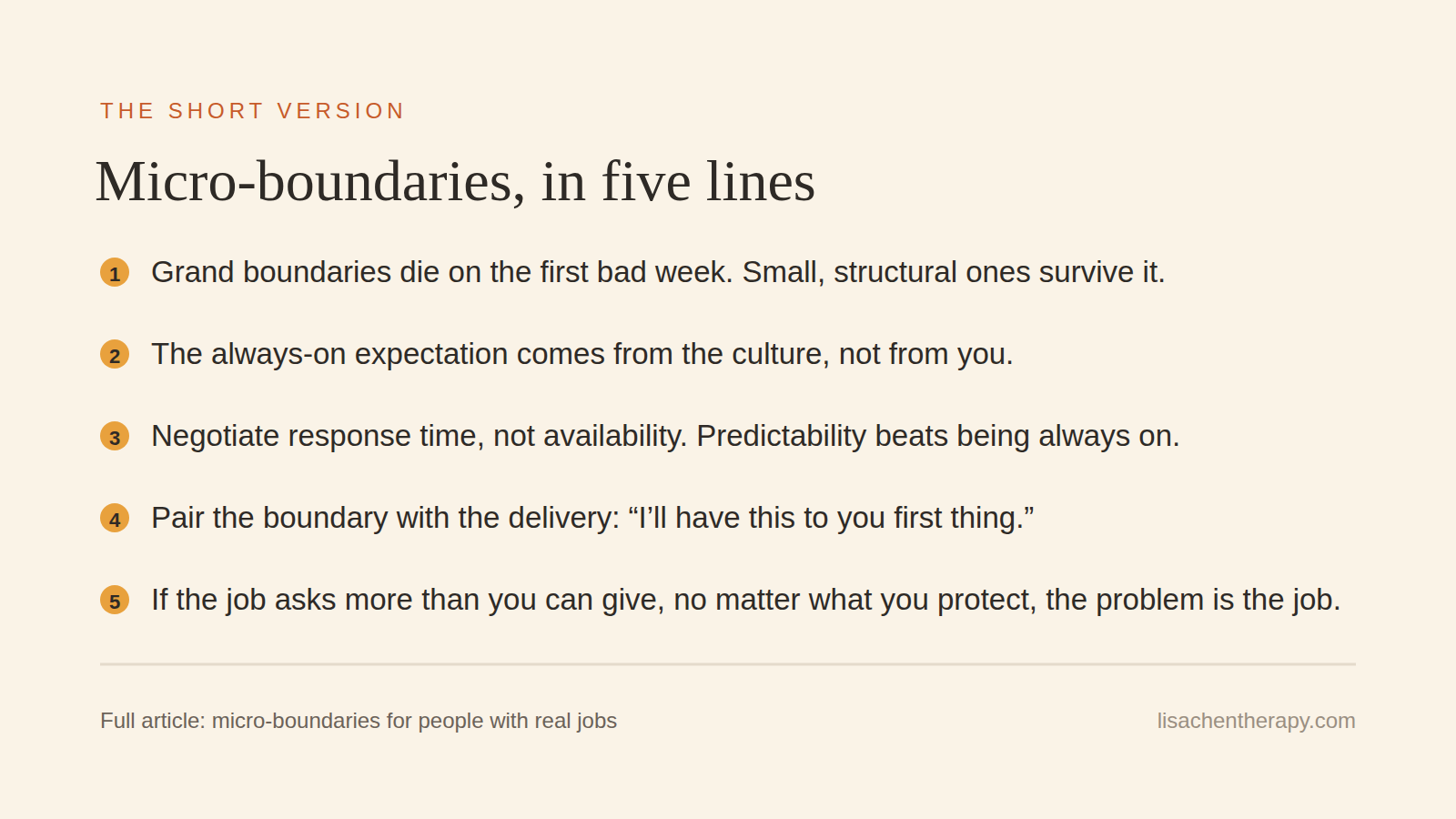
First, the grand boundary dies on the first bad week. The two-week unplug, the vow to never check email after six, the new regime announced on a good Sunday: all of it gets flattened the first time the job turns up the heat. Then you have fresh proof you can't do this, which is worse than never having tried.
Second, the current is real. Somewhere in the last decade, responsiveness quietly became a proxy for commitment. The person who replies at eleven looks devoted and the one who replies at eight looks checked out, regardless of whose work is better. This expectation operates as a property of the culture, not a flaw in you, and the World Health Organization's definition of burnout says as much: it's workplace stress that hasn't been successfully managed, a phenomenon of the environment as much as the person. If you've been filing your depletion under personal weakness, some of that weight was never yours to carry.
You can't fix the ocean. But you can do a great deal about your own stretch of it.
What is a micro-boundary?
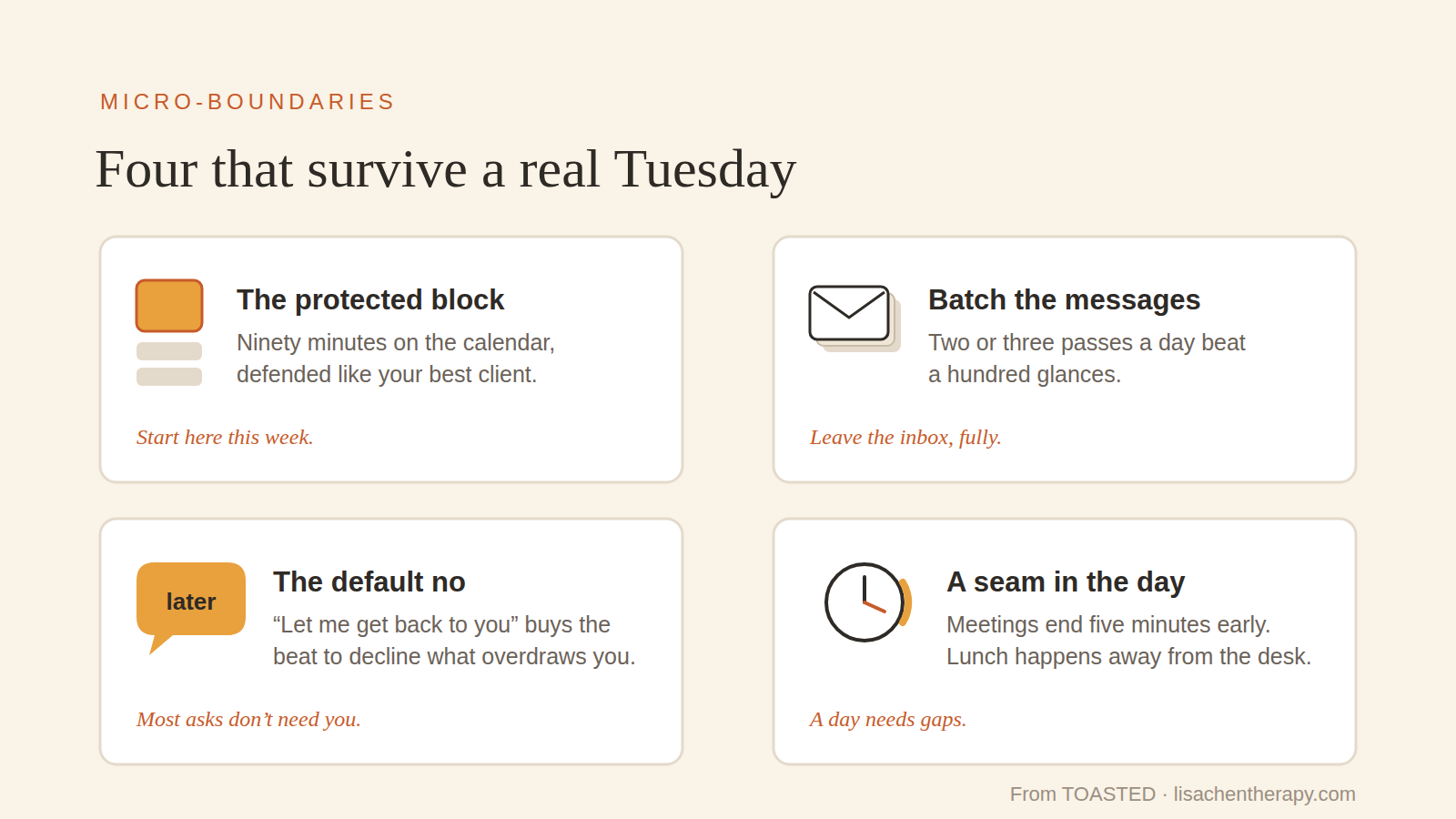
A move modest enough to survive contact with your actual week, and real enough that, repeated, it starts to shift the balance of deposits and withdrawals. Not a fortress. A foothold. A few that survive a real Tuesday:
A protected block, treated like a real meeting. Ninety minutes on the calendar, defended the way you'd defend time with your most important client, because it is. A block that lives only in your intentions gets eaten. A block on the calendar gets respected, mostly, including by you.
Batching instead of living in the inbox. The cost of an always-open inbox isn't reply time. It's that you never fully leave it, so you're half-present everywhere. Two or three deliberate passes a day return more focus than a hundred glances.
A default no to the low-value ask. "Let me get back to you" buys the beat you need to decline the things that would overdraw you. Most of them turn out not to need you at all.
A seam in the day. End your own meetings five minutes early. Take the real lunch, away from the desk. The point isn't the minutes. It's that a day with no gaps is a day spent entirely on the clock in your head.
None of these is heroic, and that's the point. The durable boundary is unremarkable, defensible, and small.
How do I set boundaries without looking less committed?
This is the fear underneath everything, so meet it directly: you believe protecting your recovery will make you look less committed, and that looking less committed will cost you. So you never raise it, and you absorb the cost yourself instead.
One reframe changes the conversation. You are not asking permission to care less. You are protecting the asset your work runs on. Pitched that way, it's not a wellness confession. It's a performance conversation, and you've been having those your whole career. Three things make it land:
Lead with the output, not the fatigue. Not "I'm exhausted and need to pull back," which invites worry about your reliability, but "I do my sharpest work when I protect a few things, and I want to keep delivering at that level."
Negotiate response time, not availability. The drain usually isn't the after-hours message itself. It's the expectation of an instant reply, and most of that expectation is assumed, not required. Naming it out loud resets a norm that was never agreed, only inherited.
Trade predictability for permission. A manager can plan around "I'm offline after seven and back at eight." What costs a team is unpredictability, not boundaries. Offer the predictable version and most reasonable bosses take it, because it makes you easier to rely on.
My client eventually said a version of this, in daylight rather than at the moment of the ask: I want to keep doing my best work for you, and the way I do that is to be properly off in the evenings and fully on during the day, so unless something is on fire, I'll pick things up first thing. She braced for it to land as a problem. It didn't. The concern on the other side had never been the hour she replied. It was whether things got handled, and a predictable person who handled things was easier to trust than a frantic one who answered instantly and came apart by spring. Most of the rules you're breaking yourself to obey were never enforced by anyone but you.
One more piece: make the recovery legible. In a culture that reads visible effort as virtue, invisible recovery can read as checking out. So pair the boundary with the delivery, out loud. "I'll have this to you first thing" does the same protective work as "I'm logging off," but one signals reliability and the other signals retreat. And if you lead people, your hours set the local weather: the late-night email you fire off expecting nothing is read by a tired report as the standard. Schedule it for morning. Say out loud that you don't expect replies after hours. The permission a team uses is the one they watch their leader take first. This is exactly how the corporate-athlete tradition frames recovery: a ritual built into the structure of the day, not a reward left to mood.
What if no boundary is enough?
Sometimes the honest answer is that the role itself is the problem: structurally built so the math never closes, where overdrawing the account weekly is a condition of the work. Learn to tell a hard season from an unsurvivable structure. A hard season has an end you can see and a recovery on the other side. An unsurvivable structure just has the next hard season, with the account never once allowed back to level.
If that's what you're in, there's a ladder, and you climb it in order: reshape the role (more scope-shedding is available than people assume, especially to someone delivering), change roles inside the same place, change your relationship to a season with a real end, and, at the far end, leave. Leaving is rarely the first move, and the urge to burn it all down is often depletion talking. But for some roles it's the only sane one, and knowing that isn't weakness. It's an honest read of the account, pointed at the thing doing the draining. Sorting out which rung you're on is work I do with clients often; if you want help running that sort honestly, here's how we work.

Frequently asked questions
What if my boss ignores my boundaries? Then manage your own response latency without announcing a policy. Let the routine message wait until morning a few times and watch, as most people do, the sky hold. The expectation lives partly in you, and that part you control completely.
Are micro-boundaries enough to fix burnout? They stop the bleeding; they don't refill the account. Micro-boundaries reduce withdrawals, but recovery also needs real deposits, and often a look at the part of you that resists making them. They're the first structural move, not the whole cure.
How do I protect boundaries when I'm the boss? Your version of the conversation is with your board, your investors, or the internalized standard that runs louder than either. Same move: name the expectation and negotiate it rather than absorbing it in silence. And remember your team is watching what you do, not what you say.
Isn't this just doing less work? No. It's funding the work you do. The protected block and the batched inbox usually raise output, because focus is worth more than coverage. You're not shrinking your commitment. You're ending the invisible tax on it.
What's the single best micro-boundary to start with? The protected block. It's the easiest to defend out loud (it looks like work, because it is), it produces visible output you can point to, and winning one small defensible fight teaches your own nervous system that the sky holds. Start there this week.
Lisa Chen, LMFT, is a licensed therapist who works with executives, founders, and other high performers. Before training as a therapist, she spent years in finance, including her own burnout and the long road back. This piece draws on the framework from her forthcoming book, Toasted: How to Tell How Burned Out You Really Are, and How to Come Back.