By Lisa Chen, LMFT. Former Wall Street trader, now a psychotherapist to high performers.
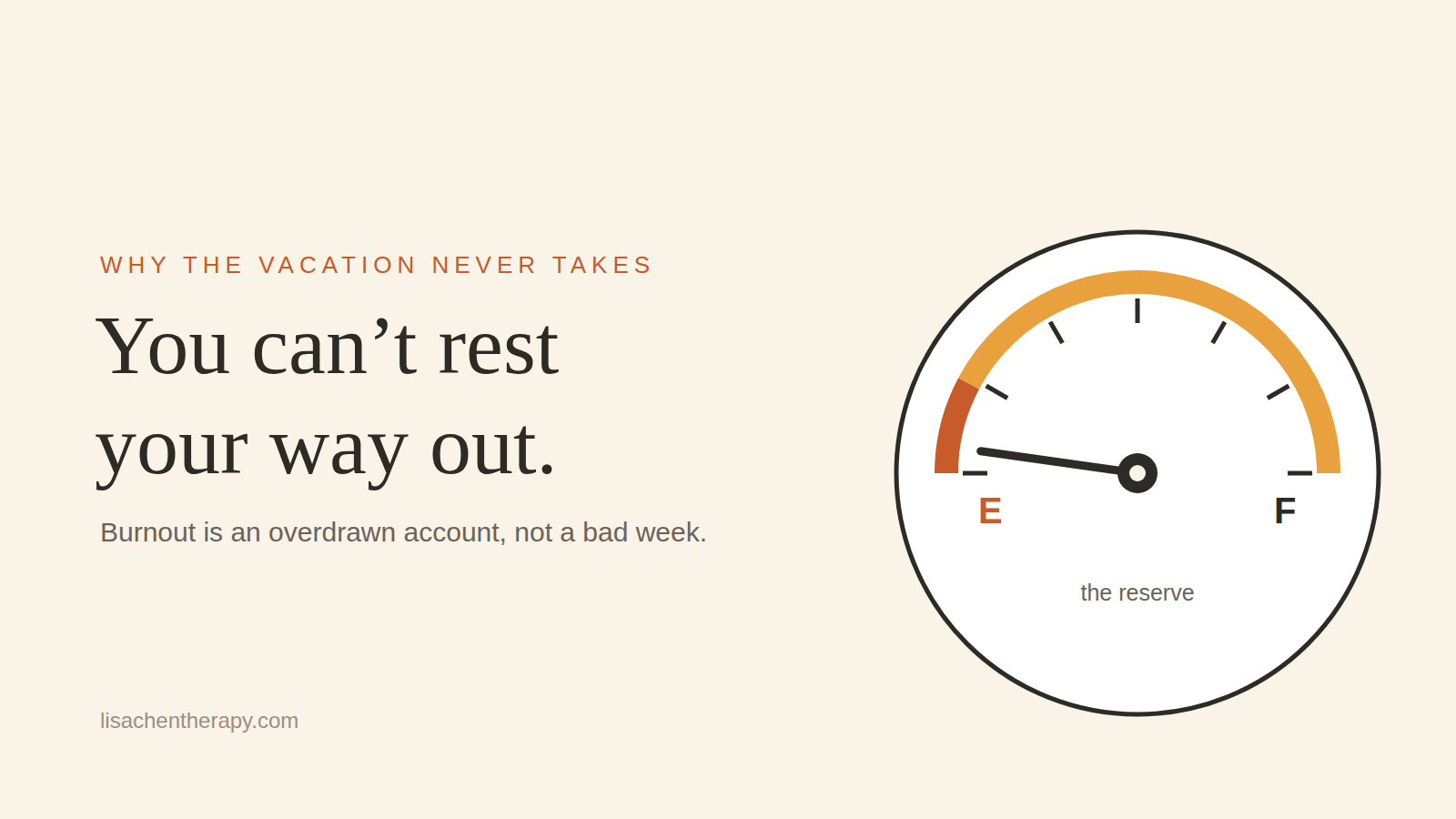
The short answer: Rest doesn't fix burnout because burnout isn't tiredness. It's a depleted reserve. A vacation is a single deposit against years of withdrawals, and it does nothing about the spending, so the account is empty again by Monday. Recovery starts when deposits begin to outpace withdrawals, which means changing what drains you, not just pausing it.
You've already run the experiment.
You took the vacation. A real one, maybe: phone mostly away, out-of-office actually on. You came home to a full inbox and the same body, and inside a week it was as though you'd never left. So you concluded what a results-oriented person concludes: rest doesn't work, or you did it wrong, or you need a longer one. Then you went back to pushing, because pushing at least produces something.
Here's what I'd offer instead, after years of sitting with people who've run that experiment more times than they'd like to admit: the experiment worked. It just proved something different than you think. It proved that what you have isn't tiredness. If the only problem were that you were tired, the long weekend would have fixed it. What you have is an overdrawn account, and you can't rest your way out of an overdraft.
What is the reserve?
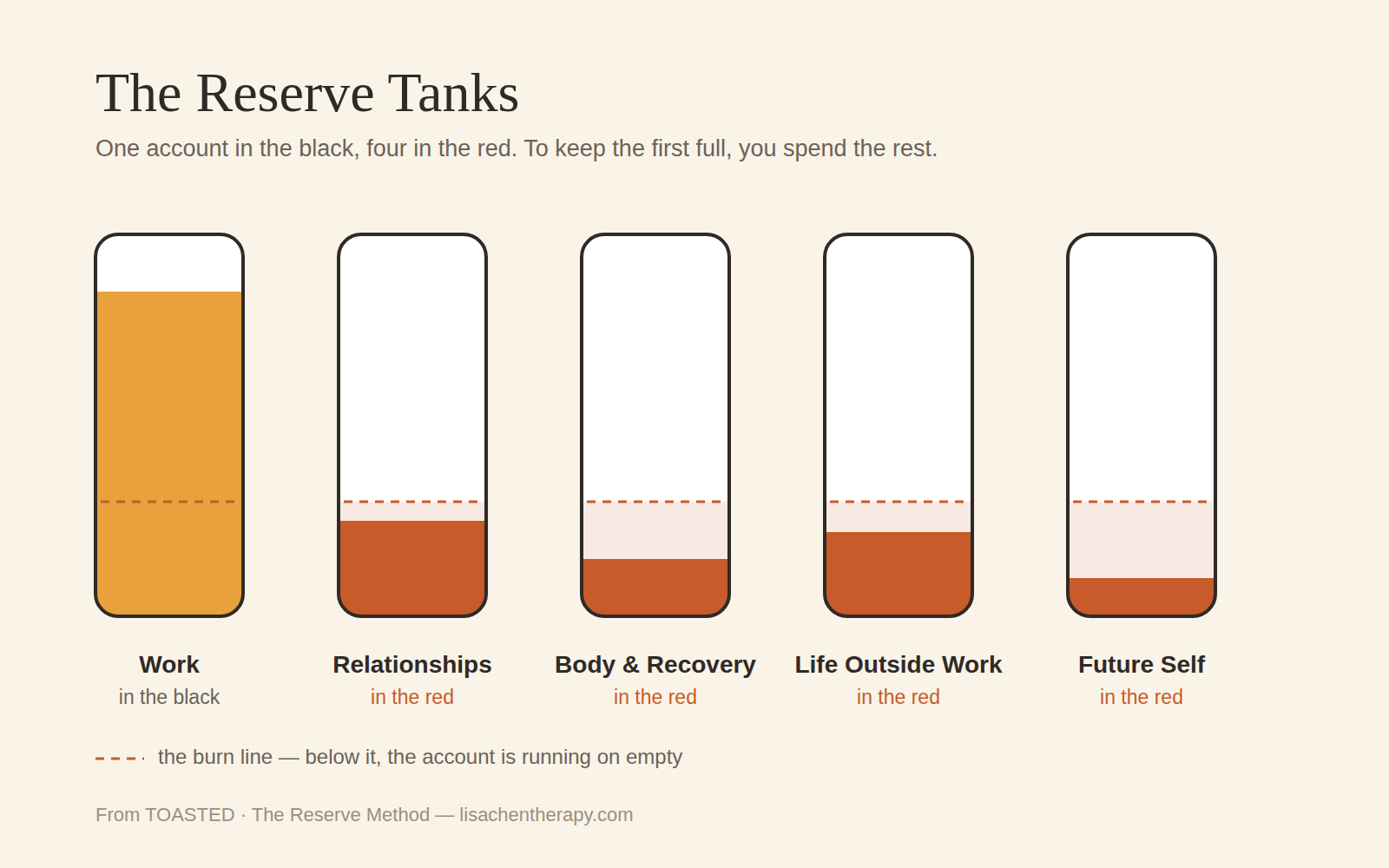
Think of your capacity as a reserve. Not a metaphor to admire. A real account: the running balance of everything you spend to do your work. Attention and patience. The judgment to make a good call at four in the afternoon, and the steadiness to come home and still have something left for the people there. You draw on that account every day, and on a good day you put something back. Sleep is a deposit. So is a real break, a hard workout, an hour when no one needs anything from you.
This isn't a figure of speech I invented. It sits on two of the best-supported ideas in stress research.
The first: people run on resources (energy, attention, emotional steadiness), and strain is what happens when you lose those resources faster than you can replace them. The psychologist Stevan Hobfoll, who built this theory, noticed something you'll recognize: when people start running low, they spend even more to protect what they have left, which drains them further, which makes them spend more again. He called these loss spirals. You would call it a normal Tuesday.
The second: your body is built to rise to a demand, meet it, and come back down. The cost shows up when the coming-down stops happening: when you stay geared up for years because there's always another demand and the body never gets the all-clear. Researchers call the accumulated wear from that allostatic load, and unlike a bad mood, it's physical and it's measurable.
Put the two together and you have the reserve in plain terms: resources you spend faster than you replace, and a body paying the maintenance cost of never standing down. Not weakness. Not a motivation problem. An account in real, physical drawdown.
Why doesn't a vacation fix it?
Now the vacation math makes sense. A long weekend is a single deposit against years of withdrawals and accumulated wear. It's real, and it's not nothing, and it's nowhere near enough. Worse, it does nothing about the spending. The account doesn't refill because you looked away from it for two days. You walk back into the same loss spiral on Monday morning, and the spiral doesn't care that you went to Cabo.
That's the flaw in nearly all standard burnout advice. "Rest more" treats the deposit side and ignores the withdrawal side. But burnout is a flow problem, not a balance problem: it's chronic (the World Health Organization defines it as the result of chronic workplace stress that hasn't been managed), and you can't fix a chronic outflow with an occasional inflow.
But hasn't taking on more always made me stronger?
This is the objection I hear most from high performers, and it deserves a real answer, because it's half right.
Capacity does grow under load. That's how the body works, the same way it works for any athlete: you stress the system, it adapts, and it comes back able to carry more. Your reserve can get bigger. You're not imagining the growth.
But the growth never comes from the load. It comes from the load followed by recovery, and the recovery is the part you've been skipping. The athlete who only trains and never rests doesn't get stronger; they break down, on a schedule, every time, because the adaptation happens during the recovery and not during the work. This is exactly how elite performers think about it. Jim Loehr and Tony Schwartz made this case to executives two decades ago in The Making of a Corporate Athlete: recovery isn't the reward for performance, it's what makes performance possible.
Skip the recovery and there is no adaptation. There's only the work, and the slow erosion you've been mistaking for it. A great deal of what felt like your reserve expanding was your reserve emptying while you narrated it as getting stronger.
Why can't I feel how empty I am?
Because performance is the last thing to go. You're good at what you do, and you compensate, so the work keeps getting done long after the reserve has thinned, which means the one signal you trust most, your own output, is the very last one to fail.
Your reserve actually warns you through three channels, and they fail in a fixed order: the body first, then the emotions, and the mind, your thinking and your output, last. That would be useful to know, except for one thing: you've spent your entire career learning to override the first two. Composure reads as competence, so you learned to treat emotions as noise to be managed. And in every competitive arena you've respected, the whole skill is pushing past what the body says. We call it mental toughness, and we're not wrong to admire it. But the two channels carrying the earliest, most honest reading of your reserve are the exact two you've trained yourself to silence. (I wrote about those early signs here.)
What actually refills the reserve?
The account refills when deposits start to outpace withdrawals. That's the whole formula, and both halves matter:
The deposit side is real recovery, not collapse: sleep that counts, breaks that actually close the file rather than just closing the laptop, movement, an hour that belongs to no one. Small, repeatable, protected. A practice, not a reward.
The withdrawal side is the harder and more important half: finding the leaks. The reflex yes. The account you keep polished because it's the one that keeps score. The pull to keep working that has stopped being about the work in front of you, because for most high achievers, the overspending has a driver, and until you meet it, every deposit you make gets spent by the same old reflex. (That driver has a name in my work, and it gets its own post.)
Here's the reframe I most want you to carry out of this piece. You manage risk and resources for a living. You would never run a company, a practice, or a portfolio the way you've been running yourself, drawing down a core asset with no reinvestment and calling the depletion commitment. If a colleague managed a balance sheet this way, you'd have a quiet word with them. Reading your own reserve isn't soft. It's the most basic competence there is, finally applied to the asset everything else depends on.
Frequently asked questions
How long does it take to recover from burnout? It depends almost entirely on how far down the account is. Someone catching it early may feel different in weeks, while someone deep in the red is looking at a longer climb. What doesn't vary: recovery time is set by the distance, not by willpower, and guessing your own position is unreliable because depletion dims the gauge you'd guess with.
Can you recover from burnout without quitting your job? Usually, yes. Recovery requires changing the flow (more real deposits, fewer invisible withdrawals), and most of that can be built inside a demanding job through small, defensible moves rather than dramatic exits. Some roles are unsustainable, but that conclusion should come after the reserve work, not instead of it.
Does sleep alone fix burnout? No, but it's the first deposit to restore, because nothing else works while sleep is broken. Sleep repairs the tiredness layer. It doesn't touch the loss spiral that's driving the spending, which is why people can fix their sleep and still feel flat.
Is burnout physically measurable? Increasingly, yes. The wear of staying geared up without recovery, allostatic load, shows up in measurable ways in the body, including in systems you rely on for judgment. Encouragingly, some of those changes appear at least partly reversible with sustained recovery.
Why do I feel worse when I finally stop? Two reasons. The body often waits for the all-clear to break down: the classic first-day-of-vacation illness. And when you're used to running geared-up, an unspent hour can feel like exposure rather than rest. Feeling worse when you stop isn't evidence that stopping is wrong; it's usually evidence of how long you've been geared up.
I worked in finance before I trained as a therapist, and I went through burnout myself. This piece draws on the framework from my forthcoming book, Toasted: How to Tell How Burned Out You Really Are, and How to Come Back.