Your Smartwatch Knows You're Burned Out Before You Do
By Lisa Chen, LMFT — therapist to high performers, former finance professional
The short answer: If your Oura ring says "strained" and you feel fine, believe the ring — but not for the reason you think. The device isn't reading something too subtle for you to feel. It's reading signals your body has been sending all along, which you've spent a career training yourself to override. The fix isn't a better wearable. It's getting back the ability to feel your own gauges — because when researchers test devices against honest self-report, the honest self-report wins.
More than a few of the high performers who come to see me arrive wearing an Oura ring or a Garmin that pings them when their stress is high. They are often surprised when I take the device seriously — and then more surprised at why.
The device isn't the problem. Some of these people have drifted so far from their own bodies that they need a screen to report what a person is built to simply feel. That's not a criticism; it's one of the quietest signs of how far the depletion goes. The body and the feelings are the first place your reserve sends its warnings — and these are people who've trained themselves, expertly, to stop receiving them, until the only signal they'll trust arrives on a screen.
Why does my watch say I'm stressed when I feel fine?
Because "feeling fine" is a skill you've overdeveloped, and the watch never learned it.
Here's the thing about high achievers: your whole competitive life rewarded overriding the body. In every arena you've respected — sport most of all — the skill is pushing past what the body is telling you. The marathoner doesn't honor the screaming legs at mile twenty; she overrides them, and we call that mental toughness, and we're not wrong to admire it. Emotions got the same training: composure reads as competence, so you learned to treat feelings as noise to be managed rather than data to be read.
But your reserve sends its statements through three channels, and they fail in a fixed order: the body first, then the emotions, then the mind — your thinking and output — last. The two channels carrying the earliest, most honest warnings are the exact two you've silenced. So when the watch flags strain you can't feel, it isn't measuring something superhuman. It's measuring the mail you've been marking as read. (The full list of signals high achievers explain away is here.)
Can a wearable actually detect burnout?
No — and this is the part almost nobody says plainly.
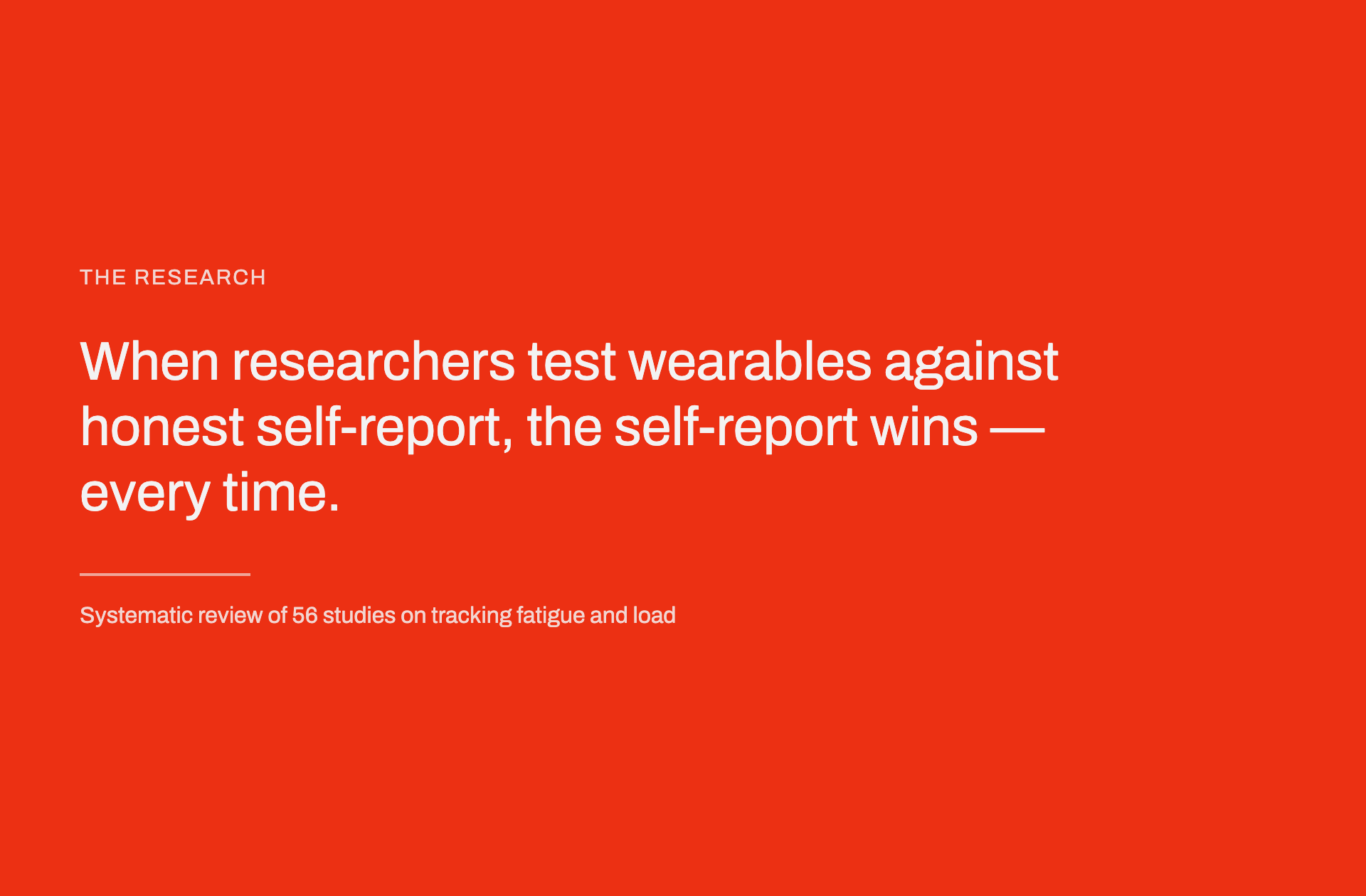
The good devices are quite accurate now at what they measure: your heart rate, its variability, the hours you slept. The trouble is that none of those numbers is your fatigue. They're raw inputs. When sport scientists put the gadgets head to head with plain honest self-report — just asking people how they actually feel — the self-report won. Across a systematic review of fifty-six studies, the subjective read tracked real changes in load and fatigue more sensitively and more consistently than resting heart rate, blood markers, the whole objective panel. The two often didn't even agree.
The reading you actually need — how far into the red you've run — is a judgment the person living in the body makes better than an algorithm working off its surface. There's a catch, and it's the one that matters for people like you: the instrument only works if you answer honestly. People get caught gaming their own check-ins, telling the form what keeps them in the game rather than what's true — which is the exact move you've spent a career perfecting. The instrument in your hands is more accurate than anything on your wrist. It just stops working the moment you perform the answer. (That honest self-read is how you locate yourself on the Burn Line.)
When the tracker makes it worse: orthosomnia
There's a place where this tips from ironic into harmful, and sleep researchers have named it: orthosomnia — chasing a good sleep score so hard that the chasing itself wrecks the sleep.
It's the whole pattern in miniature. The number becomes the thing. The body becomes a readout to be optimized. And the person ends up more wired and less rested in exact proportion to how closely they watch it. I've sat with people who lie awake doing the math on what this stretch of wakefulness will do to their readiness score — which is a perfect, closed loop: anxiety about the recovery metric preventing the recovery.
If your relationship with the score has started to feel like another performance review, that's information. Not about your sleep — about how you're relating to your own body: as an asset to be managed rather than a self to be inhabited. (I've written before about how the overachiever's drive turns everything — even rest — into a metric.)
So should I ditch the wearable?
No. Repurpose it.
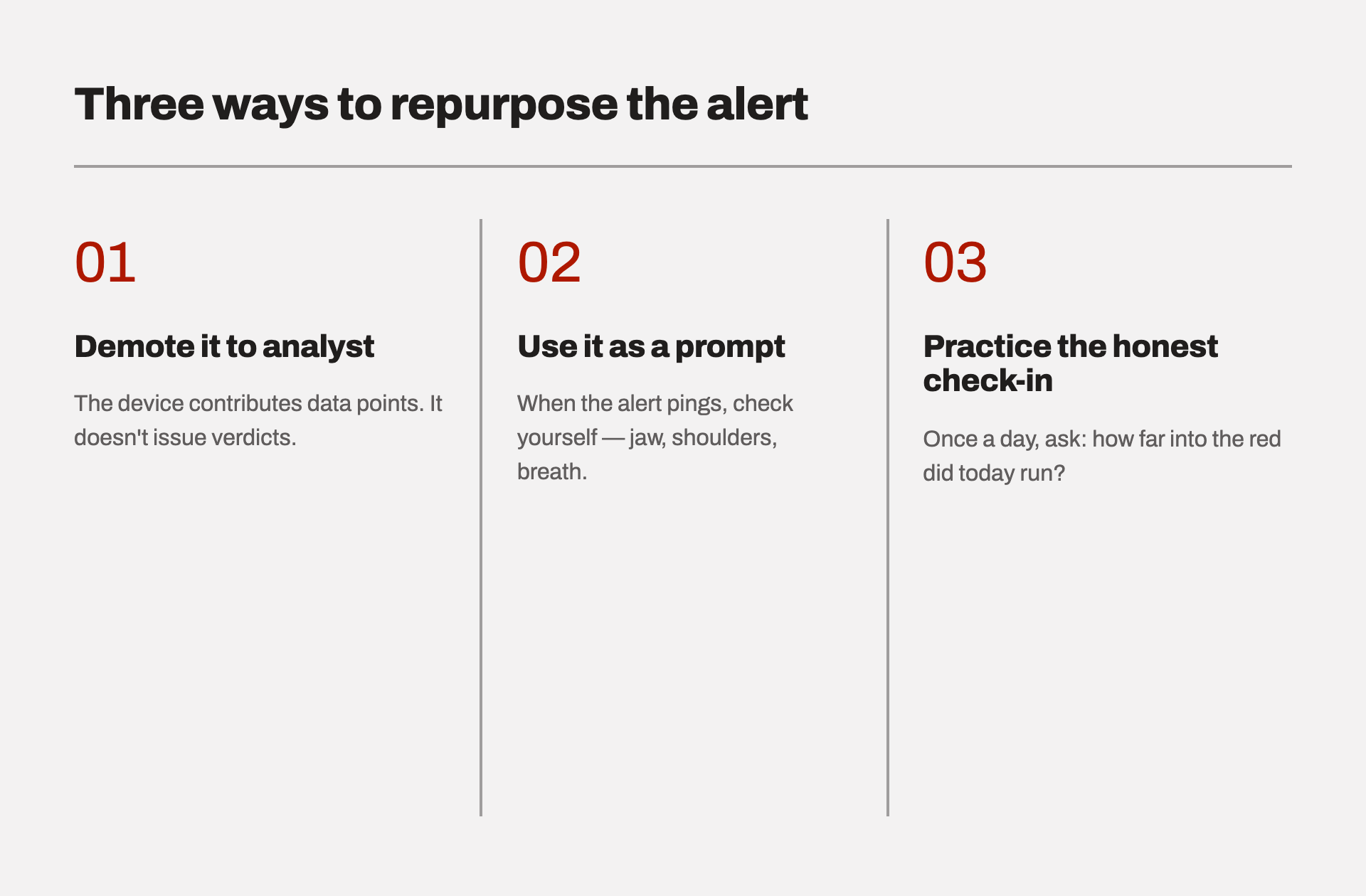
Demote it from judge to junior analyst. The device contributes data points; it doesn't issue verdicts. If the ring says strained and you feel fine, the interesting question isn't "which is right?" — it's "why can't I feel what it's seeing?"
Use it as a prompt, not a verdict. When the stress alert pings, don't check the graph — check yourself. Jaw. Shoulders. Breath. The alert's real value is as a bell that reminds you to read the channels you've been skipping.
Practice the honest check-in it can't do for you. Once a day, ask the question no algorithm can answer: how far into the red did today run? Answer as the person living your life, not the version you bring to meetings. That single honest read, practiced, is worth more than any dashboard — and it's the skill the device was quietly letting you outsource.
And if the answer keeps coming back "further than I thought" — that's worth taking seriously while the account still has road left. Rebuilding the connection between you and your own gauges is much of what working with a therapist on chronic stress actually is.
Frequently asked questions
Can my Apple Watch or Oura ring diagnose burnout? No. Burnout isn't a diagnosis a device can make — it's an occupational syndrome defined by exhaustion, detachment, and eroded effectiveness, and no heart-rate metric maps onto those. What a wearable can do is surface physiological strain you've stopped feeling, which makes it a useful prompt and a poor judge.
Is low HRV a sign of burnout? Chronically suppressed heart-rate variability is consistent with a system that's staying geared up without recovering — one ingredient of the burnout picture. But HRV varies with illness, alcohol, training, and genetics, so treat a trend as a question worth asking, never as a verdict.
Why do I sleep badly when I track my sleep closely? Possibly orthosomnia: performance anxiety about the sleep score itself disrupting the sleep. If checking the score is the first thing you do on waking and a bad number changes your mood for the day, a two-week tracking holiday is a worthwhile experiment.
What's more accurate than a wearable for spotting burnout? An honest self-report — the research consistently favors it over objective markers for tracking real fatigue. The hard part isn't the instrument; it's the honesty. High performers tend to perform the answer, and a performed answer reads "fine" all the way to the wall.
My watch flagged strain for weeks and I feel nothing — who's right? Probably both, and that's the concerning version: the strain is real and you can't feel it, which suggests the body-to-awareness channel is down. That disconnection — not the score — is the thing worth bringing to a professional.
Lisa Chen, LMFT, is a licensed therapist who works with executives, founders, and other high performers. Before training as a therapist, she spent years in finance — including her own burnout and the long road back. This piece draws on the framework from her forthcoming book, Toasted: How to Tell How Burned Out You Really Are, and How to Come Back.