Burnout at Home: Why the People You Love Notice First
By Lisa Chen, LMFT | Therapist to high performers, former finance professional
The short answer: The people you love usually see your burnout before you do. When you're running on too little for too long, the job tends to get your best hours and your best self, and the people at home get what's left: less patience, less attention, less of you. They noticed early. At some point they stopped saying so. The damage is real, and it can be repaired, but repair takes time and it happens on their timeline, not yours.
Sometimes the first honest read on how you're actually doing doesn't come from you at all.
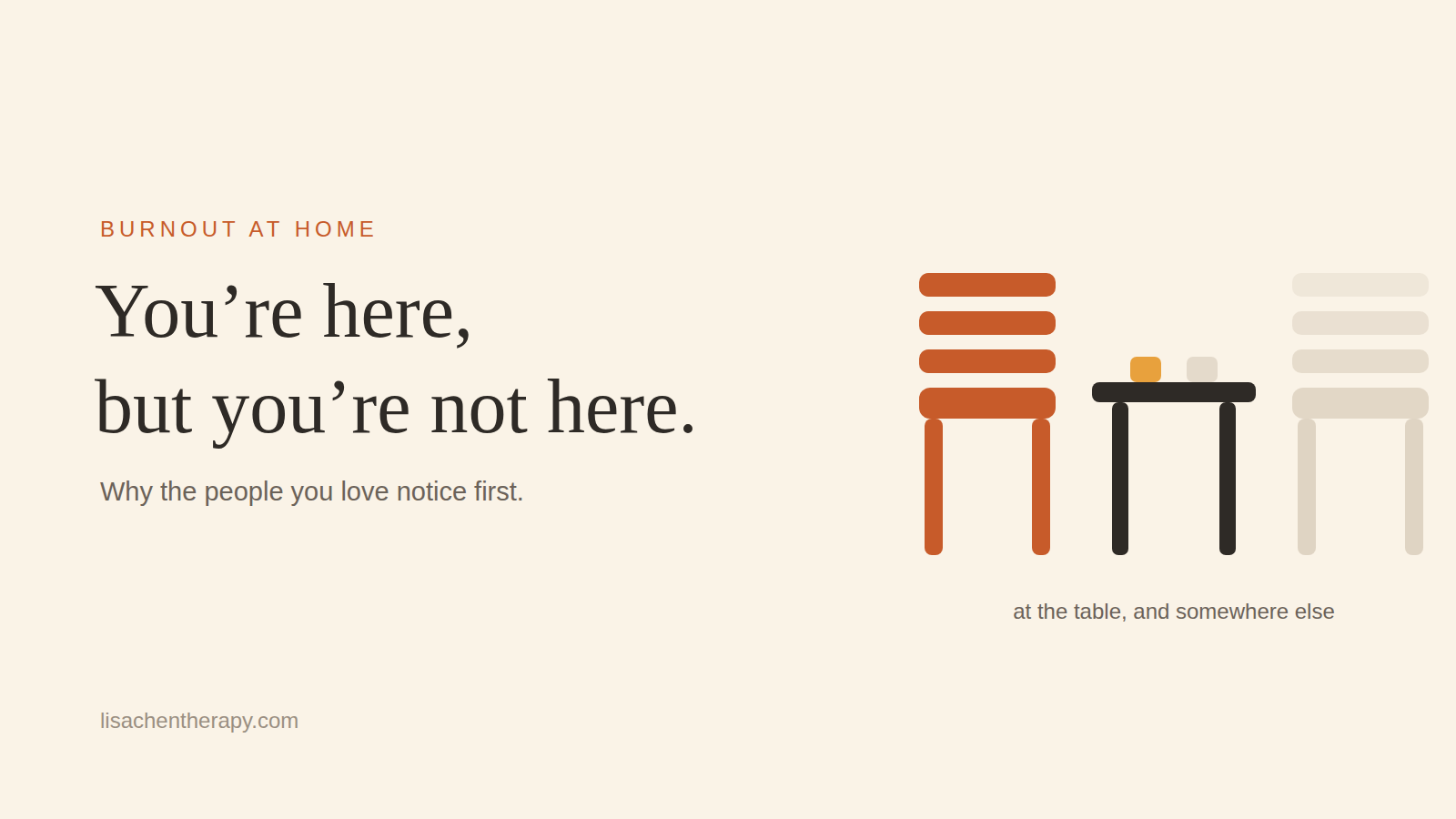
It comes from the partner who has stopped asking how your day was. Or the kid who no longer looks up when you walk in, because looking up stopped paying off a while ago. In my office, more than one high performer has arrived not because of anything at work, but because someone at home said a sentence they couldn't file away. For one client I write about as Dana, it was her husband, not in a fight but in the even voice of someone who had stopped expecting the conversation to go anywhere: you're here, but you're not here. It wasn't an accusation. It was a report.
Why do the people at home see it first?
Because home is where the shortage shows up.
You only have so much energy, patience, and attention in a day. When work is demanding and you're stretched thin, work tends to get the best of what you have. Not because you love your job more than your family, but because work asks loudly and rewards you visibly. There's a deadline, a boss, a client, a paycheck, a review. Home doesn't work that way. Nobody at home hands you a scorecard or a Friday summary. So home is where you cut corners without ever deciding to, and by the time you walk in the door, the patience is simply gone.
I think of a client I write about as Reid: excellent at his job, loves it, coaches his kids' team, and could tell you his exact standing on his company's leaderboard at any moment. At work he was golden. The shortness and the distraction showed up at home, at the end of the day, with the kid who needed the most patience exactly when he had the least of it left. If you added up his whole life, not just the job, Reid was in real trouble. But the one part everyone could see, the work, still looked great, which is why no one, himself least of all, had called it what it was. (I've written more about how that scoreboard wiring works.)
Why couldn't I hear them when they told me?
There's a specific reason, and it deserves compassion rather than shame.
Your mind is the instrument that has won you everything you have. So when someone who loves you suggests your own read on yourself is wrong, they're not just offering a worried opinion. They're asking you to trust their judgment over the one faculty your whole life is built on. That's a lot to give up on another person's say-so. So you discount them, gently, and keep trusting your own read, at the exact moment your own read is the thing that's off. This isn't stubbornness. Research on burnout shows that the cynicism and detachment it brings creep in slowly and outside your own awareness, which is why the people across the table register the change years before you do.
And here's the part worth sitting with: their noticing was never criticism. It was the most accurate reading in the house.
What has it been costing them?
Say it plainly, because the plainness is part of the repair. While the job got your best, the people you love got what was left. The partner who learned, over years, not to need you in the evenings, because needing you and not getting you hurt worse than not needing you. The kid who learned to read which version of you had come through the door before deciding whether to ask for anything. The friends who stopped calling, not because they stopped caring, but because you cancelled enough times that they filed you under unavailable.
None of that happened because you stopped loving them. It happened because there was nothing left after the work took its share, and love with nothing behind it cannot show up, however real it is. You did not choose, on any given Tuesday, to hand your family the worst of you. The exhaustion chose it. But they paid for it anyway, and getting your energy back does not, on its own, pay them back. That part you do on purpose, or it does not get done.
How do I repair it?
First, understand why it doesn't fix itself. The people you disappointed have their own hurt, and their own protective habits built around it. They've adapted to the version of you that comes home empty. They've learned to expect less, and those defenses don't come down the moment you show up with more to give. They've seen the good week before, the one that turned out to be a break in the weather rather than a change in the climate. Their wariness isn't punishment. It's self-protection, and it's reasonable. Arguing with it is itself the old pattern.
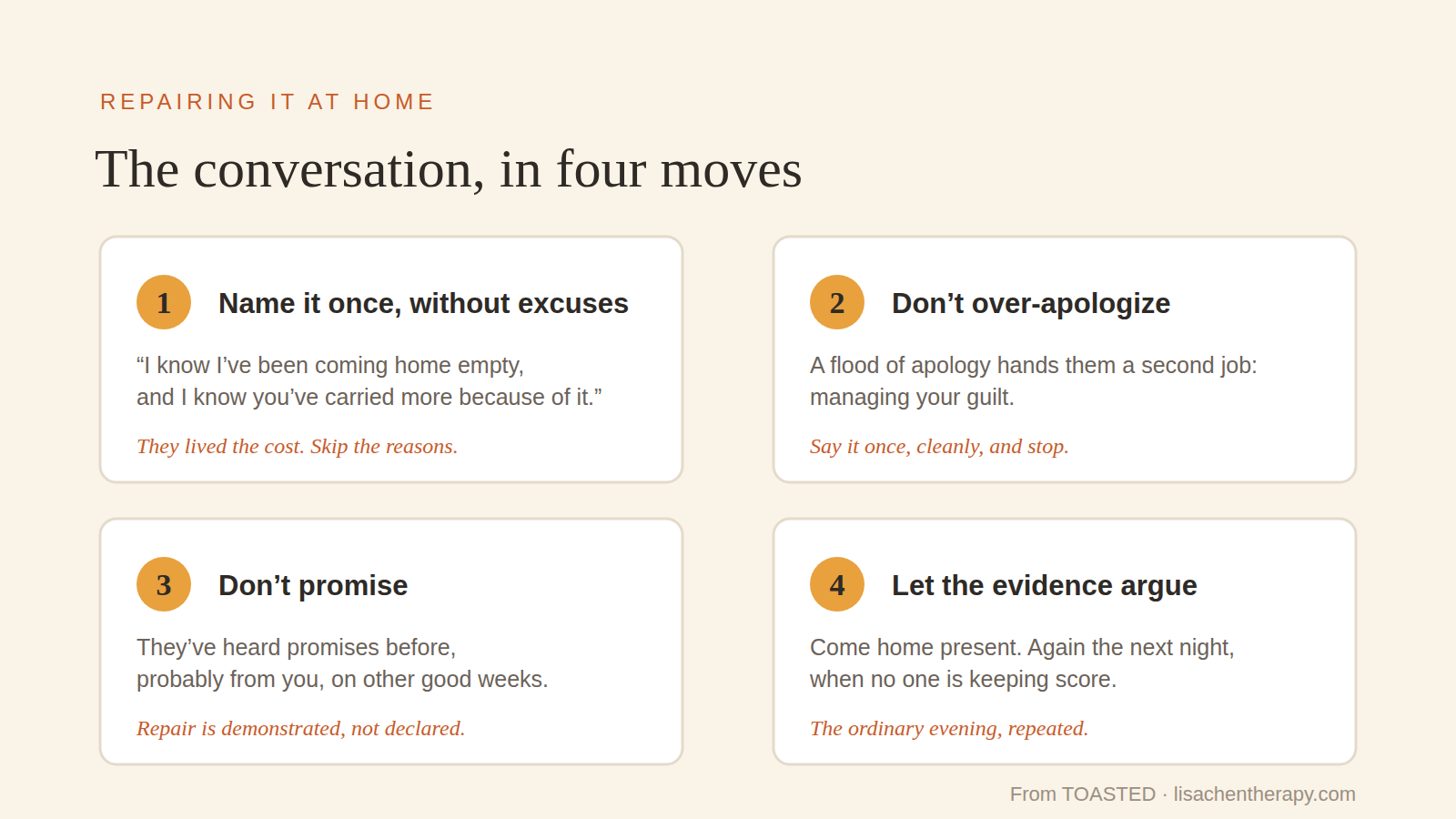
The conversation, when you have it, works best without the executive playbook:
Name it once, without excuses. Something like: I know I've been coming home empty for a long time, and I know you've been carrying more because of it. Accurate, brief, owned. They don't want the reasons. They lived the cost.
Don't over-apologize. A flood of apology feels like responsibility, but it quietly hands them a second job: managing your guilt on top of everything else. Say it once, cleanly, and stop.
Don't promise. They've heard promises, probably from you, on other good weeks. Repair is demonstrated, not declared.
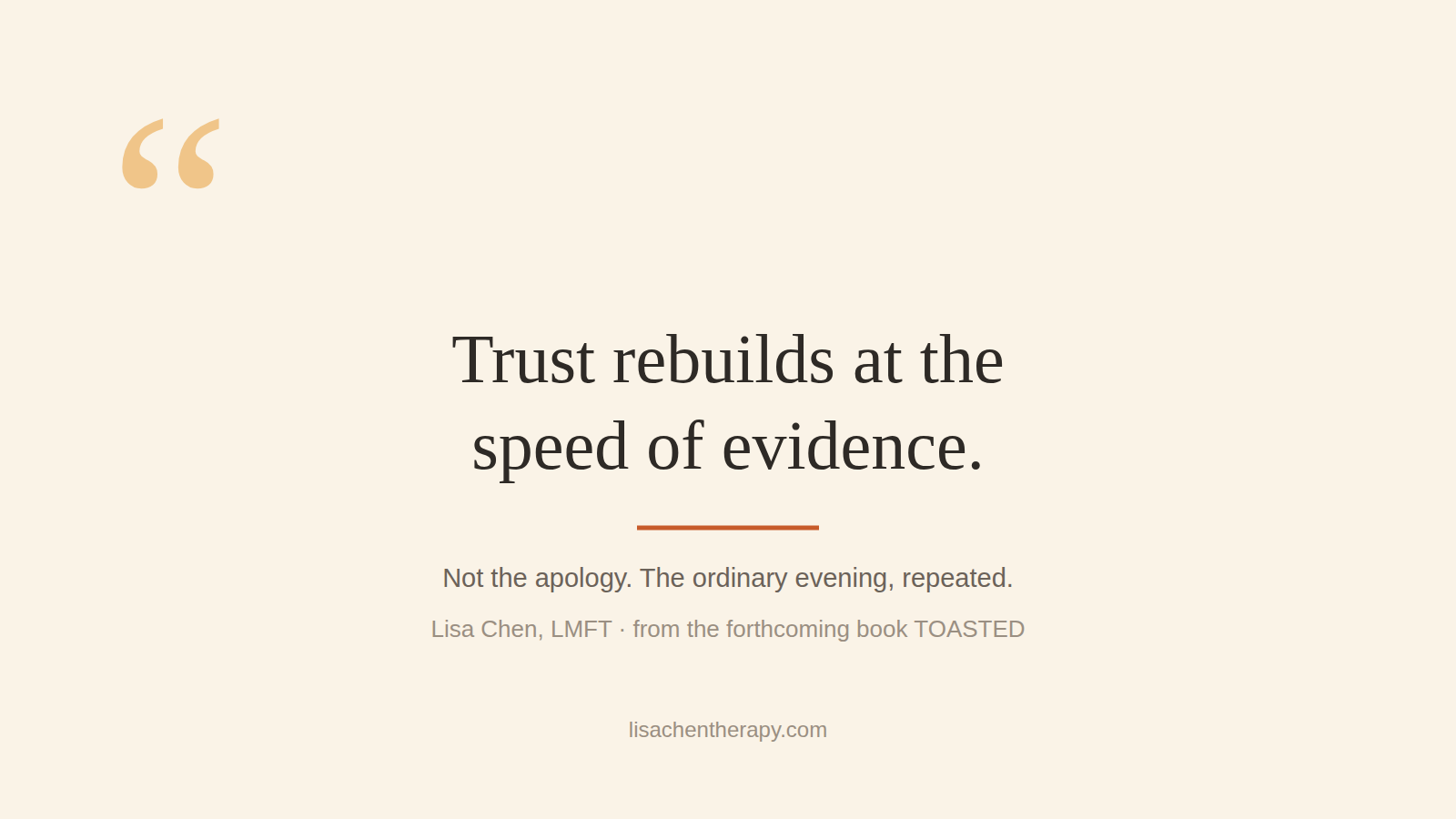
Then let the evidence do the arguing. Come home present. Do it again the next night, and the one after, when nothing is being watched and no one is keeping score. Trust rebuilds at the speed of evidence.
And watch for the counterfeit, because a high performer will find it: attendance without presence. Being at the dinner and the recital in body while running the room in your head. The people you're there for feel the difference between being attended to and being managed, the same way a client would.
One honest caution: you control your half of this, not the outcome. Most relationships open back up when you keep showing up. A few don't, and that's a grief to carry rather than a problem to solve. If the distance between you and your partner has its own history now, that's exactly the situation couples work exists for: a structured place to rebuild trust that neither of you can rebuild alone.
Frequently asked questions
Can burnout damage a marriage? Yes, and usually quietly: not through conflict but through absence. The burned-out partner is present in body and gone in attention, and the other partner slowly stops expecting more. The damage is real but very often repairable, especially once the burnout itself is being addressed rather than just apologized for.
Why am I patient at work and irritable at home? Because patience runs out, and you spend it where the pressure is. By evening there's simply none left, and home gets the leftovers. It isn't a character flaw or proof you love your family less. It's what happens when the day takes more than you have, and it changes when the day changes.
Should I explain my burnout to my kids? In age-appropriate terms, briefly, yes: I've been tired and short lately, it isn't your fault, and it's going to be different. Then let it actually be different. What convinces a kid isn't the explanation. It's the evening, repeated, until they stop bracing at the sound of the garage door.
What if my partner doesn't believe I'll change? Then they're reading the evidence accurately, and the move is to stop asking them to trust faster than the evidence warrants. Keep showing up on the ordinary nights when it would be easier not to. Their trust rebuilds on its own schedule, not yours.
When is it time for couples therapy? When the pattern has its own momentum: when even your good weeks get read as temporary, when conversations about it loop, or when you've both built defenses that fire before either of you chooses them. A third person in the room changes that. Here's how we work with couples.
Lisa Chen, LMFT, is a licensed therapist who works with executives, founders, and other high performers. Before training as a therapist, she spent years in finance, including her own burnout and the long road back. This piece draws on the framework from her forthcoming book, Toasted: How to Tell How Burned Out You Really Are, and How to Come Back.