The Worst Trade: What an Extra Hour of Work Really Costs
By Lisa Chen, LMFT — therapist to high performers, former finance professional
The short answer: The extra hour doesn't pay what you think it pays. You believe you're buying output — one more hour of you at your usual rate. You're not. The tired hour produces less than the rested one, and it costs more, because you pay it back tomorrow with interest you can't see: slower thinking, worse judgment, and a shorter fuse for the people at home. Past the edge of your reserve, more hours in stops meaning more results out. It's the worst trade you make, and you make it daily — precisely because you're disciplined enough to.
I spent years on a trading floor before I ever sat in a therapist's chair, so let me put this in the language that world taught me: you are running a position with a negative expected return, doubling down on it daily, and booking the losses to an account nobody audits.
The position is the extra hour.
Does working longer hours actually make you more productive?
Up to a point — and you passed the point a while ago.
The arithmetic that built your career, more hours in and more results out, stops holding somewhere past the edge of your reserve. When economists have looked at what actually happens to output as hours climb, the work doesn't keep pace with the time: past a threshold, each added hour returns less than the one before it, and at the extreme the marginal hour produces almost nothing at all. (The research is worth reading — the working-paper version is free.) And that's before counting what the hour costs you tomorrow.
You're not getting more done so much as getting more, let's say, done. Working harder for a smaller and smaller return, and calling the effort proof of how much you care.
What does the tired hour actually cost?
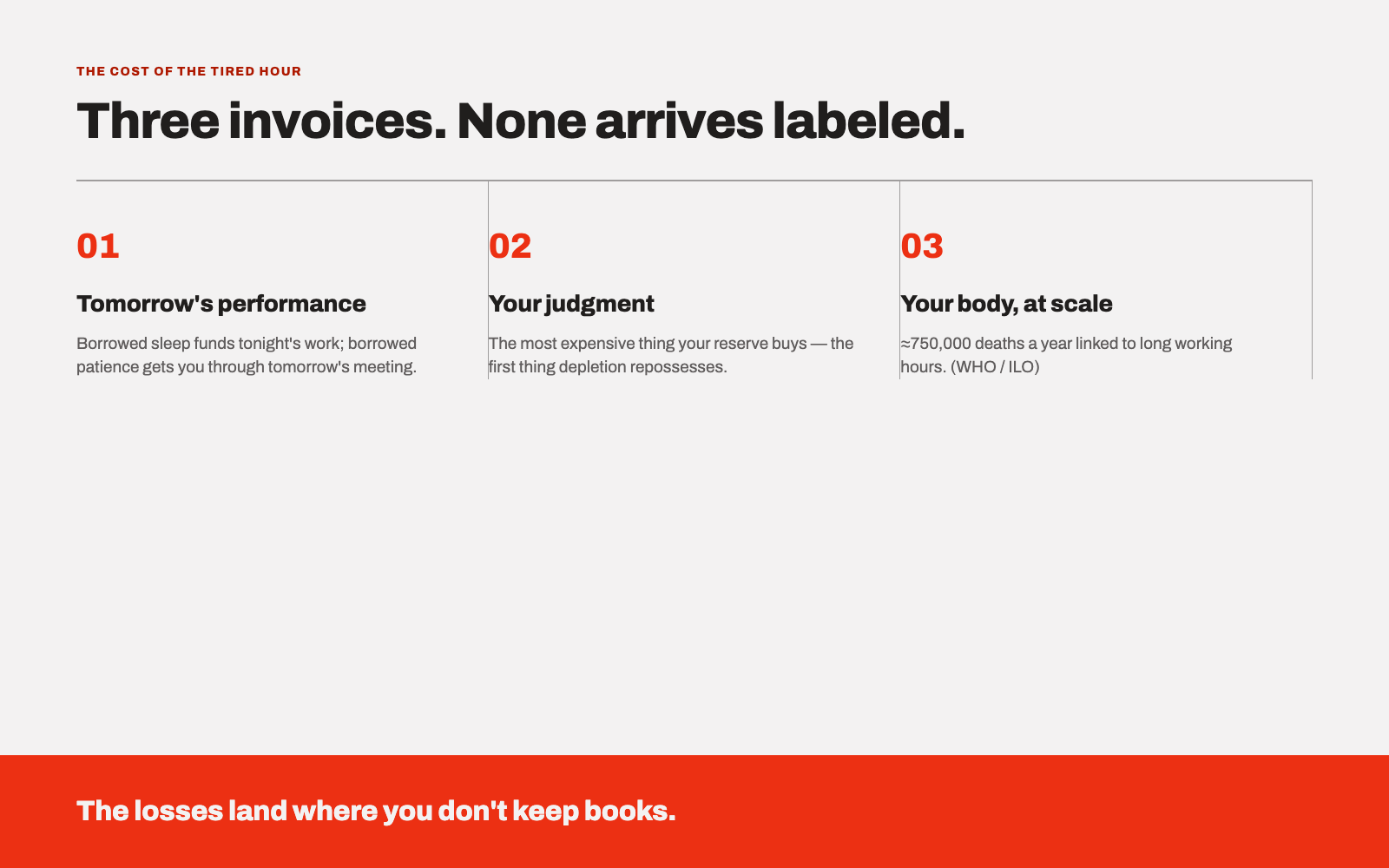
Three invoices, and none of them arrives labeled.
Tomorrow's performance. You borrow tonight's sleep to finish the work, then borrow tomorrow's patience to get through the meeting the lost sleep made harder. The tired brain also rates the same task as more effortful than a rested brain does — so tomorrow's work feels heavier while you're actually doing it worse. The loan compounds.
Your judgment — which is your actual product. Nobody pays you for hours; they pay you for calls. Judgment is the most expensive thing your reserve buys, the first thing depletion repossesses, and the last thing you notice going — because the faculty that would catch the slippage is the one that's slipping. The decision you made on Thursday that you wouldn't have made on a Monday: that's the invoice, and it never shows up itemized. When organizations have tried to price what a depleted senior person costs in lost judgment and decisions that quietly go wrong, the figure is large and almost entirely invisible — paid not as a line item but as a slow tax on everything. You are most likely the most expensive depreciating asset in your organization, and the only one no one is tracking.
Your body, at scale. The extreme end of the trade has hard numbers now: a joint WHO/ILO study attributed roughly three-quarters of a million deaths a year from heart disease and stroke to long working hours alone. The extra hour isn't just unproductive past the threshold. At sustained volume, it's actuarial.
Why do smart people keep making this trade?
Because the trade used to pay, and you're pattern-matching on old data. Early in your career, when the reserve was full, the extra hour really did buy output — that's how the habit got its track record. What changed isn't your discipline; it's the account funding the hours. The same week that would've cost you almost nothing at thirty can flatten you now, because a drained reserve makes everything cost more.
And because the losses land where you don't keep books. The gains from the extra hour post to the account that reports — the deliverable shipped, the inbox cleared, the number on the board. The losses post to the accounts that don't: the marriage, the body, the future self. A trade always looks brilliant if you only book one side of it.
There's a name for the extreme version of this pattern — living at the top of the tachometer as a way of life — and a reason pushing through feels safer than stopping, which deserves its own piece.
How to check the trade yourself
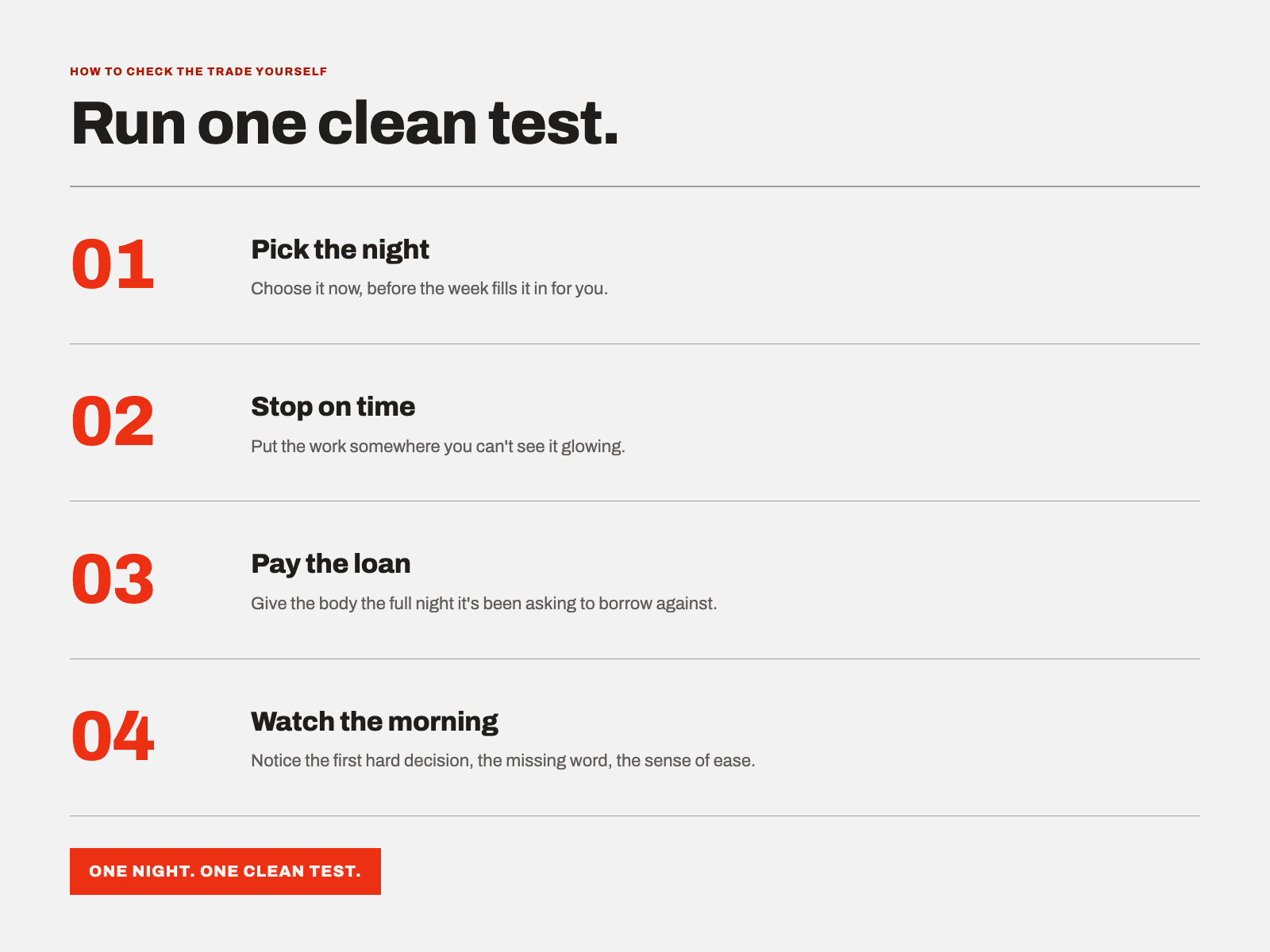
Don't take my word for the economics of your own brain. Run one clean test.
Pick one night this week — pick it now, before the week fills it in for you. Stop at a set time, put the work somewhere you can't see it glowing, and give the body the full night it's been asking to borrow against. Then pay attention to your first few hours the next morning: how quickly the first hard decision comes, whether the word that usually goes missing stays where it belongs, whether the thing that felt like pushing a boulder uphill feels — for once — like something you're good at.
That contrast is the only honest gauge of what the extra hours have been costing you, because you can't feel what depletion takes while it's taking it. You feel it only in reverse, after a little rest hands a piece of it back. One night. Cheapest experiment you'll run all quarter — and if the gap surprises you, that's a conversation worth having while the account still has road left.
Frequently asked questions
Is there research that long hours reduce productivity? Yes — the best-known is economist John Pencavel's analysis in The Economic Journal, which found output rises with hours only up to a threshold, after which each additional hour yields sharply diminishing returns. Long-hours culture survives on the visible half of the ledger: the hours are countable, the degraded output isn't.
How many hours a week is too many? The research threshold sits lower than most high performers assume — returns deteriorate meaningfully somewhere past the standard full-time range, and health risk rises measurably at 55+ hours. But the more useful line is personal: it's wherever your added hour starts getting funded by tomorrow — borrowed sleep, borrowed patience, borrowed judgment.
If the extra hour is a bad trade, why does my career keep rewarding it? Because your world prices inputs it can see. Hours are visible; the decision you'd have made better on a full reserve is invisible. The people who last at the top eventually stop trading on volume and start guarding recovery like the asset it is — they're just quieter about it than the grinders.
Doesn't this just mean "work less"? No — it means fund the hours you work. The same hours cost wildly different amounts depending on whether you meet them full or empty. I've watched people cut nothing from the workload and still climb out of the red by changing what happened around the work: the recovery, the sleep, the one protected hour.
What if I can't make myself stop working the extra hour? Then you've found the real finding. When the unspent hour feels like exposure rather than rest, the driver isn't the workload — it's a part of you that won't let the spending stop. That part has a name in my work, and it's the subject of an upcoming post (the psychology behind it starts here).
Lisa Chen, LMFT, is a licensed therapist who works with executives, founders, and other high performers. Before training as a therapist, she spent years in finance — including her own burnout and the long road back. This piece draws on the framework from her forthcoming book, Toasted: How to Tell How Burned Out You Really Are, and How to Come Back.