Chronic Redline: The Founder Version of Burnout
By Lisa Chen — Psychotherapist to high performers, former business executive
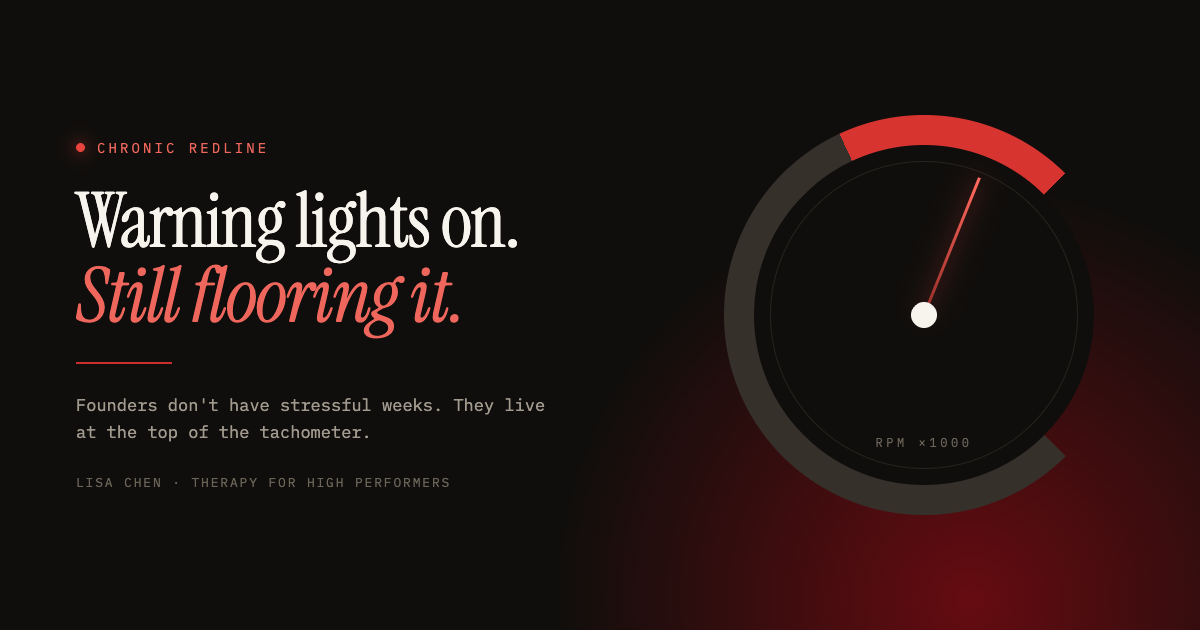
The short answer: Founders don't have stressful stretches — they live at the top of the tachometer. Chronic redline is the engine held near its limit, not for the sprint it was built for but as a way of life, the needle parked where most people's sits only in a real emergency. It rarely looks like burnout, because the founder is still visibly performing. But an engine run at redline long enough stops being able to feel any other setting — and the account it runs on goes quietly into the red.
Priya is the kind of person the word founder was made for.
She built and runs a company in an industry growing faster than she can hire for, and by every visible measure she has it: the house, the marriage, two young kids, the network, the reputation, the body she trains before the day starts. She works on herself the way she works on the company — deliberately, across every domain at once. A force of nature who keeps more plates in the air than seems possible.
She had also been running at the top of the tachometer so long she could not tell me what her engine felt like at any other setting. And she wore that as proof of how much she wanted it.
What finally brought her in was not failure. It was that she had gone flat. The word she used for herself was burnt to a crisp. She isn't, in the clinical sense — she's a redlining high performer who is still, visibly, performing, which is precisely the point and the good news she could not feel.
What is chronic redline?
Most people's stress system works like an engine in normal driving: it revs for the hard moments and returns to cruise. Founders lose the return trip. There is always a raise, a fire, a hire, a board meeting, a competitor — so the needle climbs and then simply stays there, and after enough years the elevated state stops feeling elevated. It feels like you.
That's chronic redline: the engine held at its limit as a way of life. And it connects directly to the burnout math I've written about elsewhere: you hold the engine at the red line, week after week, and the account it runs on goes into the red. The tachometer and the ledger are the same story from two seats. The redline is how you get to the red.
Your body keeps the receipts either way. It's built to rise to a demand, meet it, and come back down — the rising is healthy; it's the coming down that founders skip. Stay geared up for years and the accumulated wear becomes physical and measurable. At the population level the numbers are stark: a joint WHO/ILO study attributed hundreds of thousands of deaths a year from heart disease and stroke to long working hours alone. That's not a wellness talking point. That's the actuarial table for the lifestyle.
Why founders don't notice
Three reasons, and they compound.

First, the redline is celebrated. In founder culture, running hot isn't a symptom — it's a credential. The pace gets worn like a medal and traded as proof of commitment, and no one schedules recovery for an injury everyone keeps congratulating them on.
Second, the company's dashboard is louder than the body's. A founder watches ARR, runway, pipeline, headcount — numbers that report back on a schedule. Your own reserve sends no Friday summary. So the accounts that report get managed, and the account everything runs on gets spent first and counted last
Third, calibration is gone. After enough years at the top of the range, you lose the reference point. Priya couldn't tell me what any other setting felt like — not because she wasn't paying attention, but because the elevated state had become her baseline. You can't feel a redline you've renamed normal.
But doesn't the company need me at this pace?
This is the founder's objection, and it deserves a founder's answer: check the return on the hours.
The economics don't hold. When researchers have looked at what actually happens to output as hours climb, production stops keeping pace with time — past a threshold, each added hour returns less than the one before it, and that's before counting what the hour costs you tomorrow. The tired hour produces less and costs more. You are almost certainly the most expensive depreciating asset in your company, and the only one no one is tracking.
And the people who sustain elite output the longest do the opposite of redlining. This is the reframe the best performers already live by: elite athletes treat recovery as part of the training, not the reward for finishing — the sleep, the off day, the deliberate easing off are how the engine stays an engine. Somewhere along the way, founder culture kept the athlete's intensity and threw out the athlete's recovery, and then called the result discipline.
The judgment cost lands hardest. A founder's actual product is decisions — pricing, hiring, the term sheet, the pivot. Judgment is the first thing depletion degrades and the last thing you notice going, because the faculty that would catch the slippage is the one that's slipping. Nobody redlines their way into better calls.
How to come down without stepping back
I won't tell you to take a sabbatical. Most founders can't, and the ones who can come back to the same company and the same wiring inside a week. The work is smaller and more durable than that.
Rebuild the return trip. The problem isn't that you rev — it's that you never come down. Start with one real off-switch a day: a hard stop where the work goes somewhere you can't see it glowing. Not a reward for finishing (you never finish). A scheduled part of how the engine runs.
Put your own gauge on the dashboard. You track a dozen company metrics weekly; track one of yours. Not a wearable score — a plain honest self-check: how far into the red did this week run? Founders respect what gets measured. Measure the asset the whole company depends on.
Find the false emergency. Some of the redline is real — fundraising weeks exist. But a lot of it is a habit of treating everything as the raise. Once a week, ask which of today's fires actually required the needle at the top. The gap between "felt urgent" and "was urgent" is where your recovery lives.
Notice if you can't come down at all. If an open Saturday makes you anxious rather than relieved — if the unspent hour feels like exposure — the throttle isn't stuck, it's being held. Something in you is doing the holding, and it has its reasons. That's not a scheduling problem, and it's the subject of its own piece.
The strange, almost unfair truth is that the founders who do this work don't lose their edge. They get it back — sharper calls, faster recovery between sprints, an engine with range again instead of one pinned setting. Priya's turn wasn't about wanting it less. It was about finally being able to feel what the engine was doing. What she did about it inside a real operating role — that's a later post.
Frequently asked questions
Is founder burnout different from regular burnout? The mechanism is the same — chronic demand outpacing recovery — but the profile differs: founders rarely stop performing, their environment actively rewards the overdraft, and identity is fused with the company, so easing off registers as becoming less. That's why standard "work less" advice tends to bounce off founders entirely.
Can I recover from chronic redline without leaving my company? Usually yes — and for most founders, leaving wouldn't fix it anyway, because the wiring travels with you. Recovery is built inside the role: restoring the return trip after each rev, protecting deposits the calendar can't flatten, and dealing with the part of you that holds the throttle open.
How do I know if I'm redlining or just in a hard season? A season has an end date and a return trip — you rev, the moment passes, you come down. Redline has no down: the elevated state persists after the deadline passes, rest stops restoring you, and — the surest tell — you can no longer remember what any other setting feels like.
Is running on adrenaline actually bad if the work is getting done? The work gets done, but check what it costs: adrenaline-funded output degrades exactly the faculties a founder is paid for — judgment, patience, creative range — and the health bill for sustained long hours is documented and large. It's not free energy. It's borrowing at interest.
What's the first thing to actually do? One daily hard stop, kept like an investor meeting, for two weeks. Then read your own reaction to it: if it restores you, you caught this early; if it makes you anxious, you've learned the throttle is being held — and that's the more important discovery.
Lisa Chen is a licensed therapist who works with executives, founders, and other high performers. Before training as a therapist, she spent years in finance — including her own burnout and the long road back. This piece draws on the framework from her forthcoming book, Toasted: How to Tell How Burned Out You Really Are, and How to Come Back.
Publishing notes (for Lisa — delete before posting)
Suggested URL slug: /blog/chronic-redline-founder-burnout
Meta title (47 chars): Chronic Redline: The Founder Version of Burnout
Meta description (149 chars): Founders don't have stressful weeks — they live at the top of the tachometer. What chronic redline does to judgment, and how to come down without quitting.
Links checklist:
External embedded: WHO/ILO long-hours mortality study (×2), Pencavel productivity study (The Economic Journal), Loehr & Schwartz HBR. Open in new tab.
Internal embedded: Post 3 (/blog/burn-line-4-phases-of-burnout) — confirm slug. Add your Telehealth page link in the bio or FAQ if you want a service path (founders are your most remote-friendly segment).
Retro-links: in Post 3, link the "chronic redline" mention (Priya/founder phase-two language) to this post. When Post 9 (the Overspender) publishes, link "it's the subject of its own piece" and "the part of you that holds the throttle open" to it. When Post 8 (micro-boundaries) publishes, link "protecting deposits the calendar can't flatten."
Composite-client note: Priya is described in the manuscript as a composite; the post keeps her exactly as the book does, so no added disclosure is needed beyond your standard site language — but if your blog has a confidentiality note, this is a good post to link it on.
Distribution note: this is the series' best LinkedIn performer on paper — post the "short answer" block verbatim as a text post, and consider tagging it to founder communities. The phrase "chronic redline" is the ownable asset: use it in the LinkedIn post title.
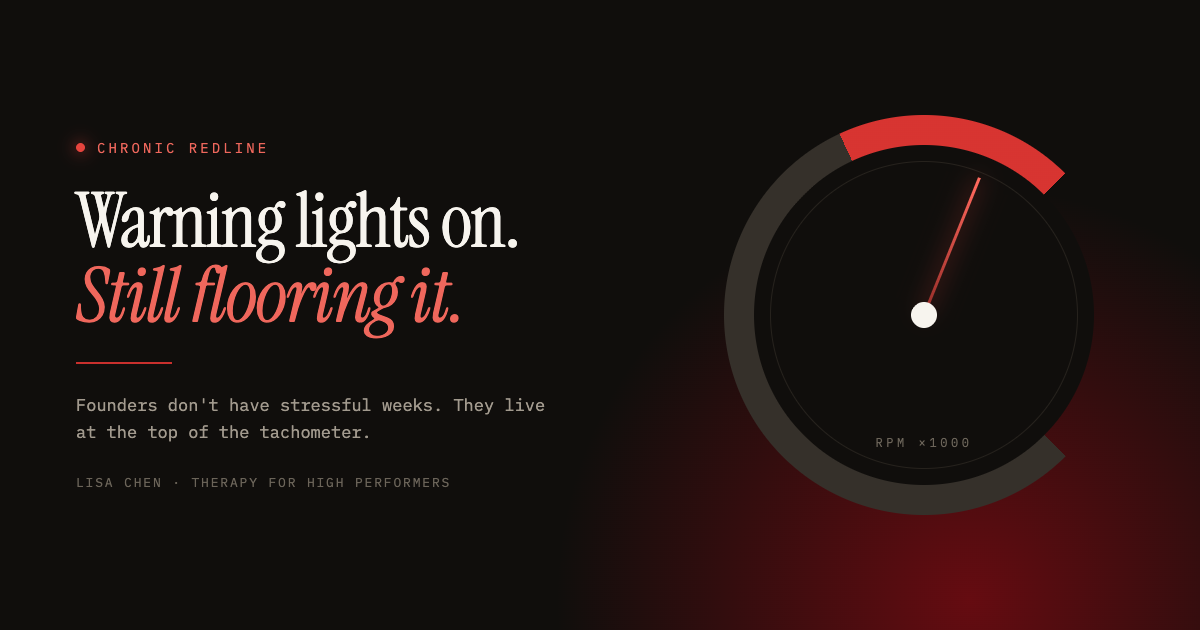
Images (2, in Canva): hero — tachometer pinned in the red, headline "Warning lights on. Still flooring it."; in-body — pull-quote card: "She couldn't tell me what her engine felt like at any other setting." Alt text: hero — "A tachometer with the needle deep in the red zone, representing a founder running at the limit as a way of life." Quote — "Pull quote from Toasted about losing the ability to feel any setting but the redline."