By Lisa Chen, LMFT. Former Wall Street trader, now a psychotherapist to high performers.
The short answer: Burnout isn't a box you fall into. It's a line you slide down, usually slowly, usually without noticing the crossing. I call it the Burn Line, and it has four phases: drawing down (spending faster than you refill), running on credit (funding performance on adrenaline), in the red (the borrowing catches up), and the forced stop (the body makes the choice you wouldn't). The dose depends on the distance: what fixes phase one won't touch phase three, which is why generic burnout advice so often fails.
Most "stages of burnout" lists get one thing wrong before they say a word: they describe boxes, as if you're either fine or you're not, either coping or collapsed. That's not how I've seen it work in years of sitting with executives, founders, and attorneys, and it's not how the research describes it either. Burnout's three dimensions (exhaustion, detachment, and an eroding sense of effectiveness) worsen along a continuum. You don't fall. You slide.
That matters practically, not just descriptively. The most common way capable people mishandle burnout is by guessing their own position and treating accordingly. Guess too high and you reach for a long weekend when you need a longer reckoning. Guess too low and you upend your whole life over something a few honest changes would have held. You cannot fix what you haven't located.
So here's the map. The top of the line, where you want to live, is a full reserve: spending hard and putting back enough that the account stays roughly level. Not a life without stress; a life where the stress is funded. (If "reserve" is a new word to you, start here.) The four phases are what the slide away from it looks like.
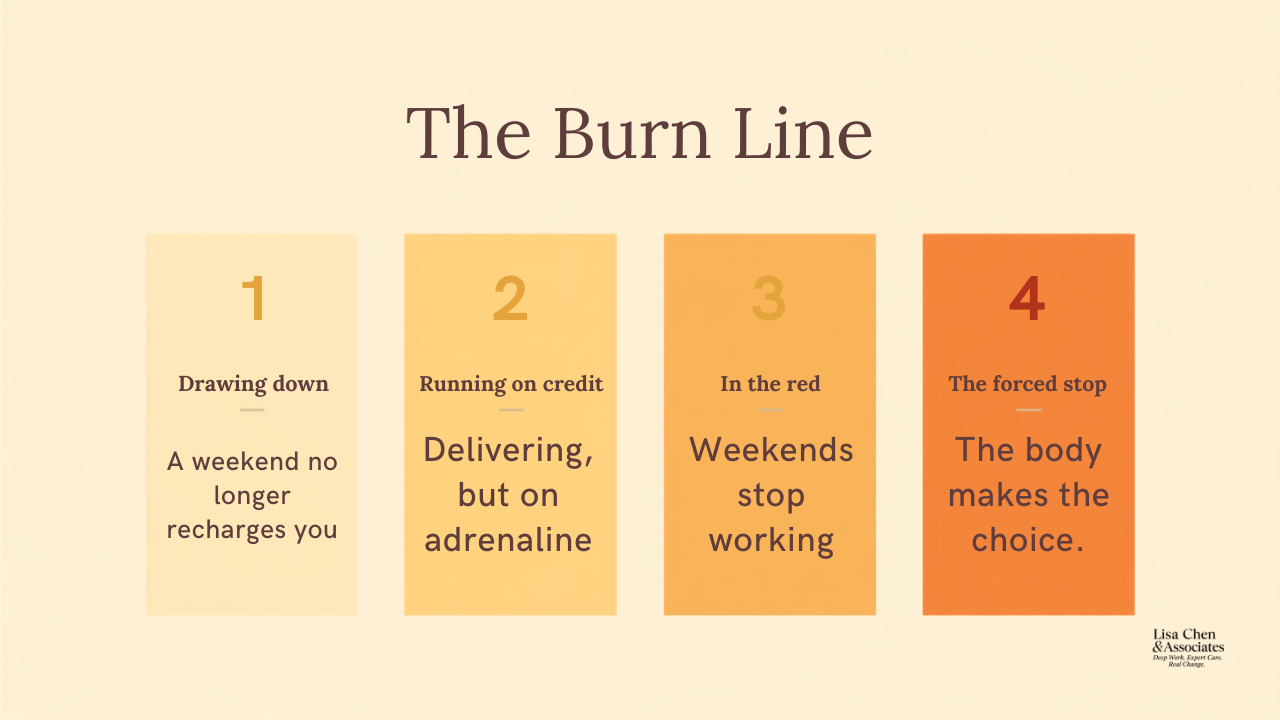
Phase 1: Drawing down
Still performing, still mostly fine, just spending a little faster than you refill. This is the phase almost everyone waves off, because nothing is visibly wrong yet.
The tells: you're tired but fully functional. A weekend off no longer recharges you the way it used to. You've cut the recovery, not the work. You still mostly enjoy the work.
I think of a lawyer I'll call Claire, who said yes to launching a new practice group in the time it took to read the email, not because she'd weighed it, but because she could no longer feel what one more yes cost. That's what this phase looks like from the inside: a capable person saying yes to one more good thing and feeling nothing as she does it.
The move: this is the cheapest place on the whole line to act. Protect a single real deposit this week (one hour, one off-switch), and refuse to spend it. The climb from here is short and preventive.
Phase 2: Running on credit
Productive and depleted at the same moment. This is where most high achievers live the longest, because it's survivable for years. You're funding the performance on borrowed energy and calling it drive.
The tells: running on caffeine, willpower, and momentum. Sleep slipping, patience thin. Still delivering, but on adrenaline. The people at home get the leftovers. Wins land flat.
That last one deserves a beat, because it's the tell people dismiss: the promotion arrives, the deal closes, and you feel a small click instead of the thing you were promised. The win isn't too small. The part of you built to feel it is running low. (More on the signs high achievers miss here.)
The move: stop using tomorrow as your default source of funding. Step off the active drain, and start getting curious about the part of you that won't let you stop, because at this phase, that part is driving. The meter runs the whole time you wait.

Phase 3: In the red
The borrowing has caught up, and it shows now, to you and to the people around you. The work that used to light you up has gone gray. A cynicism that surprises even you has crept in. The body is sending statements you can no longer file away. Weekends stop working. People who love you have started to say something.
There's a version of this phase that hides, and it's the one high performers should know about: the selective version. You keep one visible account gleaming (the number, the ranking, the practice) while every other account goes dark. At work you're golden; the scorched edge lands at home, on the people who'd never bill you for it. By the only count that matters, the sum of every account, you're deep in the red. But you've kept the one account everyone can see in the black, which is why no one, you least of all, has called it what it is.
The move: this is not a place to manage alone with a productivity tweak. Tell one person the truth, let a professional into it, and step off the drain, which at this depth is not optional. The honest timeline is months, and it's faster with help than without. (This is the kind of work I do with clients.)
Phase 4: The forced stop
The choice you wouldn't make gets made for you. Illness, a breakdown, or a stretch where you simply could not. The one move that always worked, pushing through, has stopped working, because functioning itself has broken down.
If this is you, hear this plainly: the stop was not the end of you. It was the account enforcing a limit you would not. The move here is care, not a productivity fix, and not a solo project: medical and professional support, now rather than later. And deep burnout can overlap with depression, so if you're unsure which you're in, that's a clinical question worth real help (more on that here). If you're having thoughts of harming yourself or of not wanting to be here, reach out now. In the U.S., call or text 988.
How do I know which phase I'm in?
Two honest warnings, then a pointer.
First: people almost always guess low. The gauge you'd use to check, your own judgment, dims as the reserve runs down, and performance is the last thing to go, so your output keeps reading "fine" long after the account has thinned.
Second: your smartwatch can't settle it either. When researchers put wearables and blood markers head-to-head against plain, honest self-report across a systematic review of dozens of studies, the self-report tracked real fatigue more sensitively and more consistently. The devices measure your heart rate and your sleep accurately enough, but none of those numbers is your fatigue. The reading you need is a judgment the person living in the body makes better than an algorithm. The catch: the instrument only works if you stop performing the answer.
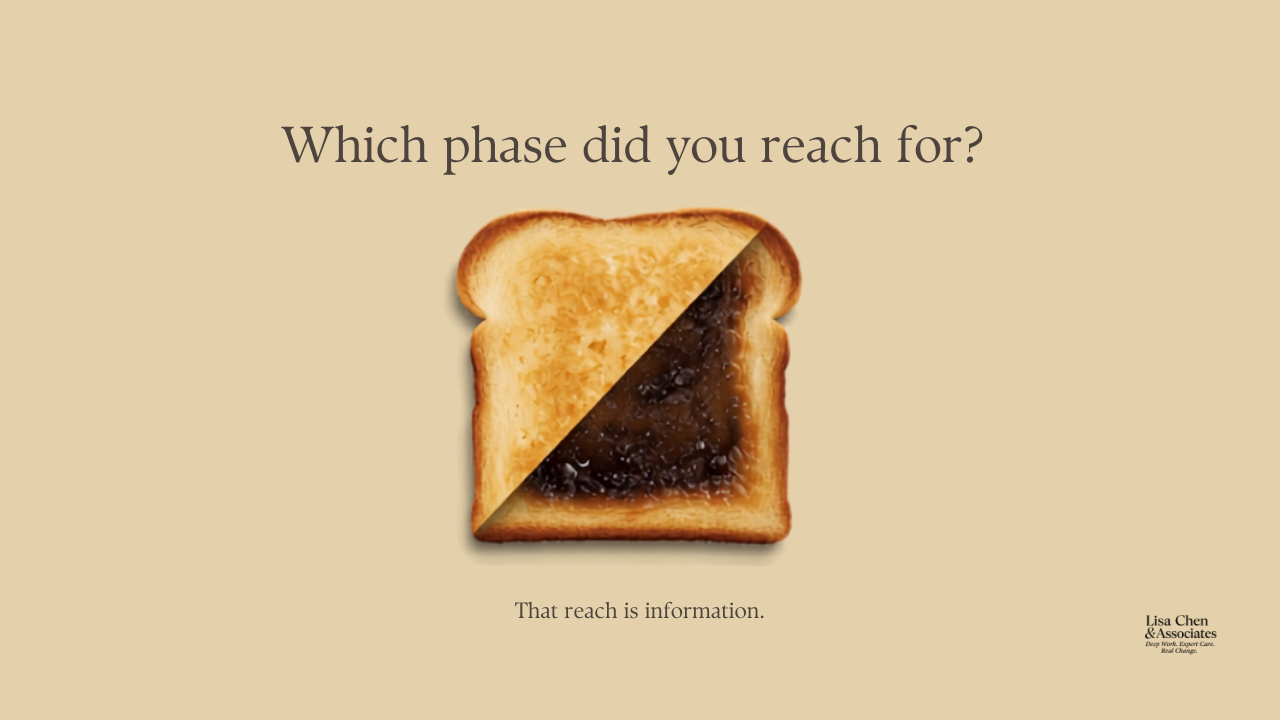
So the pointer is this: read the four phases again and notice which one you reached for. That reach is information. People who are fine don't read a list like this and feel something tighten. (You can take a free burnout check assessment that shares if you are burnt out.)
Frequently asked questions
How many stages of burnout are there? You'll find models online with 5 or even 12 stages, but the stage count matters less than the shape: burnout worsens along one continuous slide as chronic stress outpaces recovery. The Burn Line uses four phases because each one calls for a different response. That's the point of mapping it at all.
Can you skip phases or go straight to a breakdown? The slide is usually gradual, which is exactly why the crossings go unnoticed. What feels like a sudden collapse is almost always a long, quiet drawdown that finally hit the floor. The body tends to hold the line until it can't.
How long does recovery take at each phase? Early phases: weeks of consistent small changes, largely preventive. Running on credit: longer, and it requires changing the spending, not just adding rest. In the red and beyond: the honest timeline is months, sometimes more than a year, and meaningfully faster with support than without.
Is the forced stop the same as a nervous breakdown? "Breakdown" isn't a clinical term, but the experience it describes, functioning itself giving out, is what phase four looks like. It's the point where burnout stops being a performance problem and becomes a health matter, and it warrants medical and professional care, not a recovery plan built on willpower.
Can a smartwatch or Oura ring tell me if I'm burned out? It can tell you your heart-rate variability and your sleep hours, accurately, even. It can't tell you how far into the red you've run, because honest self-report outperforms the objective panel at tracking real fatigue. The device is an input. The reading is yours to make.
I worked in finance before I trained as a therapist, and I went through burnout myself. This piece draws on the framework from my forthcoming book, Toasted: How to Tell How Burned Out You Really Are, and How to Come Back.