Attachment style influences how emotionally safe intimacy feels. In couples therapy, we often see that sexual disconnect reflects attachment patterns rather than incompatibility.
Table of Contents
Attachment Style and Its Effect on Sex
Anxious Attachment in the Bedroom
Avoidant Attachment in the Bedroom
Secure Attachment
The Pursue-Withdraw Bedroom Cycle
Why Desire Drops
The Conversation With Premarital Couples
Resentment
Action Checklist
Frequently Asked Questions
What Is Attachment Style And Why Does It Affect Sex?
Attachment style is your nervous system’s blueprint for closeness.
It develops early in life and shapes how you experience:
• Emotional safety
• Rejection
• Conflict
• Vulnerability
• Physical intimacy
When closeness feels safe, sexual desire can emerge naturally.
When closeness feels uncertain, pressured, or emotionally unpredictable, desire often shuts down, even when attraction is still present.
In couples therapy, we frequently see that sex improves when emotional safety increases. It rarely improves because partners simply “try harder.”
The body does not respond to pressure.
It responds to safety.
Anxious Attachment in the Bedroom: When Sex Feels Like Reassurance
If you lean anxious, intimacy may feel like proof that the relationship is secure.
Common patterns we see in practice:
• Feeling close when sex is frequent, and alarmed when it slows down
• Interpreting “not tonight” as rejection
• Initiating more after conflict or emotional distance
• Feeling shame or panic when desire is not reciprocated
Real-life example:
One partner initiates. The other declines.
The anxious partner feels a surge of anxiety and withdraws emotionally.
Resentment builds silently.
Therapist perspective:
Anxious attachment is not about being “too needy.” It is about a nervous system that reads distance as danger.
Sex becomes a way to restore emotional stability.
Avoidant Attachment in the Bedroom: When Intimacy Feels Like Pressure
If you lean avoidant, sex may feel complicated for a different reason.
Common patterns:
• Desire emerges when things feel relaxed and low-pressure
• Desire decreases when sex becomes emotionally loaded
• Feeling criticized when your partner asks for more
• Pulling away when intimacy feels like a test of love
In therapy, we often hear:
“When they ask for sex, I feel like I’m failing.”
Avoidant attachment typically protects against feeling engulfed or emotionally responsible for someone else’s regulation.
The more pressure there is, the less desire there tends to be.
Secure Attachment: Why Flexibility Matters More Than Frequency
Secure attachment does not mean identical libido.
It means both partners can:
• Initiate without fear
• Decline without triggering relational panic
• Repair awkward moments
• Discuss intimacy directly
Secure couples still experience stress, dry spells, and mismatched desire.
But they stay aligned as a team rather than turning against each other.
The Pursue–Withdraw Bedroom Cycle (The Most Common Dynamic)
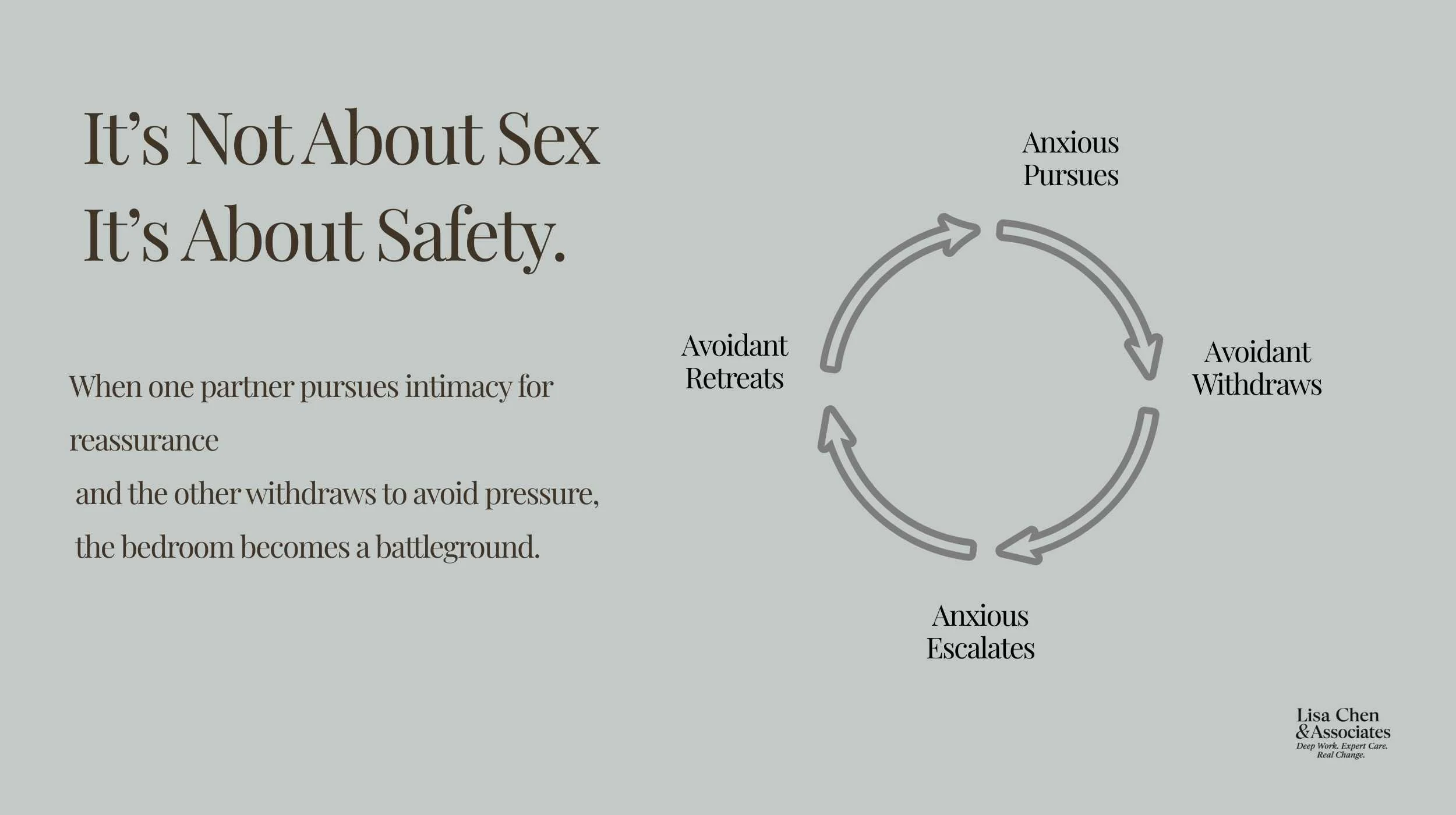
This pursue-withdraw attachment pattern often appears in couples therapy when mismatched libido is driven by emotional triggers rather than physical incompatibility.
This pattern is one of the most frequent cycles we see in couples therapy:
Anxious partner pursues intimacy for reassurance.
Avoidant partner withdraws to avoid pressure.
Anxious partner escalates emotionally.
Avoidant partner retreats further.
Both partners feel alone.
One feels unwanted.
The other feels controlled.
Neither partner is the problem.
The cycle is.
If this resonates, you may relate to our deeper exploration here:
“You’re Not Too Needy, and They’re Not Too Distant: You Just Have an Attachment Mismatch.”
Why Desire Drops (Even in Loving, High-Functioning Couples)

Attachment-focused couples therapy in Hermosa Beach helps partners shift intimacy patterns rooted in anxious and avoidant dynamics.
For high-achieving professionals, desire often declines under:
• Chronic stress
• Burnout
• Sleep deprivation
• Emotional overload
• Performance pressure
When the nervous system is in survival mode, it prioritizes output and control, not play and vulnerability.
This is why couples often say:
“We love each other. We’re attracted. We just don’t connect physically anymore.”
Often, the solution is not a new technique.
It is emotional repair, nervous system regulation, and rebuilding relational safety.
Once emotional safety begins to return, some couples find it helpful to reintroduce physical closeness through low-pressure, playful experiences rather than treating intimacy like another area to “perform.” For some, that may include exploring sensual tools or products from thoughtfully designed brands like LELO or Maude, not as a replacement for relational work, but as a way to support curiosity, comfort, and reconnection. When intimacy becomes less about pressure and more about exploration, the nervous system often responds differently.
This approach tends to work best when it follows deeper emotional repair work that helps both partners feel understood, emotionally connected, and safe again.
If you’re exploring therapy that integrates attachment, nervous system work, and deeper relational patterns, you can learn more about our couples therapy services.
Premarital Couples: The Conversation That Prevents Future Gridlock
If you are engaged, this is the ideal time to discuss intimacy openly.
Not just frequency.
Ask:
• When you feel rejected, what story do you tell yourself?
• When you feel pressured, what happens internally?
• What does sex represent emotionally for you?
• How does stress impact your desire?
These conversations complement our Gottman premarital checklist.
And if you want structured exercises to strengthen emotional connection (which often improves intimacy), explore our free Gottman exercises and free Gottman Love Map guide.
Resentment: The Silent Libido Killer
One of the most overlooked intimacy blockers is unresolved resentment.
When conflict goes unrepaired:
• Emotional distance increases
• Attraction subtly decreases
• Sex becomes weighted with meaning
• Avoidance intensifies
Sex cannot carry the entire burden of closeness.
If tension, criticism, or shutdown are recurring patterns, the relational layer must be addressed first.
This is where structured, attachment-focused couples therapy becomes essential.

At Lisa Chen & Associates Therapy in Hermosa Beach, we specialize in couples therapy in Hermosa Beach, helping couples to identify the attachment pattern beneath the tension so intimacy can become connected rather than pressured.
Action Checklist
☐ Identify your attachment style.
☐ Notice whether you pursue or withdraw under stress.
☐ Separate “preference” from “rejection.”
☐ Reduce performance pressure around sex.
☐ Address resentment before focusing on frequency.
☐ Consider couples therapy before the pattern hardens.
Frequently Asked Questions
1. Why do anxious and avoidant partners struggle sexually?
Anxious partners often use sex to restore closeness, while avoidant partners withdraw when intimacy feels emotionally loaded or pressured. This creates a pursue–withdraw cycle that can reduce desire over time. The issue is usually attachment-based, not a lack of attraction.
2. Is mismatched libido always about attachment style?
No. Hormones, medication, depression, trauma history, stress, and sleep all influence sexual desire. However, attachment style strongly affects how couples interpret and respond to mismatched libido. Therapy helps distinguish biological factors from relational patterns.
3. Should engaged couples talk about sex before marriage?
Yes. Premarital couples benefit from discussing what sex means emotionally, how each partner responds to rejection or pressure, and how stress affects desire. Addressing attachment patterns early can prevent resentment later.
If you’re engaged, you may find our free Gottman premarital checklist helpful here: