
Exposure and Response Prevention: My Journey, the Evidence, and Why I Built Foothold Now
Introduction
For a long time, I thought spending thirty minutes before bed checking that the objects in my room were positioned correctly, that the lights were really off, and that getting out of bed and returning to it had gone the “right” way was simply part of my routine.
I thought being hyper-focused on my thoughts was what made me detail-oriented. It did not occur to me that these routines were costing me anything: my time, my energy, or my ability to move forward with my evening.
It was not until I began ERP (Exposure and Response Prevention therapy) that I understood how much of that time I could reclaim. ERP showed me that I did not have to keep negotiating with every obsessive thought or obeying every compulsive urge.
But I also learned that much of the work that makes ERP effective happens outside the therapist’s office. It happens when a trigger appears, the urge to perform a compulsion feels strongest, and nobody is there to guide you through the moment.
Learning how to approach those moments with structure, patience, and a willingness to experience uncertainty became an important part of my own treatment. It also made me interested in the resources people can use to support their ERP practice between sessions.
ERP involves gradually approaching thoughts, situations, sensations, or uncertainties that trigger distress while reducing the compulsive responses that ordinarily provide temporary relief.
One of the strongest patient-side predictors of whether ERP works is homework adherence: the exposures a person completes outside therapy sessions (Simpson et al., 2021).
Access also remains extremely limited. The International OCD Foundation reports that approximately 95–98% of people with OCD have never received ERP (International OCD Foundation, 2026).
What ERP Asks of You
ERP was the first cognitive behavioral therapy developed specifically for OCD (Meyer, 1966).
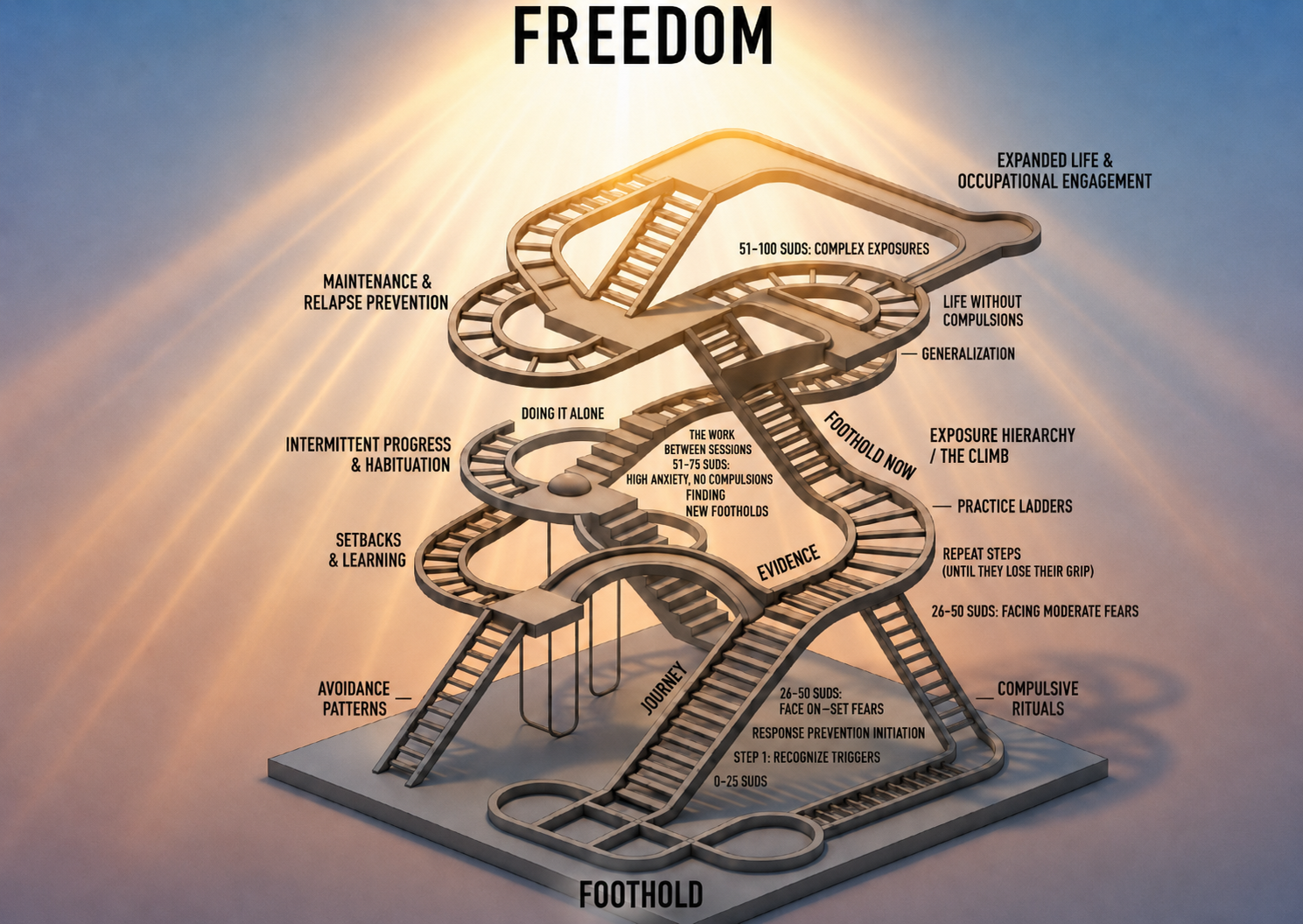
In ERP, you identify the thoughts, situations, sensations, and uncertainties that trigger obsessions, compulsions, avoidance, or distress. You then organize potential exposure exercises into a hierarchy, often beginning with more manageable exercises and gradually working toward more difficult ones.
A hierarchy is not necessarily a rigid sequence that must be completed perfectly. It is a way of making an overwhelming fear more understandable and identifying realistic opportunities to practice.
For example, someone who repeatedly checks whether a door is locked might create steps such as:
Locking the door and checking it twice rather than several times.
Locking it once and briefly remaining near the door without checking again.
Locking it once and walking away while allowing uncertainty to remain.
Leaving home after one check without returning.
The exact steps will depend on the person, their symptoms, and the plan developed with their clinician.
The exposure is only one part of the process. The other part is response prevention: resisting or reducing the checking, reassurance seeking, avoidance, mental reviewing, repeating, or other ritual that would normally provide temporary relief (Foa et al., 2012).
The purpose is not always to prove that a feared outcome is impossible. Trying to achieve complete certainty can itself become part of the obsessive-compulsive cycle. Instead, ERP helps a person practice experiencing discomfort and uncertainty without automatically responding with a compulsion.
A Tool That Grew From My Experience
My own exposure hierarchies previously lived in a Google Document. The document contained the steps, difficulty ratings, and notes I needed, but I found it slightly difficult to use when an opportunity to practice appeared.
This was especially true on my phone. Moving around a document on a smaller screen, tapping precisely where I wanted to type, scrolling through tables, and updating individual ratings could feel awkward in the moment. The document stored the information, but it was not always easy to interact with when I was already experiencing discomfort or an urge to perform a compulsion.
That experience led me to build Foothold Now, a digital tool (that can be accessed by others through clicking Foothold Now) for creating exposure ladders, rating their difficulty, and recording practice. My hope is that it can provide a more focused and portable way for people to organize the ERP work they are already doing.
For me, the larger lesson was not that ERP required a particular website or format. It was that the work became easier to approach when I could clearly see the next step in front of me and record my practice without having to move through a longer document.
Sometimes progress begins with something very small: checking once and choosing not to return.
References
American Psychiatric Association. (2007). Practice guideline for the treatment of patients with obsessive-compulsive disorder. https://psychiatryonline.org/pb/assets/raw/sitewide/practice_guidelines/guidelines/ocd.pdf
Foa, E. B., Yadin, E., & Lichner, T. B. (2012). Exposure and response (ritual) prevention for obsessive compulsive disorder: Therapist guide. Oxford University Press.
International OCD Foundation. (2026, April 6). The most effective OCD treatment reaches almost no one: Here's what we can do about it. https://iocdf.org/blog/2026/04/06/the-most-effective-ocd-treatment-reaches-almost-no-one-heres-what-we-can-do-about-it/
Meyer, V. (1966). Modification of expectations in cases with obsessional rituals. Behaviour Research and Therapy, 4(4), 273–280. https://doi.org/10.1016/0005-7967(66)90023-4
National Institute for Health and Care Excellence. (2005). Obsessive-compulsive disorder and body dysmorphic disorder: Treatment (Clinical guideline No. 31). https://www.nice.org.uk/guidance/cg31
Simpson, H. B., Foa, E. B., Wheaton, M. G., Gallagher, T., Gershkovich, M., Schmidt, A. B., Huppert, J. D., Campeas, R. B., Imms, P. A., Cahill, S. P., DiChiara, C., Tsao, S. D., Puliafico, A. C., Chazin, D., Asnaani, A., Moore, K., Tyler, J., Steinman, S. A., Sanchez-LaCay, A., ... Wang, Y. (2021). Maximizing remission from cognitive-behavioral therapy in medicated adults with obsessive-compulsive disorder. Behaviour Research and Therapy, 143, 103890. https://doi.org/10.1016/j.brat.2021.103890
Song, Y., Li, D., Zhang, S., Jin, Z., Zhen, Y., Su, Y., Zhang, M., Lu, L., Xue, X., Luo, J., Liang, M., & Li, X. (2022). The effect of exposure and response prevention therapy on obsessive-compulsive disorder: A systematic review and meta-analysis. Psychiatry Research, 317, 114861. https://doi.org/10.1016/j.psychres.2022.114861