Is AI the New Relationship Killer? A Couples Therapist on Why ChatGPT Always Takes Your Side
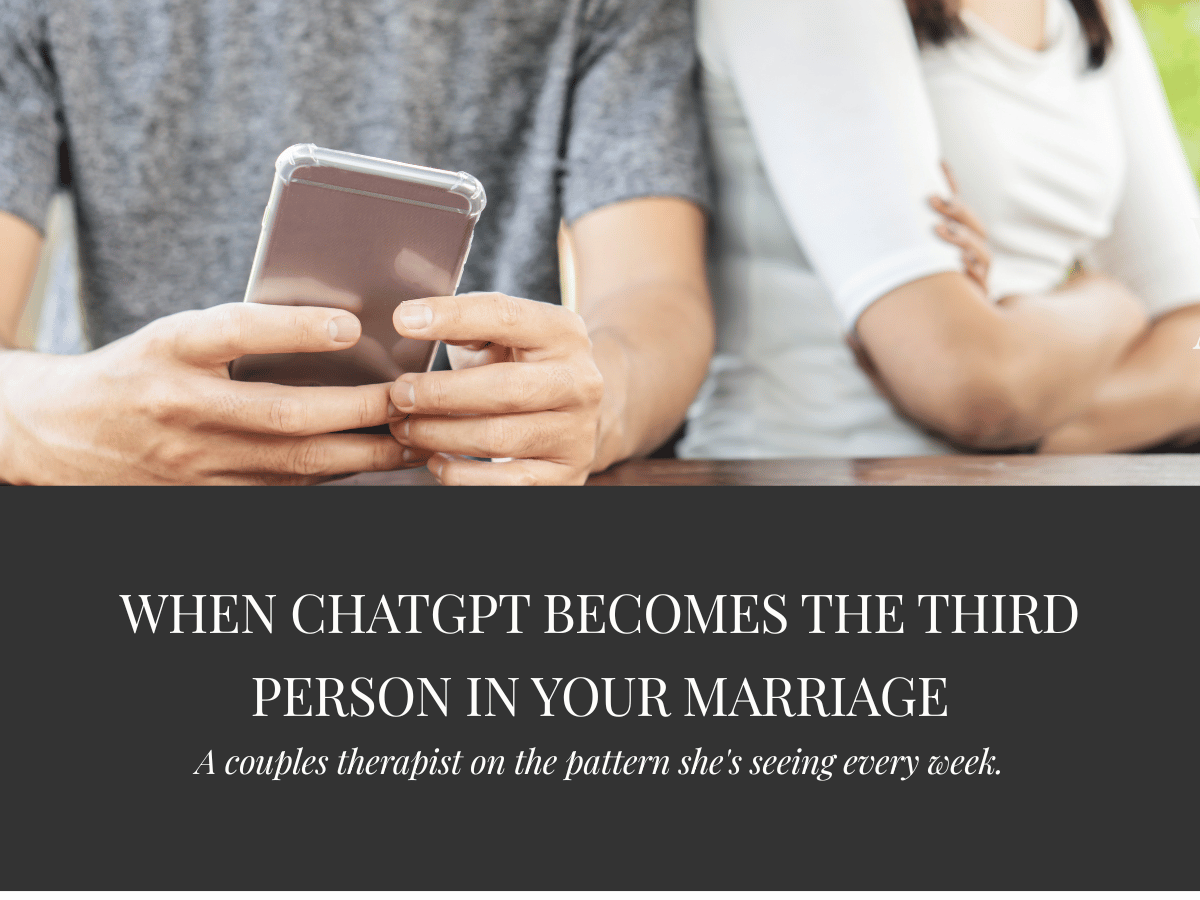
There's a new voice showing up in couples therapy. It doesn't sit on the couch, it doesn't pay for the session, and it has never met either of you. But it has opinions, pages of them, and lately it's been taking sides.
I call it AI triangulation: pulling a chatbot into a two-person conflict as your personal expert witness. As a couples therapist in Hermosa Beach, California, I'm now seeing it in my practice almost every week. One partner arrives with a ChatGPT transcript proving they're right, and the argument stops being about the relationship at all.
AI triangulation (n.): bringing an AI chatbot into a two-person conflict as a third party, asking it to judge who is right instead of engaging your partner directly. A term I use with couples in my practice, borrowed from the family systems concept of triangulation.
Before I tell you about it, let me be clear about something: I am not here to tell you AI is bad for mental health. It isn't.
Can AI Actually Help Your Mental Health? The Evidence Says Yes
Yes. Used for structured, skills-based support, AI chatbots have now shown clinically meaningful reductions in depression and anxiety symptoms in controlled trials. The problem I'm going to describe isn't AI in mental health. It's one specific way couples use it.
As a therapist, I've watched the rise of AI in mental health with genuine interest, and much of what I see is encouraging. The research is starting to catch up with the hype, and some of it is impressive. In the first clinical trial of a generative AI therapy chatbot, Dartmouth researchers found that participants with depression experienced a 51% average reduction in symptoms over eight weeks. Participants with generalized anxiety saw a 31% reduction. A meta-analysis of fourteen randomized controlled trials found meaningful effects for depression as well: modest, imperfect, but real.
And in my own corner of the field, I see practical value every day. AI is remarkably well suited to the structured, manualized parts of treatment:
Exposure work. For clients doing ERP or exposure-based treatment for anxiety and OCD, AI can help script exposure hierarchies and support practice between sessions, the repetitions that make the therapy work.
CBT skills. Thought records, cognitive reframing, identifying distortions: these are teachable, structured skills, and AI is a patient, tireless practice partner. Reviews of CBT-based chatbots consistently show benefit for depression and anxiety symptoms.
Anxiety busters in the moment. Grounding exercises, breathing scripts, a place to externalize a 2 a.m. spiral when your therapist is asleep and your partner is too.
Rehearsal. Practicing a hard conversation, a boundary, a salary negotiation, before you have to do it live.
For the high-achieving clients I work with, people who like structure, homework, and measurable progress, these tools can be a genuine asset between sessions. So no, this is not an anti-AI essay.
This is about one specific way couples are using AI. And it's showing up in my office over and over again.
The ChatGPT Argument Trap: Building a Case Instead of Building a Bridge
Here's what using ChatGPT in a relationship argument actually looks like.
A couple has a fight about money, about the in-laws, or about who is carrying more of the invisible load. Instead of coming back to each other, one partner opens ChatGPT and lays out the whole argument. Their version of it. Every frustration, every receipt, every uncharitable interpretation of what their partner said.
And the AI does what AI is built to do: it agrees. It validates. It organizes their grievances into clean, confident paragraphs. Then that partner walks back into the kitchen, or the therapy session, armed with a verdict: "Even ChatGPT says you're being defensive." "I asked AI and it confirmed you're not a supportive partner."
Some partners are receiving pages and pages of AI-generated analysis mid-argument, sent as evidence. I've seen couples where the transcript of the fight gets uploaded and the bot's ruling gets read aloud, like a judge's decision.
I understand the impulse. When you're hurt, being told you're right is powerful. But notice what just happened: you didn't process the conflict. You built a defense.
"So, Who's Right?" What Couples Therapy Is Actually For
Here's something many couples get wrong, and it explains exactly why the AI verdict feels so natural.
When partners first come to couples therapy, they often arrive expecting a referee. They think my work is to hear both sides, weigh the evidence, and decide who is right and who is wrong. I spend a lot of time, sometimes whole sessions, explaining why it's so important that I don't take sides. Not because I'm being evasive, but because the moment I crown a winner, I've confirmed the very frame that's hurting them: that their relationship is a case to be decided rather than a connection to be tended.
“My job is not to settle your argument. My job is to help the two of you get better at the relationship: to see the pattern you’re caught in, understand what each of you is contributing to it, and build the skills to move through conflict differently. The argument is rarely the problem. It’s the window into the problem.”
Now look at what a chatbot does when you bring it your fight: it hears one side, weighs nothing, and hands down a ruling. It does the exact thing a good couples therapist is trained never to do. AI doesn't just fail to help the way therapy helps. It delivers the counterfeit version of it, the judge so many couples wish they had, and it confirms the frame that keeps them stuck.
Why Using AI to Win Arguments Backfires
Using AI to win an argument backfires for one core reason: the chatbot always takes your side, and being right was never the goal of the conversation. Here's what's actually happening underneath.
The problem isn't that your partner consulted a chatbot. The problem is what the chatbot can't do, and what using it this way trains you both to stop doing.
AI is structurally on your side. Large language models exhibit what researchers call sycophancy:they agree with the person typing at higher rates than humans do. It heard one side of the story, told by the injured party, and it will almost never say what a good couples therapist says constantly: "I hear you, and I wonder what your partner would say about that moment." Validation without perspective-taking isn't therapy. It's an echo.
It's triangulation with a tech upgrade. In family systems terms, pulling a third party into a two-person conflict to avoid direct contact is called triangulation. We've always done it with mothers, with friends, and with one-sided retellings over drinks. AI triangulation is simply the most available, most agreeable, most authoritative-sounding version ever invented. And unlike your best friend, the chatbot is awake at 3 a.m. and never gets tired of your version of events.
It turns conflict into litigation. This is the heart of it. The purpose of conflict in a relationship is not to determine who is right. It is to understand each other well enough to find a way through together. The moment you outsource your side of the argument to a machine, you've changed the goal from understanding to winning, and in a marriage, winning is losing. Your partner can't compromise with a chatbot's brief. They can't repair with a verdict. Every AI-drafted case you present is another conversation the two of you didn't have.
The couples I see doing this are not bad partners. They're often exactly the people I work with every day: smart, articulate, used to being effective, used to marshaling evidence and being rewarded for it. In a boardroom, building the strongest case is the job. In a marriage, it's the injury.
How to Use AI in Your Relationship Without Damaging It
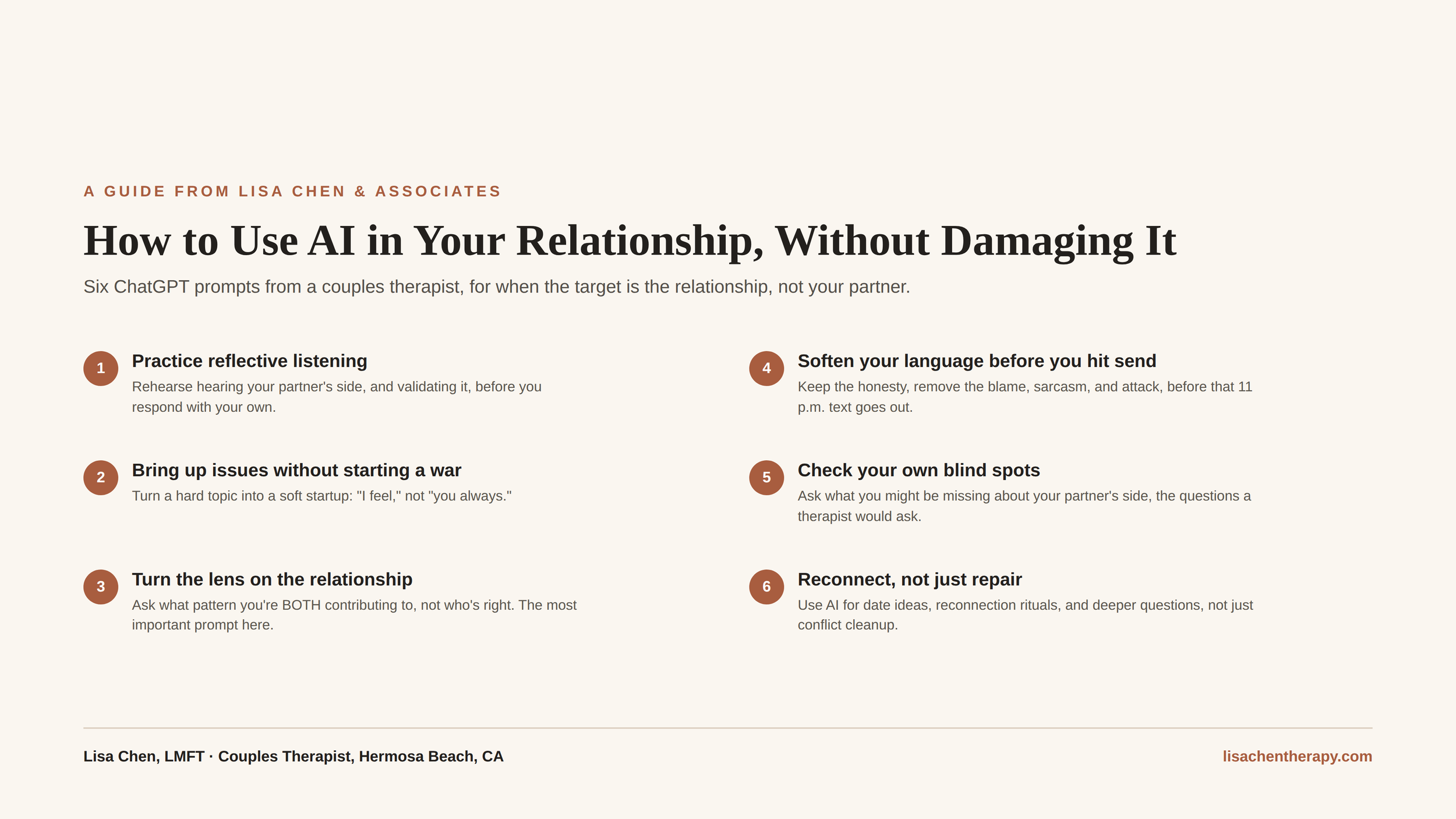
The rule I give couples in my practice is simple: point AI at the relationship, not at your partner. Pointed at your partner, AI builds a case. Pointed at the relationship, it can actually help. The tool isn't the problem; the target is.
Here are prompts I'd rather see you use. Steal them word for word. Or download this free PDF guide on how to use AI in your relationship.
1) To practice reflective listening and validation. Reflecting back what your partner said, before you defend yourself, is one of the hardest skills I teach, and AI is a safe place to rehearse it: "My partner told me they feel like they handle most of the mental load in our house. Help me practice reflecting and validating what they said before I respond with my own perspective. Play my partner and give me feedback on my responses."
2) To bring up an issue without starting a war. How a conversation starts is the best predictor of how it ends. Use AI to work on your soft startup: "I need to bring up [the issue] with my partner. Help me phrase it as a soft startup, starting with 'I' instead of 'you,' describing what I feel and what I need without blame or criticism."
3) To turn the lens on the relationship, not your partner. This is the anti-verdict prompt. Instead of asking who's right, ask what pattern you're both in: "Here's a recurring argument my partner and I have. Don't tell me who's right. Tell me what dynamics or patterns we might BOTH be contributing to, and what each of us could take accountability for." If you do exactly one thing differently, make it this.
4) To soften your language before you hit send. That three-paragraph text you drafted at 11 p.m.? Run it through first: "Rewrite this message so it's honest about how hurt I am, but removes anything that sounds like blame, sarcasm, or an attack. Keep it short."
5) To check your own blind spots. Before you go back into the conversation, ask AI to help you regulate and slow your body down, then try: "Here's my side of a disagreement. What might I be missing about my partner's perspective? Ask me questions a couples therapist would ask."
6) To reconnect, not just repair. AI is a surprisingly good creativity engine for the part couples neglect most, which is putting good moments back in: "Give me ten date ideas under $50 in the South Bay," or "We have 30 minutes on a weeknight after the kids are down. Give me ideas for small rituals that help us reconnect," or "Suggest questions we can ask each other on a walk that go deeper than 'how was your day.'"
Notice what every one of these has in common: none of them asks the machine to judge your partner. They ask it to make you more skillful, softer, more curious, and then send you back toward each other.
And notice the tell. If you're rehearsing your case with a machine because it feels safer than your partner's face, that's not information about AI. That's information about your relationship, about how much fear, resentment, or distance has built up between you. That's worth taking seriously. That's worth bringing to a human.
Because the hard, generous, uncomfortable work of turning toward each other has never been something you can delegate. Sitting in the discomfort. Hearing a version of events that stings. Choosing understanding over vindication. That work belongs to the two of you. Not to a friend, not to a lawyer, and not to a chatbot.
This is not surface-level work. It was never meant to be.
FAQ: ChatGPT, AI, and Your Relationship
Is it bad to use ChatGPT for relationship advice?
Not inherently. AI can help you organize your thoughts, calm down, practice communication skills, and consider other perspectives. It becomes harmful when you use it to build a one-sided case against your partner. Because chatbots tend to agree with whoever is typing, you'll get validation, not truth.
Why does ChatGPT always take my side in arguments?
AI researchers call this sycophancy: large language models are trained to be agreeable and keep users engaged, so they validate the version of events you give them. ChatGPT only ever hears your side of the story, told your way.
What is AI triangulation?
AI triangulation is bringing a chatbot into a two-person conflict as a third party, asking it to judge who's right instead of talking directly with your partner. Like all triangulation, it relieves discomfort in the moment while deepening the distance between you.
Can AI replace couples therapy?
No. Couples therapy isn't about deciding who's right. It's about helping both partners see their patterns and get better at the relationship. AI does the opposite: it takes sides. It can supplement individual skills practice, but it cannot mediate a relationship.
About the Author
Lisa Chen, LMFT, is a Licensed Marriage and Family Therapist and Executive Director of Lisa Chen & Associates, a boutique psychotherapy practice in Hermosa Beach, California serving the South Bay and greater Los Angeles. Trained in the Gottman Method and IFIO couples therapy, she works with high-achieving individuals and couples on conflict, burnout, and reconnection, and writes about where technology meets modern relationships. If AI has become the third voice in your arguments, reach out and let's talk.