Whether you should get a divorce depends heavily on the kind of marriage you are in. Research by Amato and Hohmann-Marriott (2007) found people leaving high-distress marriages became happier after divorce, while people leaving low-distress marriages became less happy. Most adults recover well. Lisa Chen & Associates Therapy in Hermosa Beach helps individuals and couples make this decision with evidence, in person and by telehealth across California.
You have run the numbers in your head more times than you can count. You make hard calls for a living, and you are good at them. But this one will not resolve. Some weeks the marriage feels survivable. Other weeks you catch yourself picturing a quieter apartment and feeling relief, then guilt for feeling relief. And underneath it all is a question you have not said out loud to anyone: should I get a divorce?
No article can answer that for you, and you should be wary of any that claims to. What research can do is replace some of the fear and folklore with evidence, and give you a better set of questions than the one that keeps looping at 2 a.m.
Why this decision is so hard for high achievers
People who are used to solving problems tend to treat a struggling marriage as one more problem that should yield to effort. When it doesn't, the decision to leave can feel like a personal failure rather than a judgment call. There is also the exposure: the conversations with family, the impact on your reputation and finances, the time it will take from work. Those costs are real, and they make it tempting to postpone the decision indefinitely.
But postponing is also a decision, with its own costs. The research below can help you weigh both sides honestly.
"High achievers often treat divorce as a verdict on their character. It is not. It is a decision about a relationship, and it deserves the same clear thinking you give every other high-stakes call." Lisa Chen, LMFT
What research says about who is happier after divorce
The single most useful finding for anyone on the fence is that the answer depends on the kind of marriage you are in.
Amato and Hohmann-Marriott (2007) studied 509 couples who divorced and found that about half had been in high-distress relationships and the rest in low-distress ones. The difference in outcomes was striking: "individuals in high-distress marriages reported increases in happiness following divorce, whereas those in low-distress marriages reported declines in happiness."
Hawkins and Booth (2005) looked at people who stayed in unhappy marriages over 12 years. They found that "remaining unhappily married is associated with significantly lower levels of overall happiness, life satisfaction, self-esteem, and overall health, along with elevated levels of psychological distress." They also noted that unhappily married people "may have greater odds of improving their well-being by dissolving their low-quality unions."
So the question is not simply whether divorce is good or bad. It is whether your marriage is high distress, marked by ongoing conflict, contempt, or harm, or low distress, where things feel flat or disappointing but not damaging. The research suggests leaving a high-distress marriage tends to help, while leaving a low-distress one often does not.
What recovery after divorce actually looks like
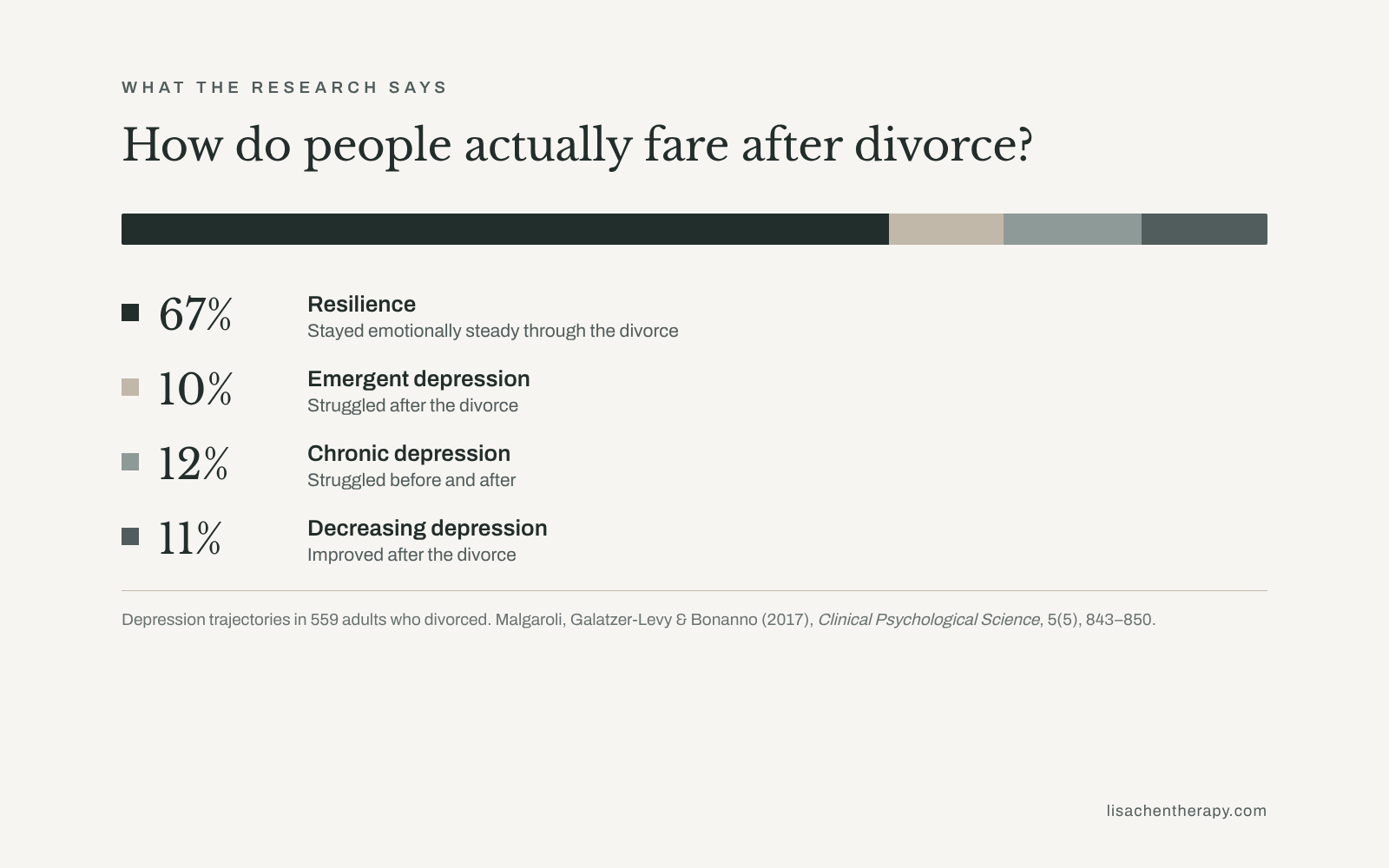
Most people are more resilient than they fear. In a study of 559 adults who went through a divorce, Malgaroli, Galatzer-Levy and Bonanno (2017) found four patterns: "resilience (67%), emergent depression (10%), chronic pre-to-post divorce depression (12%), and decreasing depression (11%)." Two out of three people stayed emotionally steady, and another group got better after the divorce than they had been before it.
People who divorce after a long marriage show a similar pattern. In a Swiss study of 308 people whose marriages had lasted more than 20 years on average, Knöpfli, Morselli and Perrig-Chiello (2016) concluded that "the majority of individuals divorcing after a long-term marriage adapt successfully over time."
The honest caveat comes from Lucas (2005), who followed more than 30,000 people for 18 years: "satisfaction drops as one approaches divorce and then gradually rebounds over time. However, the return to baseline is not complete." Divorce is not a clean reset, and the decline often starts well before the paperwork.
E. Mavis Hetherington's long-term research, summarized in her book For Better or For Worse: Divorce Reconsidered, reached a similar overall conclusion decades earlier: most adults and children come through divorce functioning reasonably well, while a smaller group struggles for years. The quality of what comes after, including conflict levels and support, matters a great deal.
A should I get a divorce checklist worth using
Online quizzes tend to ask how unhappy you are. These questions are more useful because they get at the things research shows actually matter.
Is my marriage high distress or low distress?
Think about frequent hostile conflict, contempt, stonewalling, or feeling unsafe or diminished, versus loneliness, boredom, or drifting apart. Both are painful. They point toward different decisions.
Have we actually tried, with real help?
Many couples come to divorce after years of trying on their own and a few sessions with a therapist who was not trained in couples work. A skilled couples therapist using a researched approach such as the Gottman Method is a different experience. If you have not had that, you may not yet know what is possible.
Are we both leaning the same way?
Often one partner is leaning out while the other wants to keep trying. Discernment counseling, a short-term approach developed by William Doherty at the University of Minnesota, was designed for exactly this situation. Over a small number of sessions it helps a couple choose among three paths: keep things as they are for now, move toward divorce, or commit to a full six-month effort in couples therapy with divorce off the table during that time.
Is anything making the marriage unsafe or unworkable?
Abuse, coercive control, and untreated addiction change the calculation. If drinking is part of the picture, our post on deciding whether to stay with a high-functioning drinker goes deeper.
What would I regret more in five years?
Picture two futures. In one, you stayed and nothing changed. In the other, you left. Notice which one your body reacts to more strongly. It will not make the decision, but it often reveals what you already believe.
"The goal is not to find the perfect answer. It is to make a decision you can explain to yourself in five years with a clear conscience." Lisa Chen, LMFT
How to decide without rushing or stalling
Two mistakes are common. One is deciding in the heat of a terrible week. The other is waiting years for clarity that never arrives on its own.
A better approach is to give yourself a defined period, often three to six months, to gather real information. Get individual support so you are not deciding from exhaustion. If your partner is willing, try focused couples therapy or discernment counseling. Quietly understand your finances and talk with a family law attorney so the practical unknowns stop feeding your fear. At the end of that window, you will be deciding based on what happened, not on what you were afraid might happen.
How therapy helps you decide
At Lisa Chen & Associates Therapy, we work with executives, founders and high achievers who are facing this decision, individually or as a couple. Our couples work draws on approaches including the Gottman Method, Imago Relationship Therapy, IFS and EMDR. We help you separate what you know from what you fear, try the work that research says can help, and make a decision you can stand behind, whichever way it goes. For couples who want more than a weekly session, we also offer intensive formats.
We see clients in person in Hermosa Beach and Pasadena and by telehealth across California. Every new client starts with a free 20-minute consultation, and session fees range from $180 to $450 depending on the clinician.
Research cited
Amato, P. R., & Hohmann-Marriott, B. (2007). A comparison of high- and low-distress marriages that end in divorce. Journal of Marriage and Family, 69(3), 621–638.
Hawkins, D. N., & Booth, A. (2005). Unhappily ever after: Effects of long-term, low-quality marriages on well-being. Social Forces, 84(1), 451–471.
Malgaroli, M., Galatzer-Levy, I. R., & Bonanno, G. A. (2017). Heterogeneity in trajectories of depression in response to divorce is associated with differential risk for mortality. Clinical Psychological Science, 5(5), 843–850.
Knöpfli, B., Morselli, D., & Perrig-Chiello, P. (2016). Trajectories of psychological adaptation to marital breakup after a long-term marriage. Gerontology, 62(5), 541–552.
Lucas, R. E. (2005). Time does not heal all wounds: A longitudinal study of reaction and adaptation to divorce. Psychological Science, 16(12), 945–950.
Hetherington, E. M., & Kelly, J. (2002). For Better or For Worse: Divorce Reconsidered. W. W. Norton.
Doherty, W. J., & Harris, S. M. (2017). Helping Couples on the Brink of Divorce: Discernment Counseling for Troubled Relationships. American Psychological Association.
Frequently asked questions
How do I know if I should get a divorce?
Research suggests the most important question is whether your marriage is high distress, marked by ongoing hostility, contempt or harm, or low distress, where it feels flat but not damaging. People leaving high-distress marriages tend to become happier. Also ask whether you have tried skilled couples therapy and whether anything makes the marriage unsafe.
Are people happier after divorce?
It depends on the marriage. Amato and Hohmann-Marriott (2007) studied 509 divorced couples and found people in high-distress marriages reported more happiness after divorce, while those in low-distress marriages reported less. Hawkins and Booth (2005) found that staying unhappily married was linked to lower happiness, self-esteem and overall health.
How long does it take to recover from a divorce?
It varies, but most people are resilient. Malgaroli, Galatzer-Levy and Bonanno (2017) found 67 percent of divorcing adults followed a resilient pattern. Lucas (2005) found life satisfaction drops as divorce approaches and gradually rebounds, though not always fully. Support, a new routine and lower conflict all help recovery.
What is discernment counseling?
Discernment counseling is a short-term approach developed by William Doherty at the University of Minnesota for couples where one partner is leaning out. Over a few sessions, the couple chooses among three paths: keep things as they are for now, move toward divorce, or commit to six months of couples therapy with divorce off the table.
Should I try couples therapy before getting a divorce?
If the marriage is not unsafe and both partners are willing, it is usually worth trying with a therapist trained in a researched couples method such as the Gottman Method. Many couples have only tried on their own. A focused effort gives you real information, so whatever you decide, you decide it with more confidence.
Where can I get help deciding whether to divorce in Los Angeles?
Lisa Chen & Associates Therapy works with executives, founders, high achievers and couples facing this decision, in person in Hermosa Beach and Pasadena and by telehealth anywhere in California. Every new client starts with a free 20-minute consultation, and session fees range from $180 to $500 depending on the clinician.